


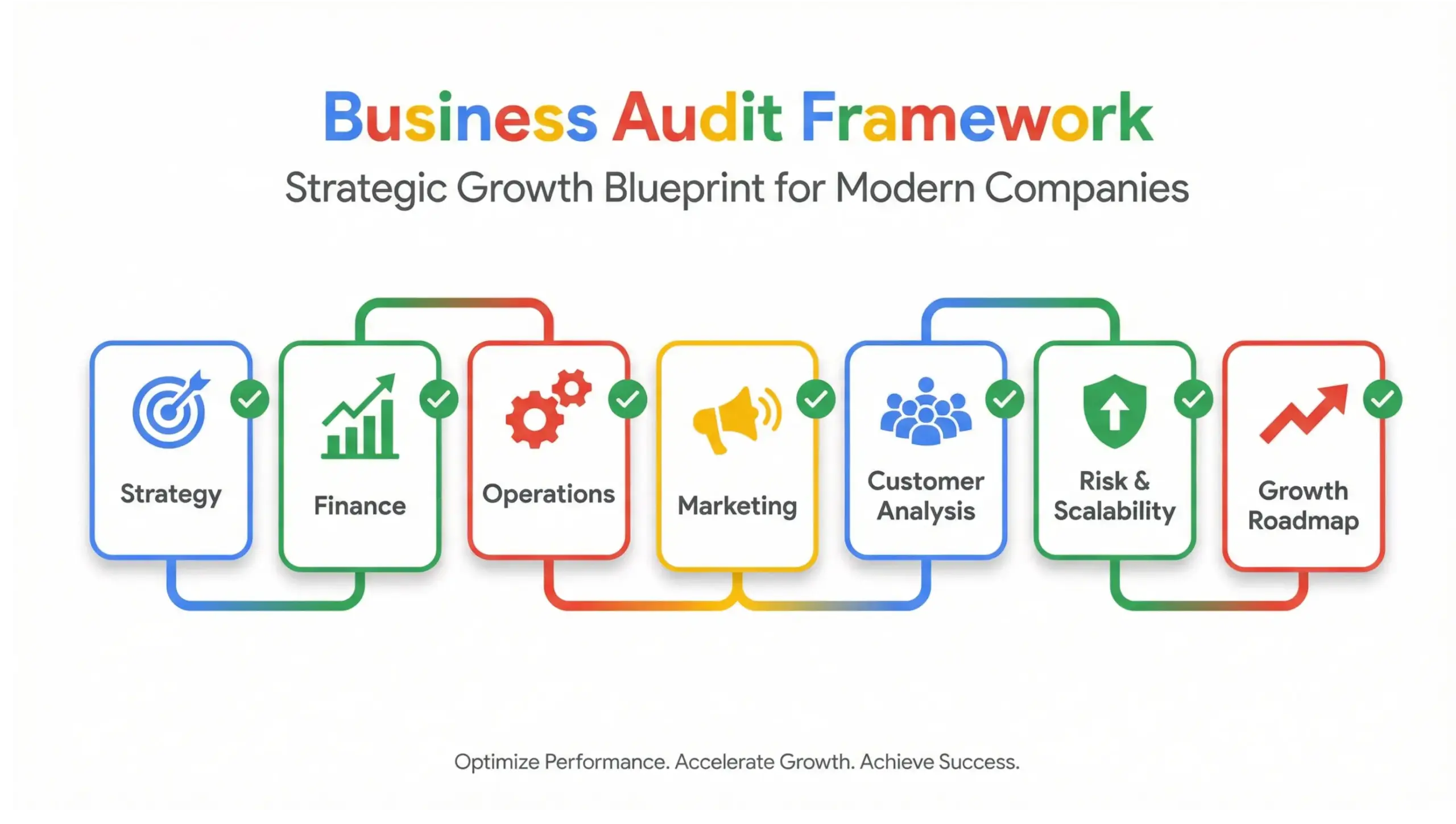
A business audit is a structured evaluation of a company’s strategy, operations, financial performance, marketing systems, and growth infrastructure to identify inefficiencies, risks, and untapped opportunities. Unlike a financial audit, which focuses strictly on accounting accuracy, a business audit analyzes how the entire organization performs and how it can scale more efficiently, profitably, and sustainably.
If you want clarity, direction, and measurable growth, a business audit is the first step.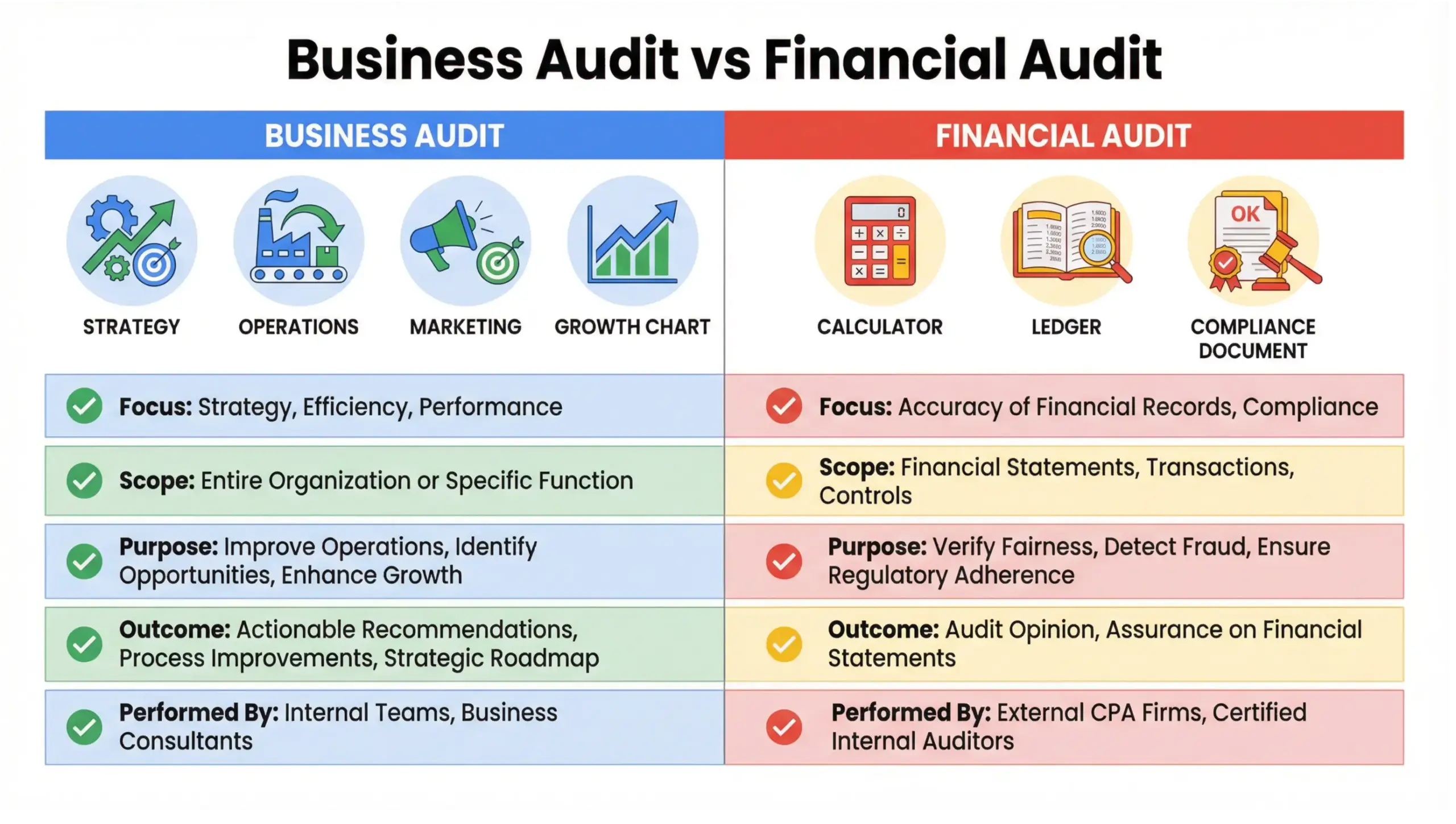
What Is a Business Audit?
A business audit is a comprehensive review of how a company operates, generates revenue, manages resources, and executes strategy. Its purpose is to assess performance gaps, operational inefficiencies, brand positioning, financial health, and growth potential.
At its core, a business audit answers three essential questions:
- Where are we now?
- What is limiting our growth?
- What systems must change to scale?
“Clarity creates confidence. A structured audit replaces assumptions with measurable insight.”
Why Is a Business Audit Important for Growth?
A business audit is important because most companies grow reactively rather than strategically. Without structured evaluation, inefficiencies compound, marketing becomes disconnected from revenue goals, and leadership decisions rely on guesswork.
According to industry analysis, companies that align strategy with measurable KPIs outperform peers by significant margins over time. A business audit helps you:
- Identify operational bottlenecks
- Improve profit margins
- Strengthen brand positioning
- Reduce unnecessary costs
- Align marketing with ROI
- Prepare for scaling or investment
Without visibility, small inefficiencies can cost thousands annually.
Business Audit vs Financial Audit: What’s the Difference?
A financial audit evaluates the accuracy of financial statements. A business audit evaluates overall performance and strategic alignment.
| Category | Business Audit | Financial Audit |
|---|---|---|
| Focus | Strategy, operations, marketing, growth | Accounting accuracy |
| Purpose | Improve performance & scalability | Ensure compliance & reporting accuracy |
| Scope | Cross-departmental | Financial records |
| Outcome | Growth roadmap | Verified financial statements |
| Performed By | Consultants or strategy teams | CPA or certified auditor |
A financial audit protects compliance. A business audit protects growth.
When Should a Company Conduct a Business Audit?
You should conduct a business audit when:
- Revenue growth has stalled
- Profit margins are shrinking
- Marketing ROI is unclear
- Leadership is planning to scale
- Entering a new market
- Preparing for acquisition or funding
- Experiencing operational inefficiencies
High-growth companies typically conduct strategic audits annually or biannually.
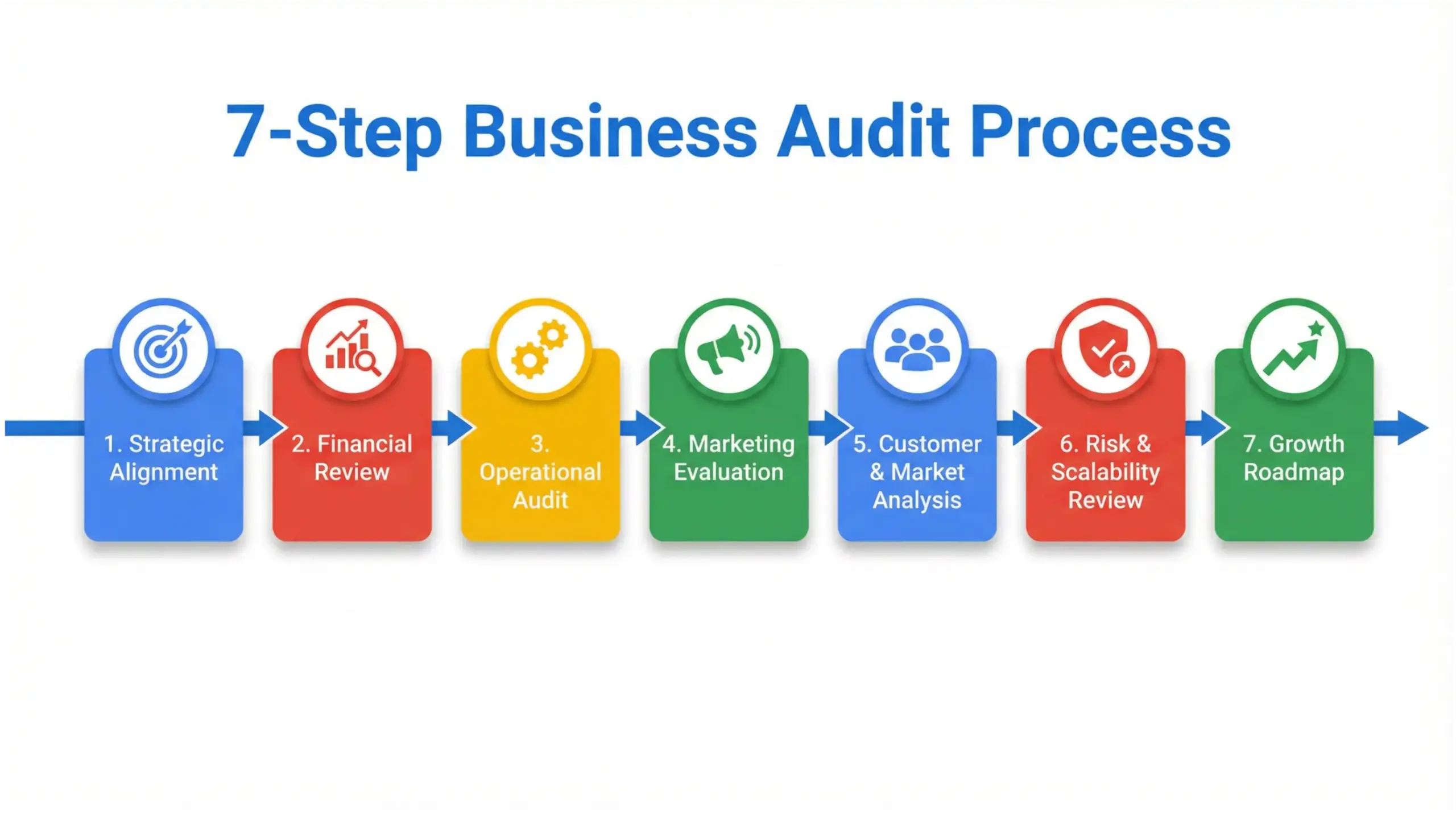
The 7-Step Business Audit Framework
Step 1: Strategic Alignment Review
Start by evaluating mission, positioning, and long-term objectives.
Ask:
- Is the company’s vision clearly defined?
- Does department execution align with strategy?
- Does leadership operate from measurable objectives?
Deliverables may include strategic clarity scoring, objective alignment metrics, and competitive positioning review.
Step 2: Financial Performance Analysis
A business audit evaluates financial health beyond accounting accuracy.
Key metrics reviewed:
- Gross profit margin
- Net profit margin
- Customer acquisition cost (CAC)
- Lifetime value (LTV)
- Cash flow stability
- Cost structure analysis
Companies that monitor contribution margins per segment often see stronger capital efficiency over time.
Step 3: Operational Efficiency Audit
Operations often hide the largest profit leaks.
We examine:
- Workflow bottlenecks
- Redundant processes
- Automation gaps
- Vendor cost efficiency
- Staff productivity ratios
Lower operational waste improves margins without increasing revenue.
Step 4: Marketing & Brand Audit
Many companies struggle because brand clarity and marketing performance are disconnected.
Audit components include:
- Brand messaging consistency
- Website conversion rates
- Lead generation systems
- SEO & visibility performance
- Paid media ROI
- Content authority
Businesses that align marketing and sales often generate significantly more revenue from marketing efforts.
Step 5: Customer & Market Positioning Analysis
Understanding the market is essential.
We assess:
- Target audience clarity
- Competitive differentiation
- Customer journey mapping
- Retention rates
- Brand perception
A strong audit reveals whether the company competes on price, value, or authority.
Step 6: Risk & Scalability Assessment
Growth without infrastructure creates collapse.
This step evaluates:
- Legal exposure
- Overdependence on single revenue streams
- Founder bottlenecks
- Technology limitations
- Scalability of systems
“Growth is not about speed. It’s about sustainability.”
Step 7: Growth Roadmap Development
An audit without action is wasted insight.
Final deliverables include:
- 90-day execution plan
- KPI dashboard
- Budget realignment recommendations
- Marketing & operational improvements
- Long-term scaling framework
What Is Included in a Complete Business Audit?
A professional business audit often includes:
- Executive summary
- SWOT analysis
- KPI breakdown
- Financial performance evaluation
- Operational review
- Brand & marketing evaluation
- Competitive analysis
- Risk assessment
- Growth recommendations
- Implementation timeline
Comprehensive audits typically range from 20-60 pages depending on complexity.
How Long Does a Business Audit Take?
| Business Size | Estimated Duration |
|---|---|
| Startup | 1-2 weeks |
| Small Business | 2-4 weeks |
| Mid-Size Company | 4-6 weeks |
| Enterprise | 8-12 weeks |
Preparation speed significantly affects timelines.
What Tools Are Used in a Business Audit?
- Google Analytics & Search Console
- Financial reporting dashboards
- CRM data analysis
- Customer surveys
- SWOT frameworks
- KPI dashboards
- Benchmarking software
- Heat mapping tools
- Market research databases
Technology supports insight, but strategy interprets it.
Benefits of a Business Audit for Small Businesses
Small businesses benefit disproportionately from structured audits because inefficiencies impact margins more severely.
Key benefits:
- Cost reductions
- Clear growth priorities
- Better cash flow management
- Stronger brand positioning
- Improved conversion rates
- Informed investment decisions
Even a 5% operational efficiency improvement can significantly impact annual profitability.
Common Mistakes During a Business Audit
- Treating audits as one-time events
- Ignoring data inconsistencies
- Over-focusing on revenue without margin analysis
- Skipping customer feedback
- Failing to implement findings
An audit without execution is just documentation.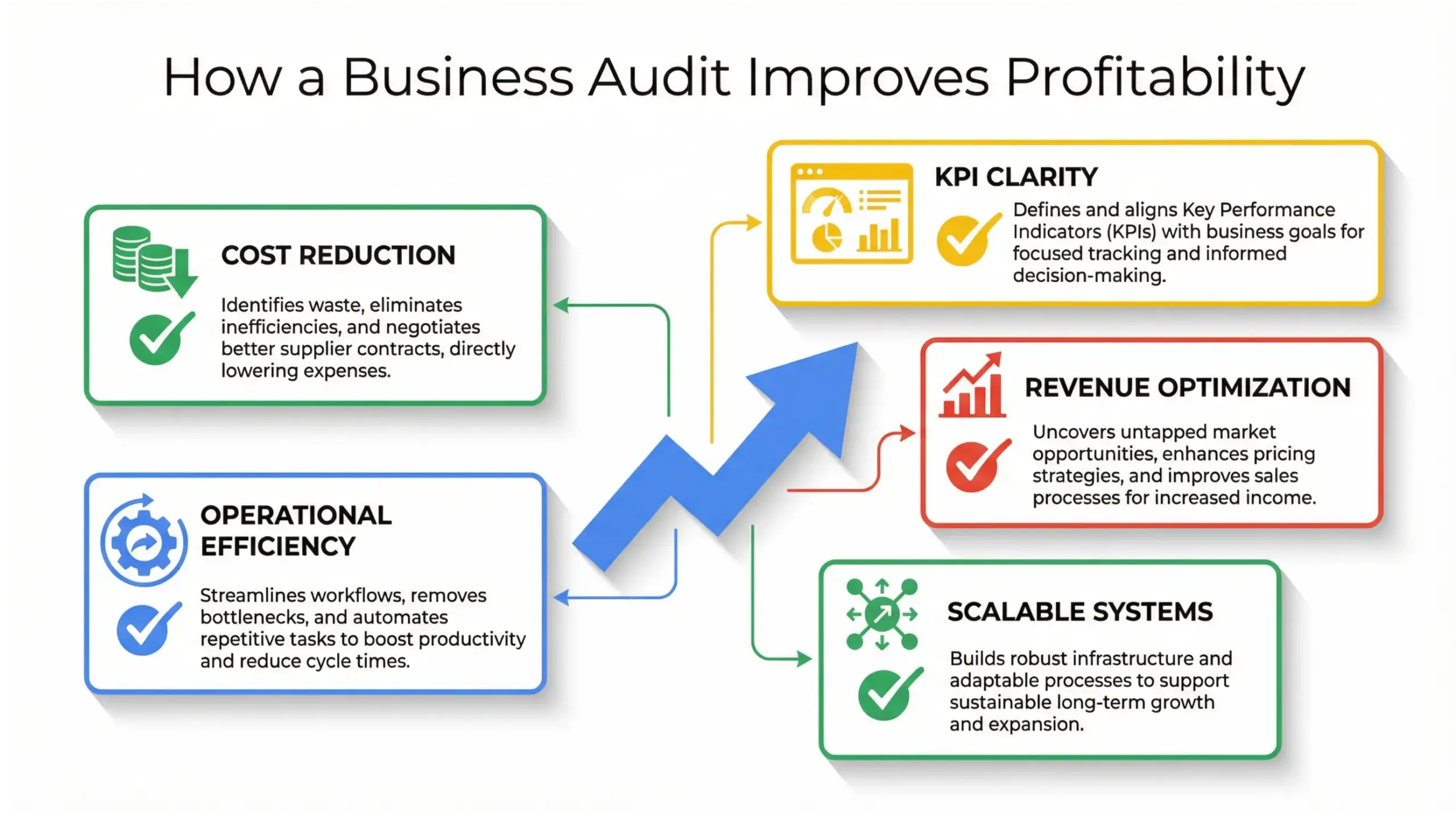
10 Frequently Asked Questions About Business Audits
1. What is the main purpose of a business audit?
To evaluate performance, identify inefficiencies, and create a structured growth roadmap.
2. How often should a business audit be conducted?
Most companies perform annual audits. High-growth firms may conduct quarterly performance reviews.
3. Is a business audit only for struggling companies?
No. High-performing companies use audits to capture and scale efficiency.
4. How much does a professional business audit cost?
Costs vary widely but typically range from $2,000 for small reviews to $25,000+ for enterprise-level audits.
5. Can a business owner perform their own audit?
Yes, but objectivity and benchmarking experience may be limited.
6. What departments are reviewed in a business audit?
Strategy, finance, marketing, operations, HR, and customer experience.
7. Does a business audit increase revenue immediately?
It may not create instant revenue but identifies levers that significantly improve profitability over time.
8. What is the difference between an internal and external audit?
Internal audits are performed by company staff. External audits are conducted by independent professionals.
9. How do you measure audit success?
By tracking improvements in KPIs such as profit margin, revenue growth, cost reductions, and conversion rates.
10. What happens after the audit is complete?
Implementation begins. Strategy turns into action plans with measurable performance tracking.
Final Thoughts: Why Every Growing Business Needs a Business Audit
A business audit is not about finding faults. It’s about finding leverage.
Companies that regularly audit their systems make smarter decisions, reduce risk, and scale sustainably.
“Clarity. Consistency. Conversion.”


