


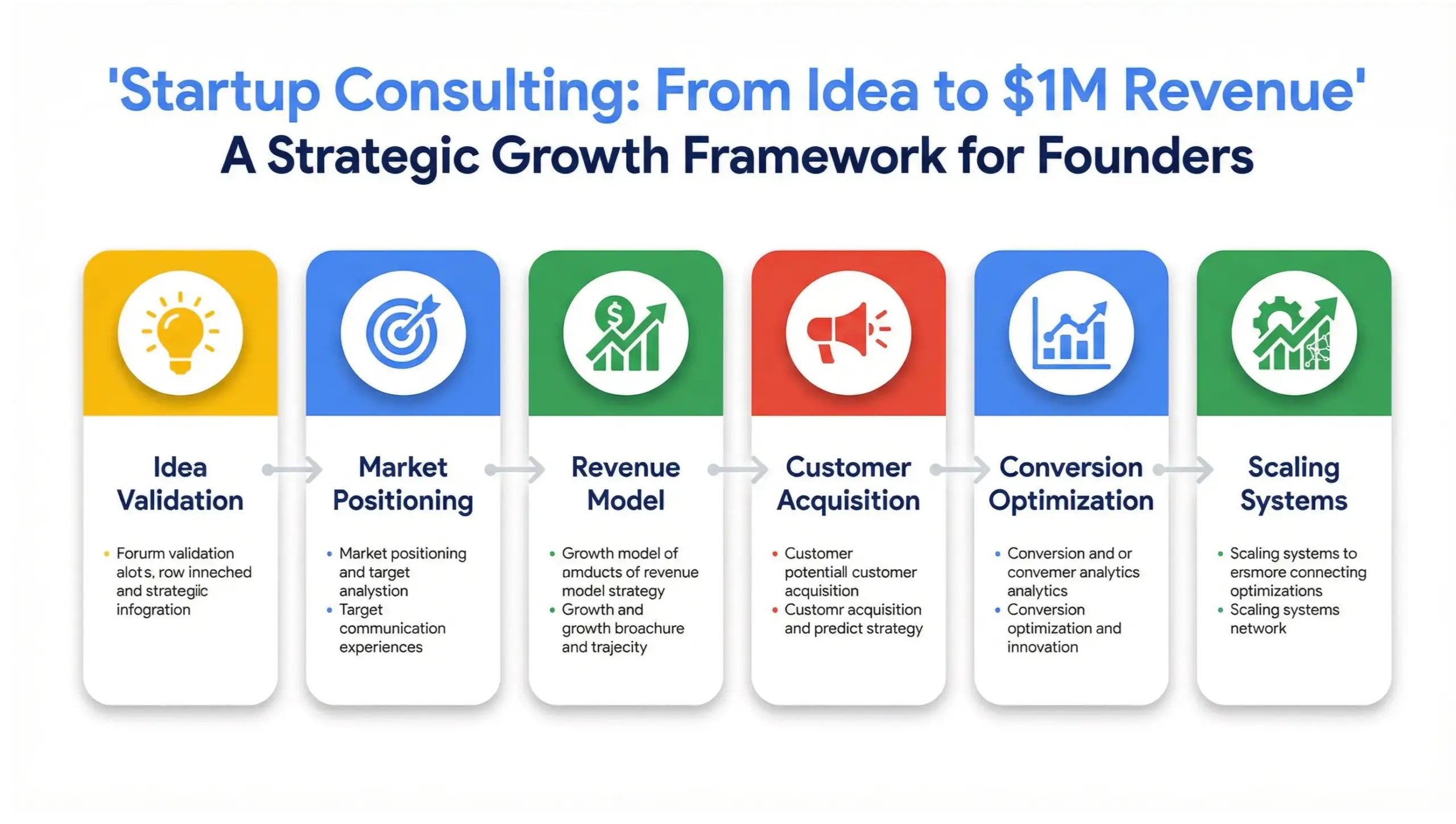
Startup consulting helps founders move from idea to scalable revenue by building clear positioning, validated offers, operational systems, and growth strategies that reduce risk and accelerate execution. For high-growth companies, not just advice, consulting provides structured systems, measurable growth, and momentum.
If you are building a startup and want to reach your first $1 million in revenue, this guide provides a practical, strategic, and data-driven roadmap.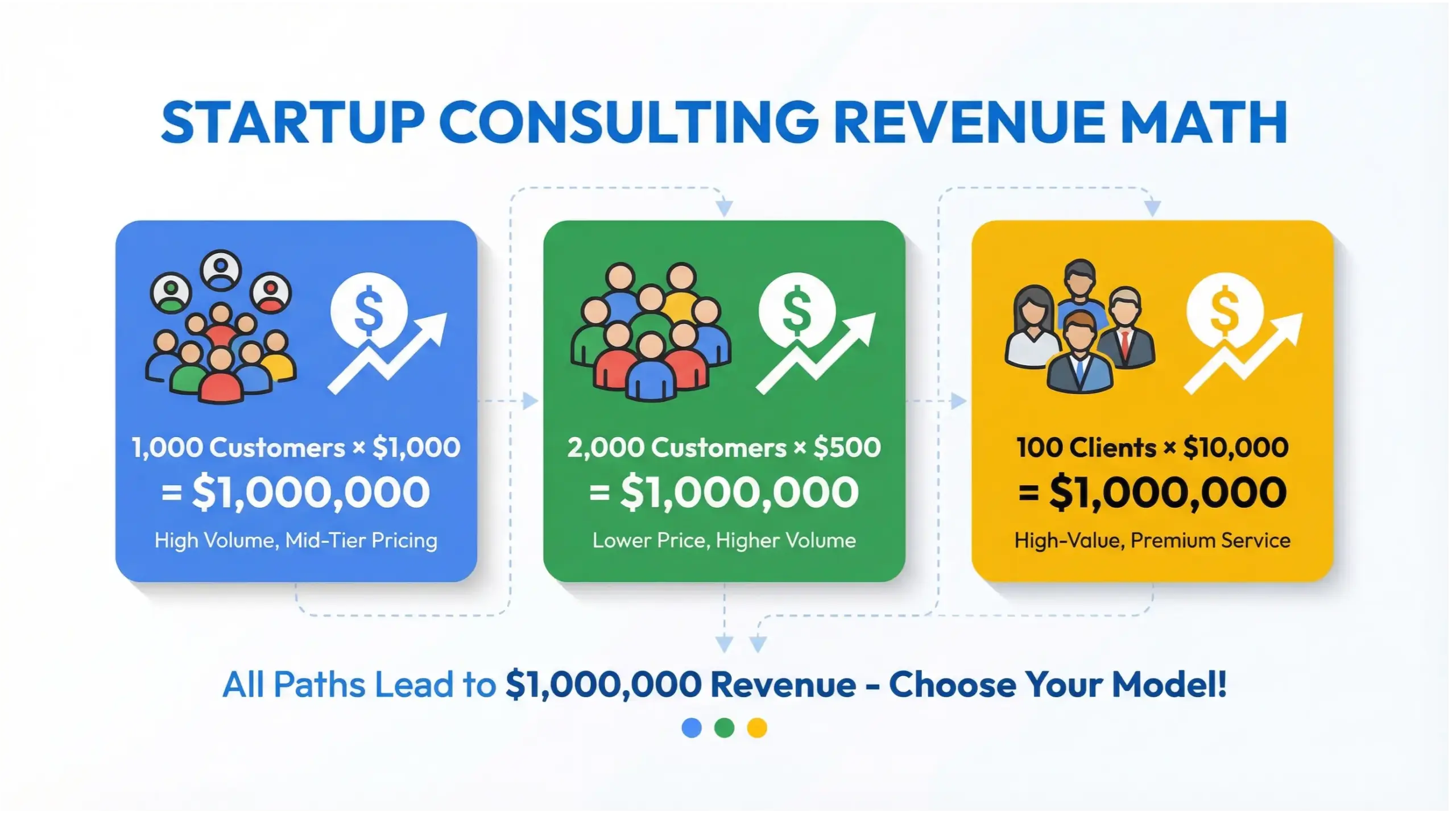
What Is Startup Consulting?
Startup consulting is a strategic advisory service that helps early-stage founders validate ideas, define positioning, build operational systems, and implement scalable revenue strategies. Unlike general business coaching, startup consulting focuses on high-growth potential and structured execution.
Startup consultants typically support:
- Business model validation
- Market research & positioning
- Go-to-market strategy
- Revenue forecasting
- KPI tracking systems
- Brand and messaging clarity
- Funding preparation
“Startup consulting turns vision into validated execution.”
At its core, startup consulting bridges the gap between ideas and traction.
Why Do Startups Fail Without Strategic Consulting?
Most startups fail not because of poor ideas, but because of unclear positioning, lack of product-market fit, weak financial systems, or premature scaling. Strategic consulting reduces these risks.
Common reasons startups fail include:
- No product-market fit
- Low customer retention
- Poor cash flow management
- Early shutdowns
- Weak differentiation
- High competition pressure
- Scaling too early
- Operational collapse
- No structured KPIs
- Misguided decisions
A startup consultant addresses these early, before they become expensive mistakes.
“Clarity before capital is the difference between scaling and struggling.”
How Does Startup Consulting Help You Reach $1M in Revenue?
Startup consulting accelerates the path to $1M by building structured growth systems instead of relying on unpredictable tactics. Revenue becomes engineered, not accidental.
The process typically includes:
- Offer validation
- Revenue model design
- Customer acquisition systems
- Conversion optimization
- Retention strategy
- Operational scalability
The $1M Revenue Math
To reach $1,000,000 annually:
- 1,000 customers × $1,000/year
- 5,000 customers × $200/year
- 100 clients × $10,000/year
A startup consultant helps you design a model aligned with your industry and margins.
What Does a Startup Consultant Actually Do?
A startup consultant diagnoses business gaps, designs growth frameworks, and implements scalable systems across strategy, marketing, operations, and revenue.
Here’s what that looks like in practice:
1. Market & Positioning Clarity
- Define target audience
- Identify market gaps
- Build differentiation strategy
2. Product-Market Fit Validation
- Early adopter interviews
- Feedback loops
- Offer iteration
3. Revenue Strategy
- Pricing model optimization
- Monetization channels
- Forecasting
4. Systems & KPIs
- Dashboard creation
- Unit economics tracking
- CAC/LTV modeling
5. Go-To-Market Execution
- Launch campaigns
- Brand storytelling
- Funnel strategy
“Revenue without structure is temporary. Structure creates sustainable scale.”
When Should You Hire a Startup Consultant?
The ideal time to hire a startup consultant is before scaling, ideally at idea validation, early traction, or revenue plateau stages.
Hire a Consultant If:
- You have an idea but need validation
- You launched but are not converting
- You are stuck below consistent revenue
- You plan to raise funding
- Growth feels chaotic
Hiring too late often means fixing avoidable damage.
Startup Consulting vs Business Coaching: What’s the Difference?
Startup consulting focuses on strategy, systems, and measurable execution, while business coaching focuses on mindset and accountability.
| Startup Consulting | Business Coaching |
|---|---|
| Data-driven | Motivational focus |
| Market analysis | Personal development |
| Revenue modeling | Leadership clarity |
| Operational design | Habit improvement |
| Performance metrics | Accountability |
Both are valuable, but startups often need structure first.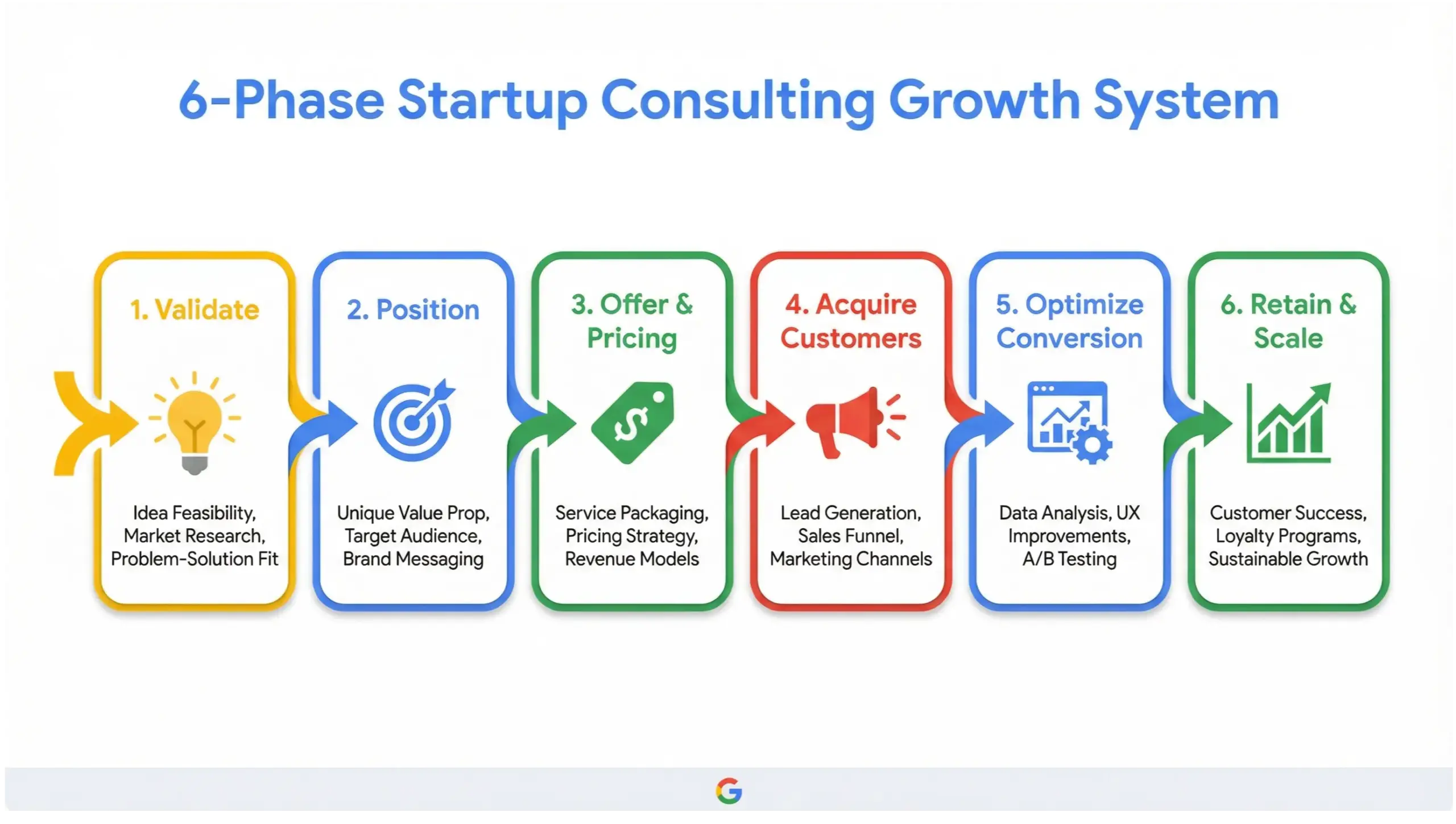
The 6-Phase Startup Consulting Framework (Idea to $1M)
Phase 1: Idea Validation
Objective: Confirm demand before building heavily.
- Problem interviews
- Market sizing
- Competitive mapping
- MVP concept testing
Phase 2: Positioning & Brand Clarity
Objective: Own a clear market niche.
- Target audience definition
- Unique value proposition
- Messaging framework
- Brand identity alignment
Phase 3: Offer & Pricing Architecture
Objective: Build scalable monetization.
- Tiered offers
- Subscription or one-time pricing
- Profit margin optimization
Phase 4: Customer Acquisition System
Objective: Predictable lead generation.
- Paid ads
- Organic SEO
- Partnerships
- Social media funnels
Phase 5: Conversion Optimization
Objective: Improve revenue per lead.
- Landing page testing
- Sales script refinement
- Funnel tracking
Phase 6: Retention & Scale
Objective: Increase LTV and operational efficiency.
- CRM systems
- Email automation
- Team delegation
- Performance dashboards
How Much Does Startup Consulting Cost?
Startup consulting typically ranges from $2,000 to $15,000+ per month depending on scope, expertise, and growth stage.
Pricing models include:
- Hourly ($150-$500/hour)
- Project-based ($5K-$50K)
- Retainer-based
- Equity-based advisory
The key question is ROI, not cost.
“The right consultant pays for themselves through prevented mistakes and accelerated growth.”
Common Mistakes Startups Make Without Consulting
- Building before validating
- Pricing emotionally, not strategically
- Hiring too early
- Ignoring data dashboards
- Scaling ads without retention
- Weak differentiation
- No cash runway planning
A consultant prevents these structural errors.
Case Example: Idea to $1M Path
Imagine:
- SaaS startup
- $49/month subscription
- 1,700 users
Revenue:
1,700 × $49 × 12 months = $999,600/year
That requires:
- Product-market fit validation
- Paid acquisition funnel
- 5% monthly churn control
- Email retention automation
That is strategic engineering, not luck.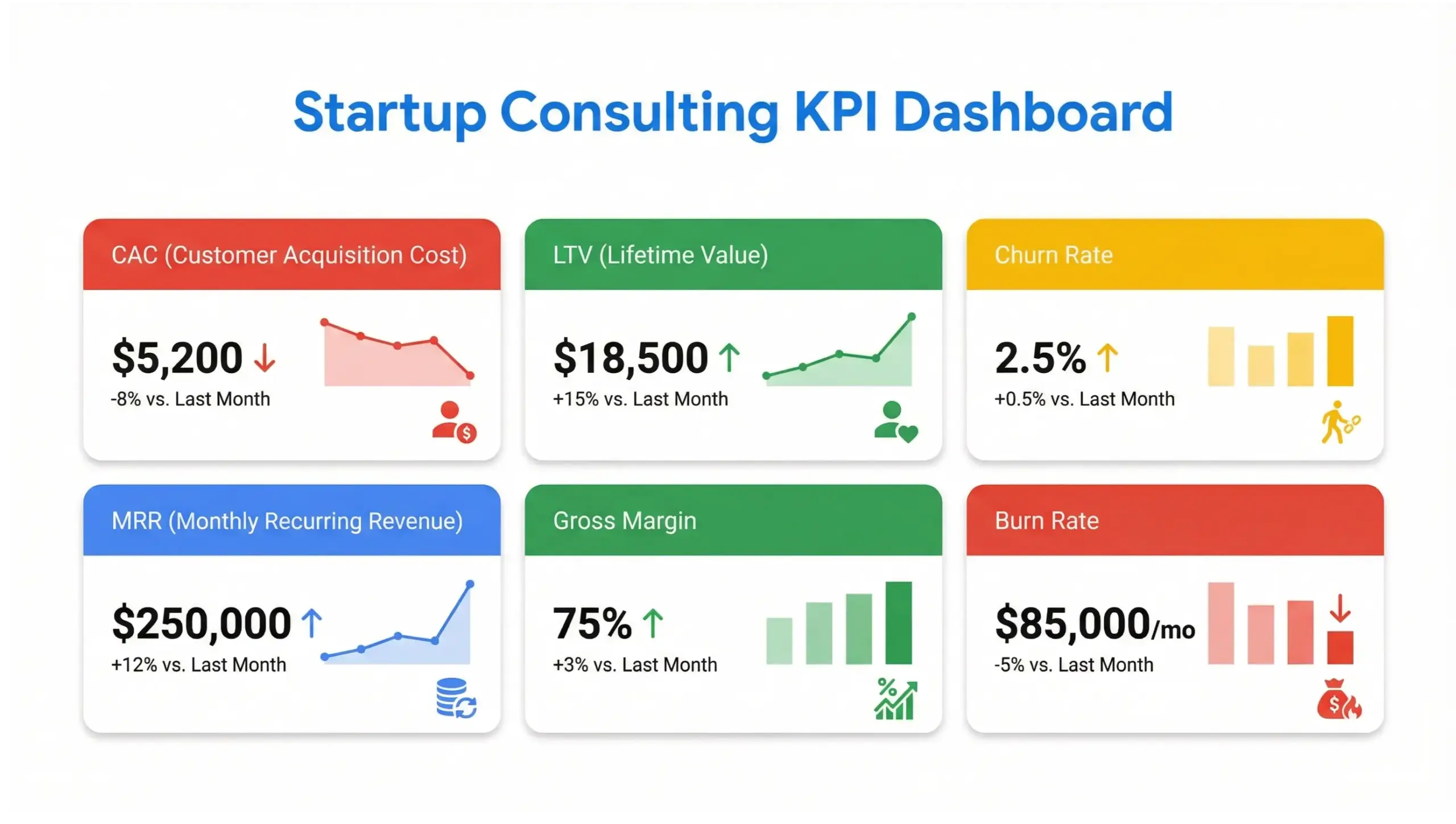
10 Frequently Asked Questions (FAQ)
1. What is startup consulting in simple terms?
Startup consulting is professional guidance that helps founders validate ideas, build growth systems, and scale revenue strategically.
2. How can a startup consultant help me reach $1M?
By structuring pricing, acquisition, retention, and operations into measurable systems aligned with revenue targets.
3. Is startup consulting worth it for early-stage founders?
Yes, especially before scaling. Early clarity reduces expensive pivots later.
4. How long does it take to reach $1M with consulting?
Typically 12-36 months depending on market, model, and execution discipline.
5. What industries benefit most from startup consulting?
SaaS, e-commerce, service businesses, fintech, health tech, local services, and digital product startups.
6. Do startup consultants help with funding preparation?
Yes. They help refine pitch decks, validate metrics, and structure financial forecasts.
7. What KPIs should a startup track?
- CAC (Customer Acquisition Cost)
- LTV (Lifetime Value)
- Churn Rate
- Gross Margins
- Burn Rate
- MRR/ARR
8. Can a startup consultant help with marketing?
Yes. They design structured go-to-market strategies and customer acquisition funnels.
9. How do I choose the right startup consultant?
Look for proven case studies, data-driven approach, strategic clarity, industry alignment, and transparent pricing.
10. What’s the difference between a startup advisor and consultant?
Advisors provide guidance periodically. Consultants implement structured systems actively.
Conclusion: Startup Consulting Is Structured Growth
Startup consulting is not an expense. It is a strategic acceleration mechanism.
If your goal is:
- Clear positioning
- Predictable revenue
- Scalable systems
- Measurable KPIs
- Sustainable growth
Structured consulting provides the framework to move from idea to $1M with confidence.
“Startups don’t scale because they try harder. They scale because they build smarter.”


