


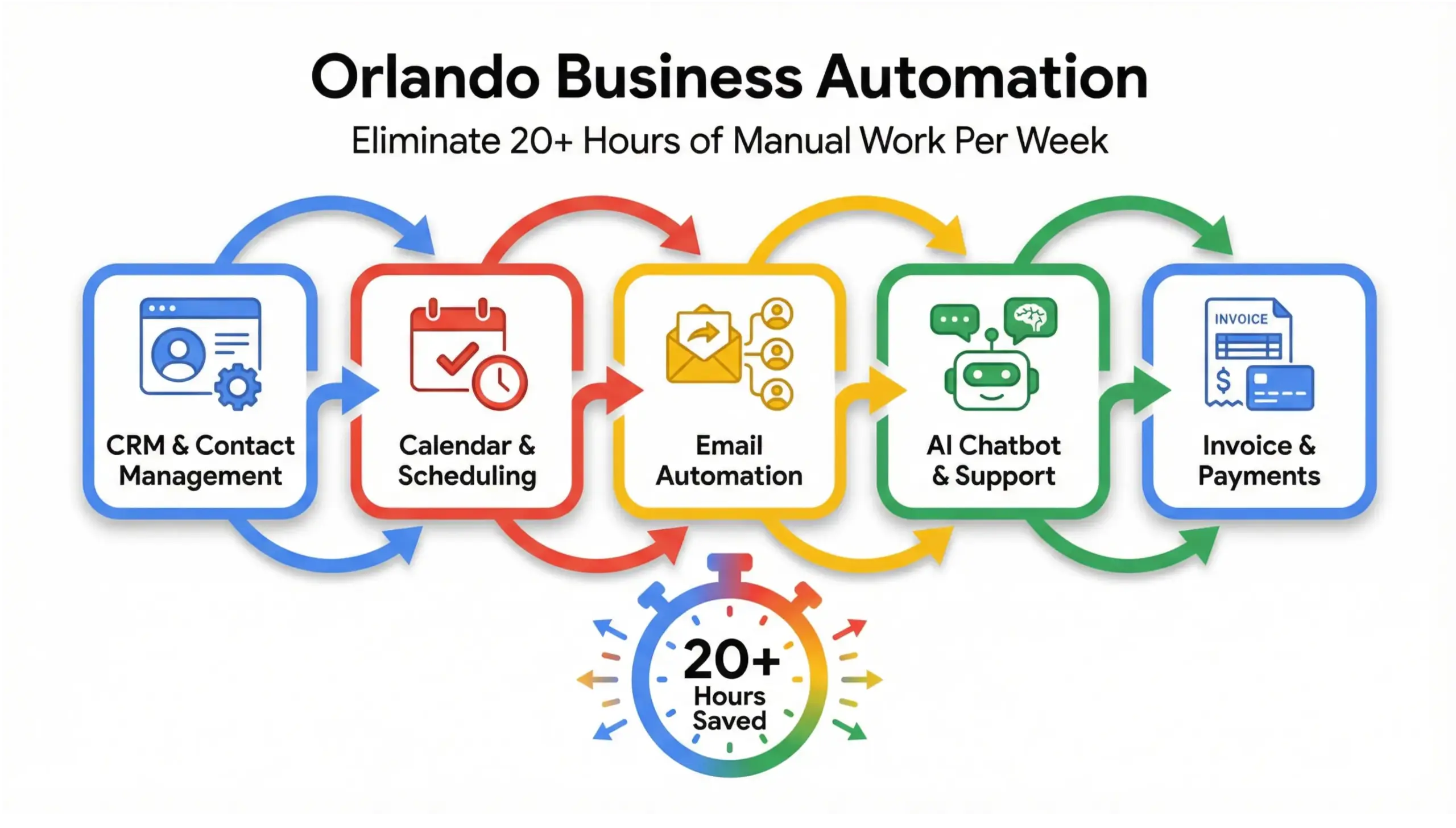
Orlando business automation is the strategic use of digital systems, AI tools, and workflow integrations to eliminate manual work, reduce human error, and increase profitability for local companies. In 2026, businesses that automate core operations – like lead management, follow-ups, scheduling, invoicing, and reporting – outperform competitors by saving 15-30 hours per week and scaling without hiring additional staff.
For Orlando-based service providers, local retailers, and growing startups, automation is no longer optional. It is the infrastructure that turns daily operations into measurable growth systems.
“The businesses that scale in 2026 are not the busiest – they’re the most automated.”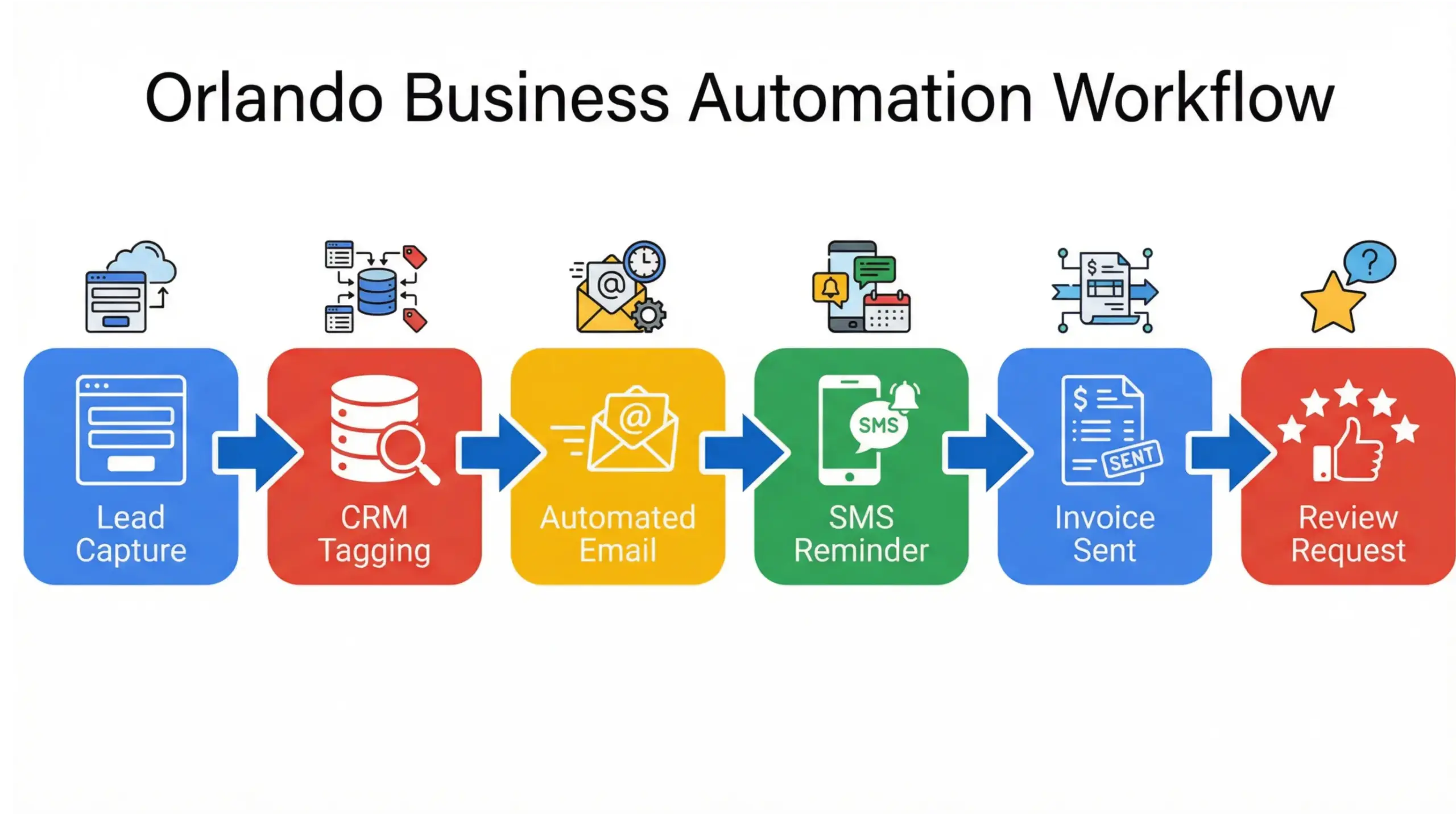
What Is Business Automation for Orlando Companies?
Business automation for Orlando companies refers to the implementation of software, CRM systems, AI-driven workflows, and integrations that automatically complete repetitive operational tasks. Instead of manually responding to leads, assigning tasks, sending reminders, or generating invoices, automation systems execute these actions consistently and instantly.
Instead of manually:
- Responding to new leads
- Assigning tasks internally
- Sending reminders
- Generating invoices
- Following up with prospects
Automated workflows handle these processes without human intervention.
Example automation flow:
- A new lead fills out a website form.
- The CRM automatically logs the contact.
- A welcome email is triggered.
- A sales task is assigned.
- A follow-up SMS is scheduled.
- The lead is tagged and tracked.
All without manual input.
Why Is Business Automation Critical for Orlando Small Businesses in 2026?
Orlando’s economy is competitive. Customer expectations are high, and response speed often determines conversion. Businesses that respond within minutes are significantly more likely to close deals than those that delay.
Research indicates small businesses spend an average of 20+ hours per week on repetitive administrative tasks. That equals more than 1,000 hours per year per employee.
Automation helps Orlando businesses:
- Reduce operational costs
- Increase response speed
- Improve customer experience
- Eliminate human error
- Scale without expanding payroll
“Automation doesn’t replace people – it replaces inefficiency.”
What Types of Businesses in Orlando Benefit Most from Automation?
Nearly every business benefits from automation, but service-based companies in Orlando see the highest ROI because they depend heavily on inquiries and bookings.
| Business Type | Automation Impact | Example |
|---|---|---|
| Home Service Providers | Faster lead response | Auto CRM + SMS follow-up |
| Medical Practices | Appointment efficiency | Scheduling reminders |
| Law Firms | Lead management | Automated intake forms |
| Marketing Agencies | Lead nurturing | Drip campaigns |
| E-commerce Stores | Sales growth | Cart abandonment flows |
| Local Retail Shops | Customer retention | Loyalty automation |
Service-based businesses experience the fastest ROI because automation directly affects revenue generation.
What Processes Should Orlando Businesses Automate First?
The best starting point is automating tasks that consume the most time and directly impact revenue.
1. Lead Capture & Follow-Up
Automated first-response systems increase conversion probability significantly.
- Instant confirmation emails
- SMS follow-ups
- Appointment scheduling links
- Sales pipeline tagging
2. Appointment Scheduling
- Calendar syncing
- Reminder emails
- SMS confirmations
- Rescheduling links
3. Invoicing & Payments
- Invoice generation
- Payment reminders
- Auto receipts
- Recurring billing
4. CRM & Lead Management
- Lead tagging by source
- Sales stage automation
- Internal task assignments
- Notification triggers
5. Marketing Campaigns
- Welcome sequences
- Review requests
- Referral campaigns
- Reactivation flows
How Much Time Can Orlando Business Automation Save?
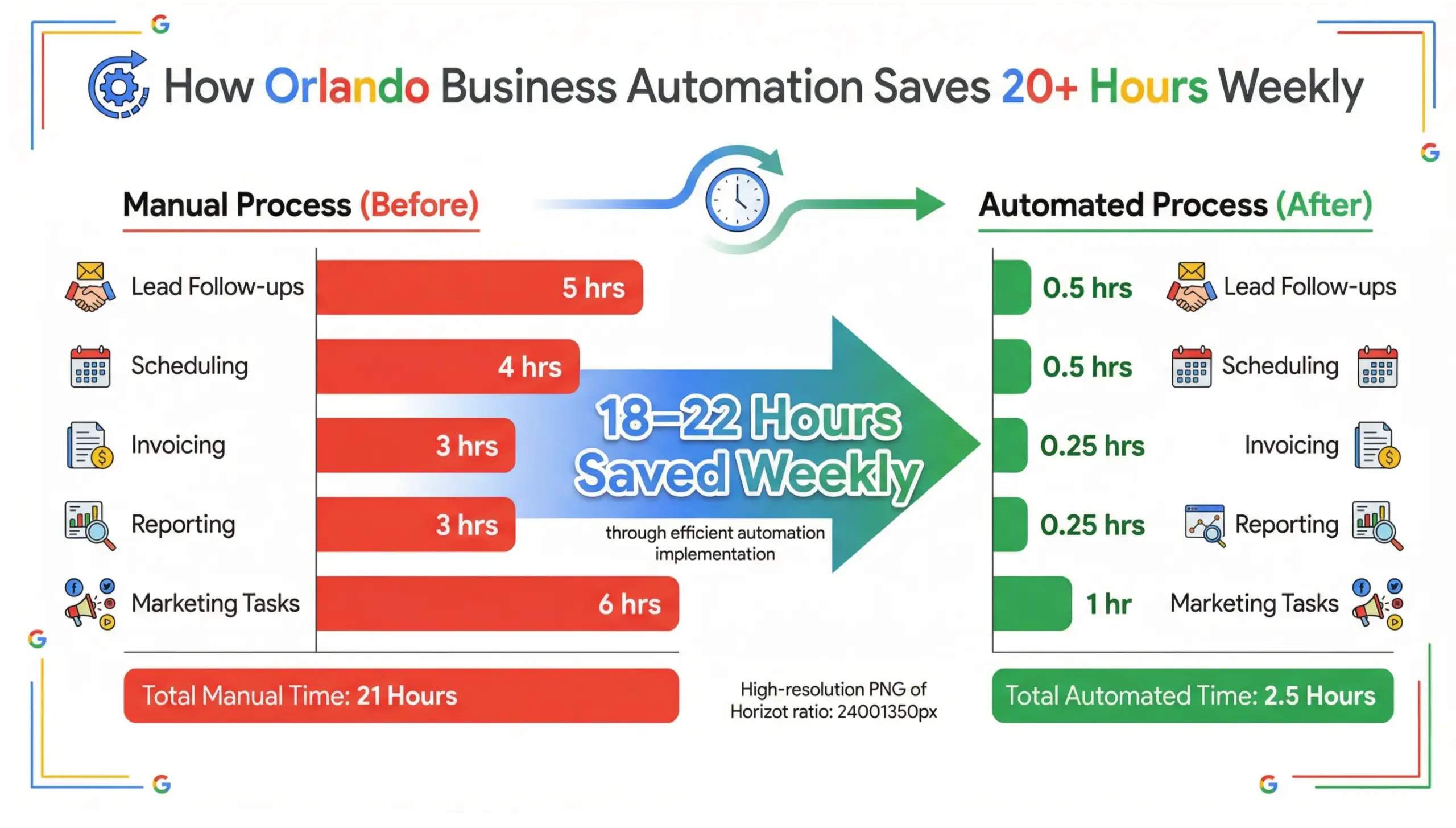
Most Orlando small businesses save 15-30 hours per week after implementing structured automation systems.
| Task | Weekly Time (Manual) | Automated Time |
|---|---|---|
| Lead follow-up | 6 hrs | 20 mins |
| Scheduling | 4 hrs | 15 mins |
| Invoicing | 3 hrs | 30 mins |
| Reporting | 2 hrs | 10 mins |
| Marketing tasks | 6 hrs | 1 hr |
Total potential savings: 18-22+ hours weekly.
That time can be redirected toward sales, service quality, and strategic growth.
What Tools Are Used for Orlando Business Automation in 2026?
Modern automation combines CRM systems, AI tools, and integration platforms.
- HubSpot
- Go High Level
- Zapier
- Make (Integromat)
- Active Campaign
- Shopify automations
- Google Workspace automations
- AI chatbots
- GPT workflow agents
The key is not just tools – it’s how they are structured together.
“Software without strategy is just expensive clutter. Automation requires architecture.”
How Does Business Automation Increase Revenue?
Automation increases revenue in three primary ways:
1. Faster Lead Response = Higher Conversion
Businesses that respond within 5 minutes are significantly more likely to close deals.
2. Improved Customer Retention
Automated follow-ups increase repeat bookings and lifetime value.
3. Reduced Operational Costs
Less administrative labor reduces payroll overhead and increases margins.
For many Orlando service providers, automation improves profit margins by 10-25% within the first year.
What Is the Cost of Business Automation in Orlando?
Costs vary depending on complexity and scale.
| Automation Level | Estimated Investment |
|---|---|
| Basic CRM setup | $1,000-$3,000 |
| Workflow integration | $3,000-$7,000 |
| Full system automation | $7,000-$20,000+ |
| AI & advanced systems | $500-$1,500/month |
ROI often outweighs the investment within 3-6 months.
Is AI Part of Orlando Business Automation?
Yes. AI is increasingly integrated into automation systems.
Examples include:
- AI chatbots for lead qualification
- AI-generated follow-up emails
- Predictive lead scoring
- Smart scheduling optimization
- Automated content generation
AI enhances automation by adding intelligence to decision-making.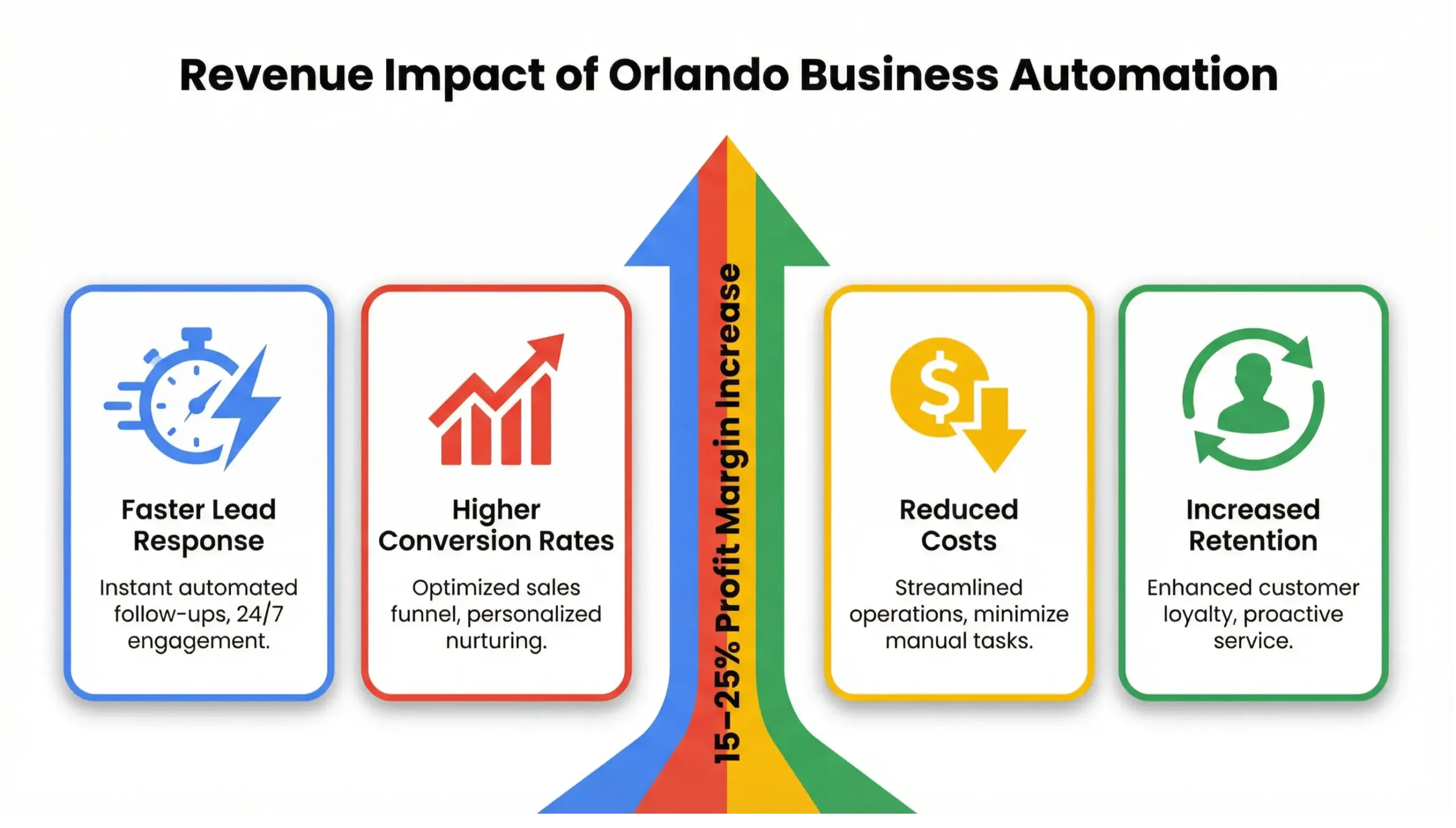
How Long Does It Take to Implement Automation?
| Phase | Timeline |
|---|---|
| Discovery & audit | 1-2 weeks |
| System mapping | 1 week |
| Build & integration | 2-4 weeks |
| Testing & optimization | 1-2 weeks |
Most Orlando businesses fully automate core processes within 30-60 days.
What Are the Biggest Mistakes Businesses Make with Automation?
- Automating broken processes
- Overcomplicating systems
- Using too many disconnected tools
- Ignoring employee training
- Failing to measure ROI
Automation must simplify, not complicate.
10 Frequently Asked Questions About Orlando Business Automation
1. What is business automation?
Business automation uses software and workflows to complete repetitive tasks without manual effort.
2. Is automation only for large companies?
No. Small Orlando businesses often see faster ROI because they operate leaner.
3. How much does automation cost?
Basic systems start around $1,000-$3,000 and scale based on complexity.
4. Can automation replace employees?
No. It supports employees by removing repetitive tasks.
5. What is the best CRM for Orlando businesses?
Popular options include HubSpot and GoHighLevel, depending on business size and goals.
6. How long before I see ROI?
Most businesses see measurable ROI within 3-6 months.
7. Is automation secure?
Yes, when implemented with secure, encrypted platforms.
8. Can automation help with Google reviews?
Yes. Automated review requests significantly increase review volume.
9. Do I need technical skills?
No. Systems can be built and maintained professionally.
10. Is automation worth it in 2026?
Absolutely. Businesses without automation risk falling behind in speed and scalability.
Final Thoughts: Why Orlando Businesses Must Automate Now
Orlando business automation is no longer a luxury – it’s a growth requirement. In a competitive market, speed, consistency, and operational efficiency define success.
Businesses that automate:
- Respond faster
- Convert more leads
- Retain more customers
- Operate with fewer errors
- Scale without chaos
The real question is not “Should we automate?”
It’s “How much revenue are we losing by not automating?”


