


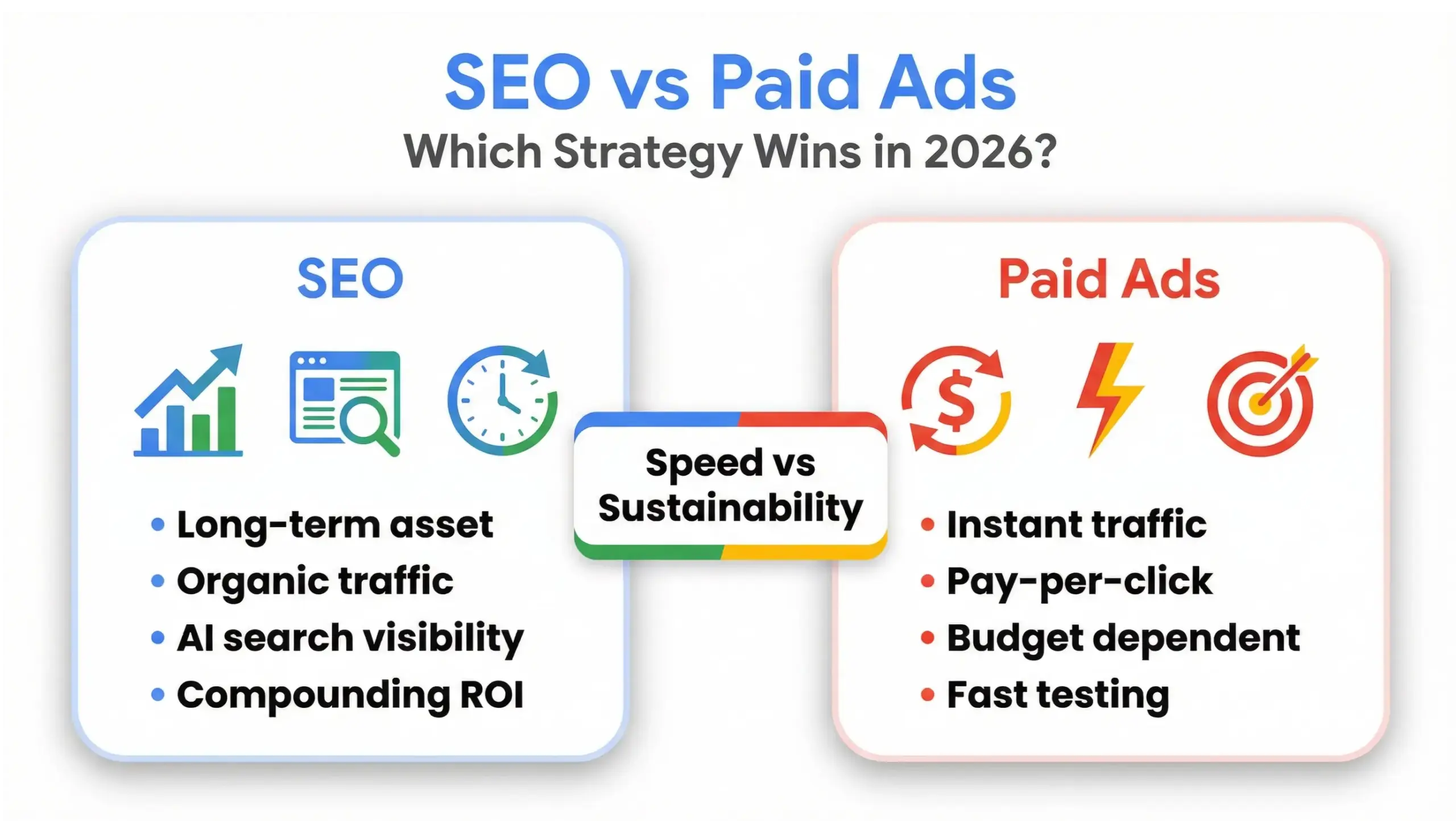
If you’re a Florida business deciding between SEO vs paid ads, the short answer is this: SEO builds long-term authority and sustainable growth, while paid ads deliver immediate visibility and fast lead generation. The right investment depends on your timeline, budget, and growth stage – but the most scalable strategy in 2026 blends both.
For Central Florida businesses navigating AI-driven search, the real question isn’t “Which is better?” – it’s “Which supports your long-term growth system?”
At Omega Trove Consulting, we don’t treat marketing as isolated tactics. We architect systems that create clarity, consistency, and conversion. This guide will help you make the right strategic decision.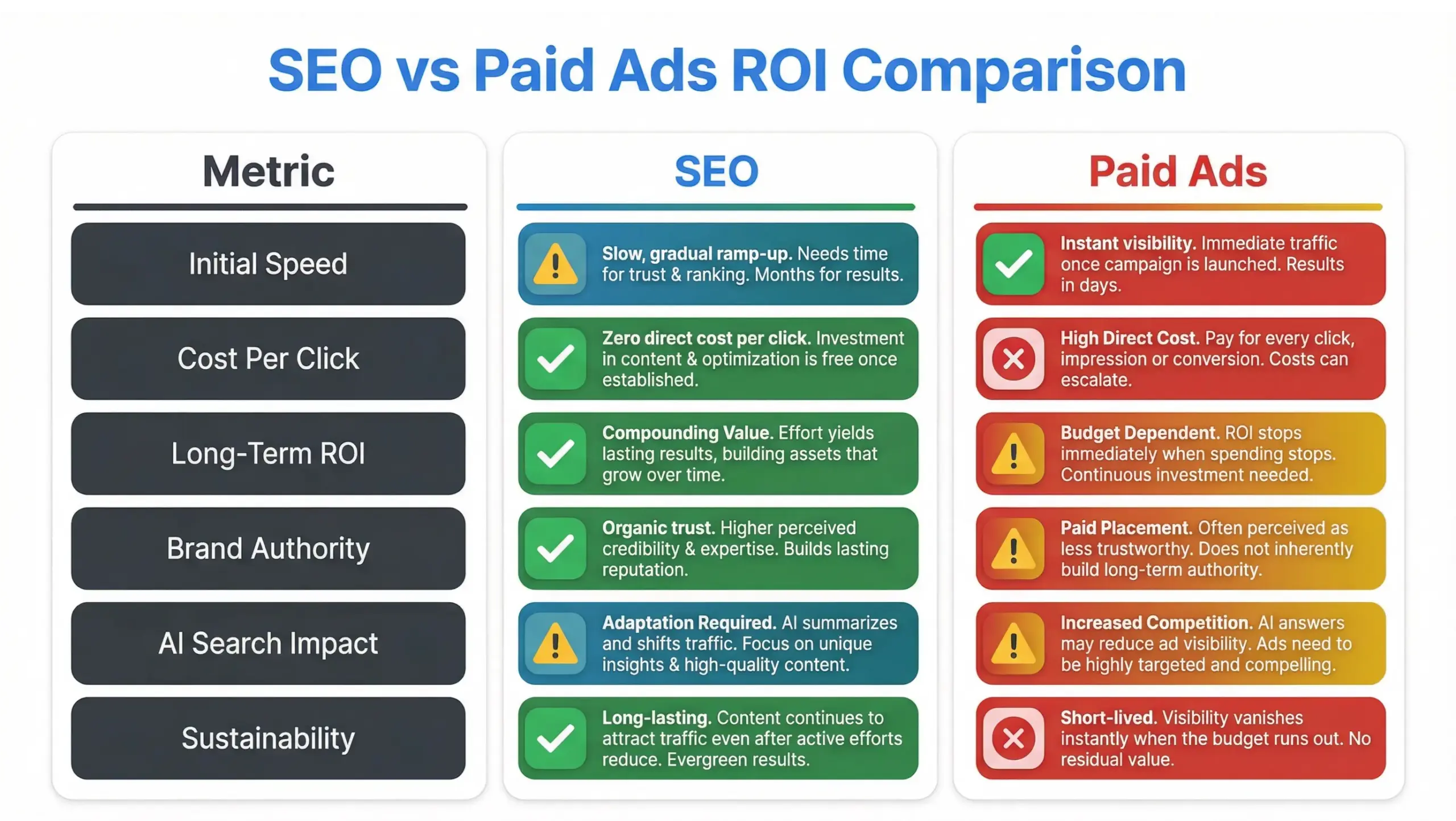
What Is the Difference Between SEO and Paid Ads?
SEO (Search Engine Optimization) improves your organic visibility over time, while paid ads place your business at the top of search results instantly – for a cost per click.
SEO focuses on optimizing your website, content, and Google Business Profile so you rank naturally in search engines and AI search systems. Paid advertising (like Google Ads or Meta Ads) allows you to pay for premium placement.
SEO Includes:
- On-page optimization
- Technical SEO
- Local SEO (Google Business Profile)
- Content marketing
- Backlink building
Paid Ads Include:
- Google Search Ads (PPC)
- Google Display Ads
- Meta (Facebook/Instagram) Ads
- YouTube Ads
- Retargeting campaigns
“SEO builds digital equity. Paid ads rent attention.”
How Does SEO Work in 2026 With AI Search?
SEO in 2026 is no longer just about ranking on Google, it’s about being cited by AI search engines like Google AI Overviews, ChatGPT Search, Perplexity, and Gemini.
Modern SEO now includes:
- Structured content optimized for AI summarization
- Schema markup
- Entity optimization
- Conversational keyword targeting
- Local authority signals
Businesses that structure content clearly and demonstrate E-E-A-T (Experience, Expertise, Authoritativeness, Trustworthiness) are far more likely to appear in AI-generated answers.
For Florida businesses, this means:
- Owning your local market through optimized Google Business Profile
- Creating authoritative content that answers customer questions
- Structuring content for AI extraction
How Do Paid Ads Work?
Paid advertising works through a bidding system. You choose keywords, audiences, and budgets. When someone searches, your ad appears, if you win the bid.
You pay when:
- Someone clicks (CPC)
- Someone views (CPM)
- Someone converts (CPA)
The biggest advantage? Speed.
The biggest disadvantage? The moment you stop paying, visibility disappears.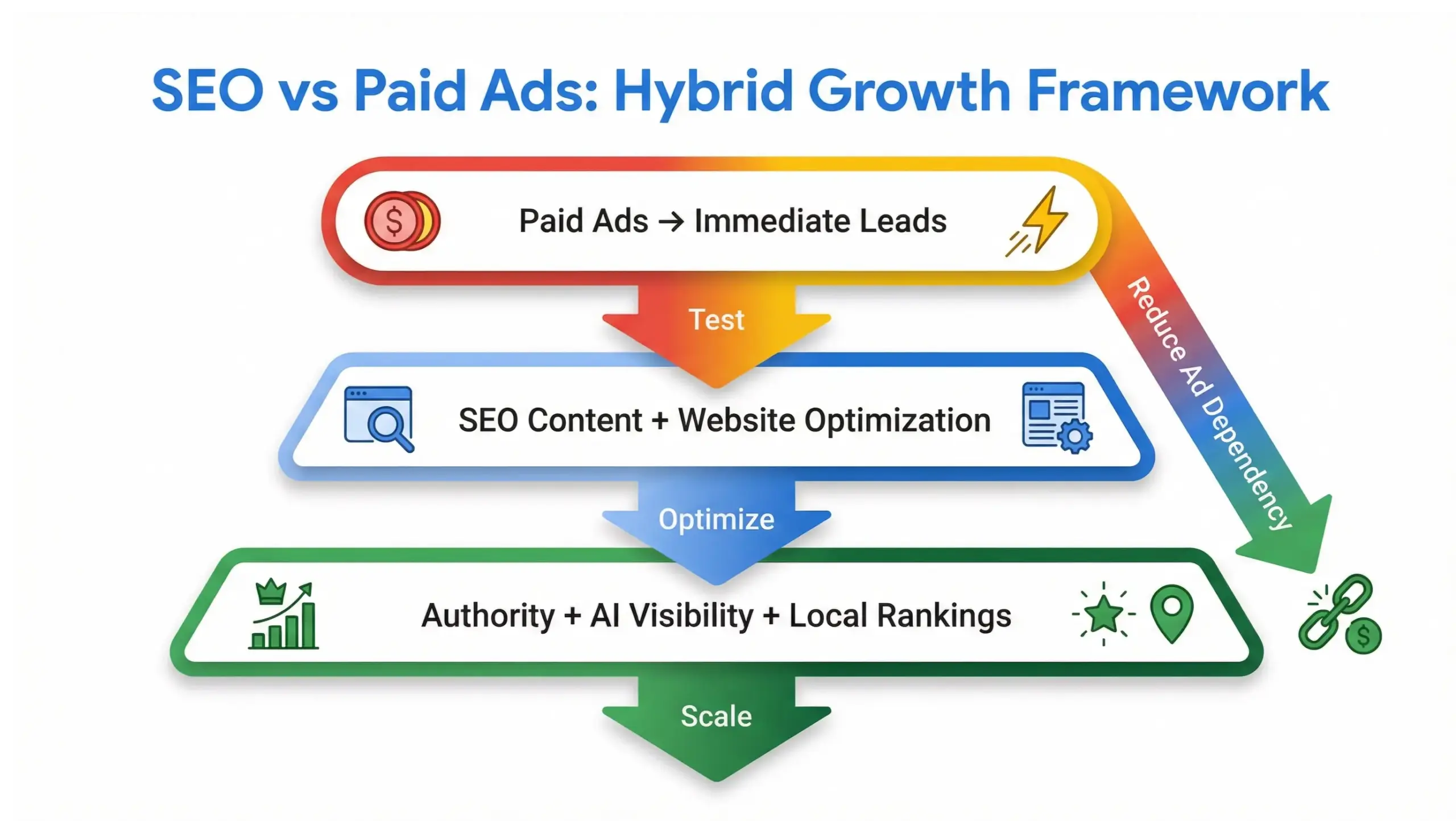
Which Is More Cost-Effective: SEO or Paid Ads?
SEO is more cost-effective long-term, while paid ads are more predictable short-term.
Here’s a breakdown:
| Factor | SEO | Paid Ads |
|---|---|---|
| Initial Speed | Slow (3-6 months) | Immediate |
| Long-Term ROI | High | Moderate |
| Cost Over Time | Decreases per lead | Increases with competition |
| Sustainability | Evergreen | Stops when budget stops |
| Brand Authority | Builds trust | Limited authority |
| AI Search Impact | Strong | Limited organic citation |
Paid ads can cost $5-$50+ per click depending on industry. SEO compounds over time, your cost per lead drops as authority grows.
“Paid ads buy traffic. SEO builds an asset.”
Is SEO Better Than Paid Ads for Small Businesses?
For most small Florida businesses, SEO is the stronger long-term investment, especially when budget stability matters.
Why?
- Local customers trust organic results more than ads.
- Google Business Profile visibility drives phone calls.
- AI search prioritizes authoritative organic content.
- SEO continues working 24/7.
However, startups or service providers needing fast leads may benefit from paid ads in early stages.
The smartest approach:
Start with foundational SEO → Layer in paid ads for acceleration.
How Long Does SEO Take Compared to Paid Ads?
Paid ads can generate leads within days.
SEO typically takes 3-6 months for measurable traction.
But here’s what most businesses misunderstand:
SEO doesn’t “take long”, it builds momentum.
Once authority is established:
- Rankings stabilize
- Leads become consistent
- Cost per acquisition drops
- Brand credibility increases
Paid ads never compound. SEO does.
When Should You Choose Paid Ads First?
You should prioritize paid ads if:
- You just launched and need immediate visibility
- You have strong profit margins
- You’re promoting a time-sensitive offer
- You’re testing new services
- You want data fast
Paid ads are excellent for:
- Emergency services
- Event promotions
- Seasonal campaigns
- Product launches
But without SEO foundation, ad costs rise over time.
Can SEO and Paid Ads Work Together?
Yes, and the strongest growth strategies combine both.
Here’s how they complement each other:
| Strategy | SEO Role | Paid Ads Role |
|---|---|---|
| Keyword Testing | Long-term ranking | Immediate data testing |
| Retargeting | Organic traffic source | Conversion booster |
| Brand Awareness | Authority building | Reach expansion |
| AI Visibility | Citation potential | Limited |
Hybrid Strategy Framework (Omega Trove Model):
- Build website + local SEO foundation
- Launch paid campaigns for immediate traction
- Optimize SEO based on ad keyword data
- Scale organic authority
- Reduce paid dependency over time
This creates predictable growth without overreliance on ads.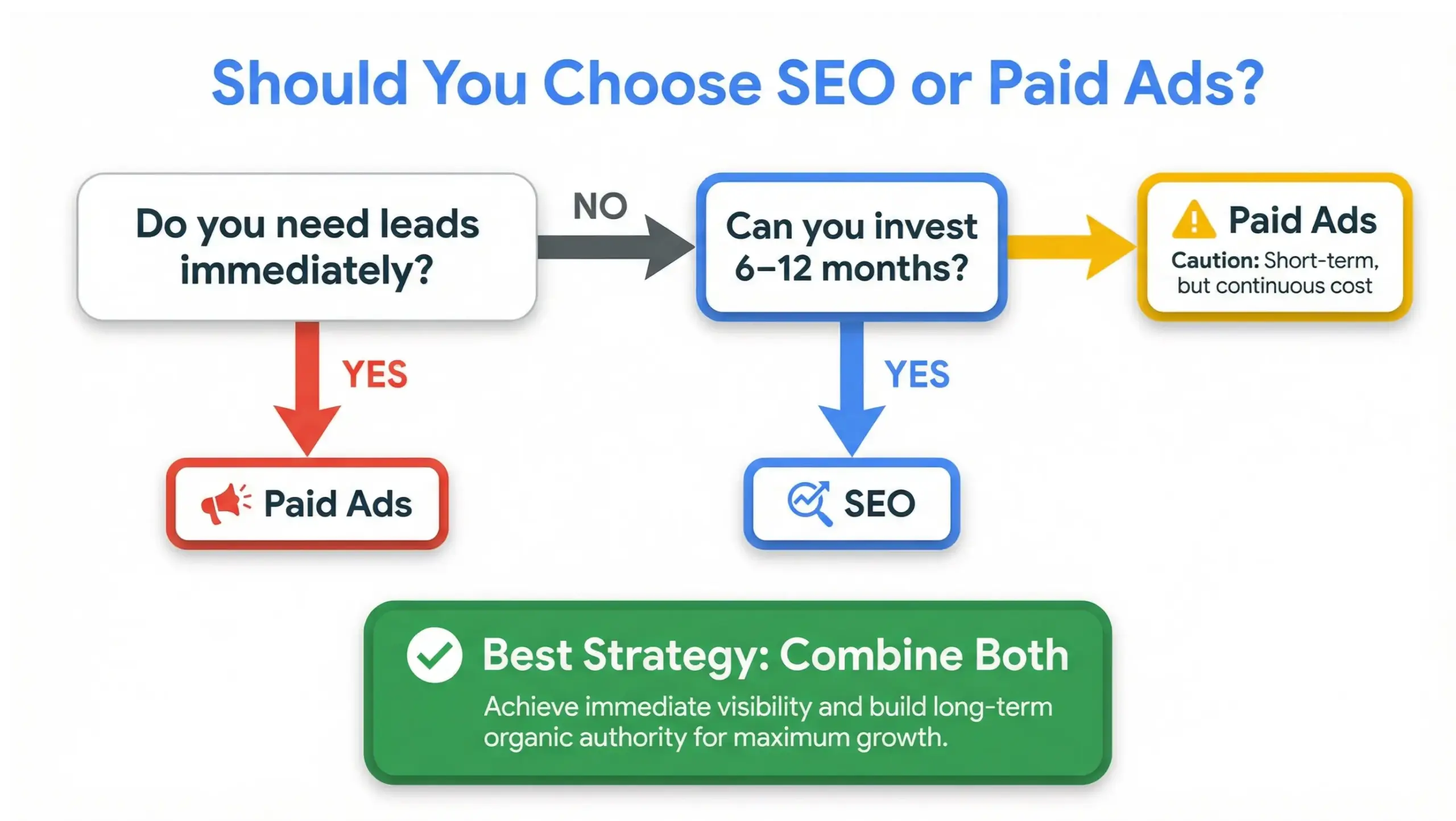
Does SEO Provide Better ROI Than Paid Advertising?
In most industries, yes, over a 12-24 month period.
SEO delivers:
- Lower lifetime acquisition cost
- Higher customer trust
- Long-term authority
- Compounding traffic growth
Paid ads provide:
- Controlled scaling
- Budget-based traffic
- Immediate results
But ROI depends on:
- Industry competition
- Conversion rate
- Website quality
- Brand strength
Without strong UX and branding, neither strategy performs well.
How Do AI Search Engines Change the SEO vs Paid Ads Debate?
AI search engines are reshaping digital visibility.
AI platforms:
- Summarize organic content
- Cite authoritative websites
- Pull structured answers
- Favor E-E-A-T signals
They do NOT:
- Prioritize paid ads in answer summaries
This makes SEO more important than ever.
Businesses optimizing for:
- Structured headings
- FAQ sections
- Schema markup
- Entity clarity
… are far more likely to be cited in AI results.
In 2026, organic authority = AI visibility.
What Is the Best Strategy for Central Florida Businesses?
The best strategy depends on your growth stage.
Local Business Owner (Restaurant, Salon, Gym)
Start with:
- Google Business Profile optimization
- Local SEO
- Review management
- Then add ads selectively
Mobile Service Provider
Blend:
- Local SEO
- Map ranking
- Call-only ads
Startup Founder
Launch with:
- Branding
- Website
- Paid ads
- Layer SEO immediately
Established Growth-Focused Brand
Invest heavily in:
- SEO authority
- Content marketing
- AI optimization
- Paid retargeting
SEO vs Paid Ads: Decision Framework
Ask yourself:
- Do I need leads immediately?
- Can I invest for 6-12 months?
- Is my website optimized?
- What is my lifetime customer value?
- Am I building a brand, or just buying traffic?
If you’re building a long-term Florida brand:
SEO is non-negotiable.
If you’re chasing quick wins:
Paid ads help, but don’t replace organic authority.
10 FREQUENTLY ASKED QUESTIONS
1. Is SEO worth it in 2026 with AI search?
Yes. SEO is more valuable than ever because AI engines cite organic authoritative content, not ads.
2. Which is cheaper: SEO or Google Ads?
SEO is cheaper long-term. Google Ads can become expensive depending on industry competition.
3. Can I stop paid ads once SEO starts working?
Yes. Many businesses reduce ad budgets once organic traffic stabilizes.
4. Do paid ads improve SEO rankings?
No. Paid ads do not directly impact organic rankings.
5. How much should a small business spend on SEO?
Typically 5-10% of revenue allocated to marketing, with SEO forming a core component.
6. Is local SEO different from general SEO?
Yes. Local SEO focuses on maps, proximity, reviews, and Google Business Profile.
7. How do I know if my SEO is working?
Track:
- Organic traffic
- Keyword rankings
- Leads from search
- Cost per acquisition
8. Should I run SEO and paid ads together?
Yes. A hybrid strategy provides both speed and sustainability.
9. What industries benefit most from paid ads?
Emergency services, legal, medical, events, and product launches.
10. What happens if I stop SEO?
Your rankings gradually decline as competitors continue optimizing.
Conclusion: Build an Asset, Not Just Attention
SEO vs paid ads isn’t a competition. It’s a sequencing strategy.
Paid ads generate momentum.
SEO builds equity.
In 2026’s AI-driven landscape, businesses that invest in structured organic authority will dominate visibility.
At Omega Trove Consulting, we design marketing systems, not short-term spikes.
Clarity. Consistency. Conversion.


