


Training AI employees is not about teaching software to generate content – it’s about building structured digital team members that understand your brand voice, workflows, standards, and strategic objectives. Businesses that treat AI like a system – not a shortcut – gain consistency, scalability, and measurable growth.
In 2026, AI employees are operational assets. When trained correctly, they improve output quality, reduce internal friction, and protect brand clarity across departments.
What Does It Mean to “Train AI Employees”?
Training AI employees means creating structured frameworks, documentation systems, and brand guardrails that guide how AI tools produce content, make decisions, and support workflows.
AI does not learn your business automatically. It performs based on:
- Context you provide
- Systems you build
- SOPs you define
- Examples you feed it
- Constraints you enforce
“AI without structure produces noise. AI with structure produces leverage.”
Why Do Most AI Employees Sound Robotic?
Most AI outputs sound generic because businesses skip the training layer and rely only on prompts.
Common reasons AI sounds robotic:
- No defined brand voice document
- No tone calibration examples
- No real-world messaging samples
- Overuse of generic prompt templates
- No human review process
AI reflects the quality of the instructions it receives. If your internal messaging lacks clarity, AI amplifies that confusion.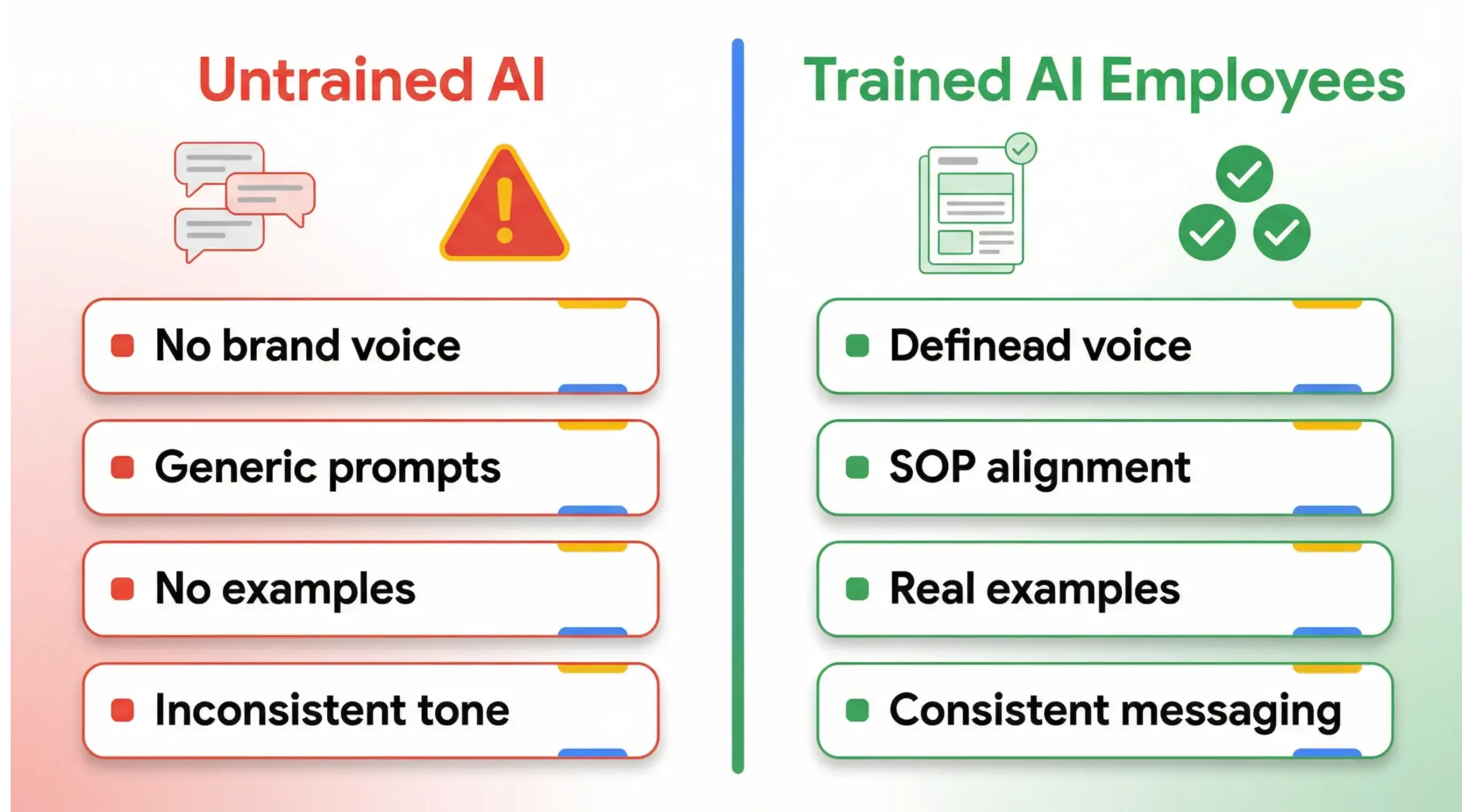
Step 1: Define Your Brand Voice Before Training AI
You cannot train AI employees if you cannot clearly describe your brand voice.
A complete AI training foundation should include:
| Brand Component | What to Define |
|---|---|
| Tone | Confident? Warm? Direct? Analytical? |
| Vocabulary | Words you use often / avoid |
| Sentence Structure | Short & punchy or detailed & structured |
| Emotional Style | Inspirational, data-driven, community-focused |
| Audience Level | Beginner-friendly or expert-focused |
Your AI should know:
- How you open emails
- How you close proposals
- How you structure blog posts
- How you respond to objections
If it doesn’t know these patterns, it cannot replicate them.
Step 2: Build an AI Training Document (Internal AI SOP)
The fastest way to train AI employees is to create a centralized AI Operations Document.
This document should include:
- Brand voice guide
- Approved messaging samples
- Company positioning statement
- Target audience personas
- Do/Don’t messaging rules
- Formatting rules
- Industry terminology
- Frequently used frameworks
This document becomes the “brain reference” for every AI tool used across the company.
“Your AI employee is only as smart as your documentation.”
Step 3: Feed AI Real Examples (Not Just Instructions)
AI learns patterns from examples better than descriptions.
Provide:
- 10 previous blog posts
- 10 email campaigns
- 10 sales messages
- 5 landing pages
- 5 proposal templates
Then define:
- What makes them strong
- What should be repeated
- What should be avoided
AI improves dramatically when it sees high-quality output examples.
Step 4: Create Prompt Frameworks (Instead of Random Prompts)
Random prompts produce inconsistent results. Framework prompts produce aligned output.
Instead of:
“Write a blog about AI.”
Use:
“Write a 2,000-word strategic blog post for small business owners explaining how to train AI employees. Tone: confident but empathetic. Use structured headings, tables, and data-driven explanations. Avoid generic language. Provide actionable steps.”
Build prompt templates for:
- Blog posts
- Emails
- Ads
- SOP drafting
- Client reports
- Sales pages
This ensures consistency across teams.
Step 5: Implement Human-in-the-Loop Review
AI employees should not operate autonomously without review.
Implement:
- Senior-level content review
- Compliance checks
- Brand alignment scoring
- Tone audits
AI accelerates production. Humans protect positioning.
The winning model is hybrid – not fully automated.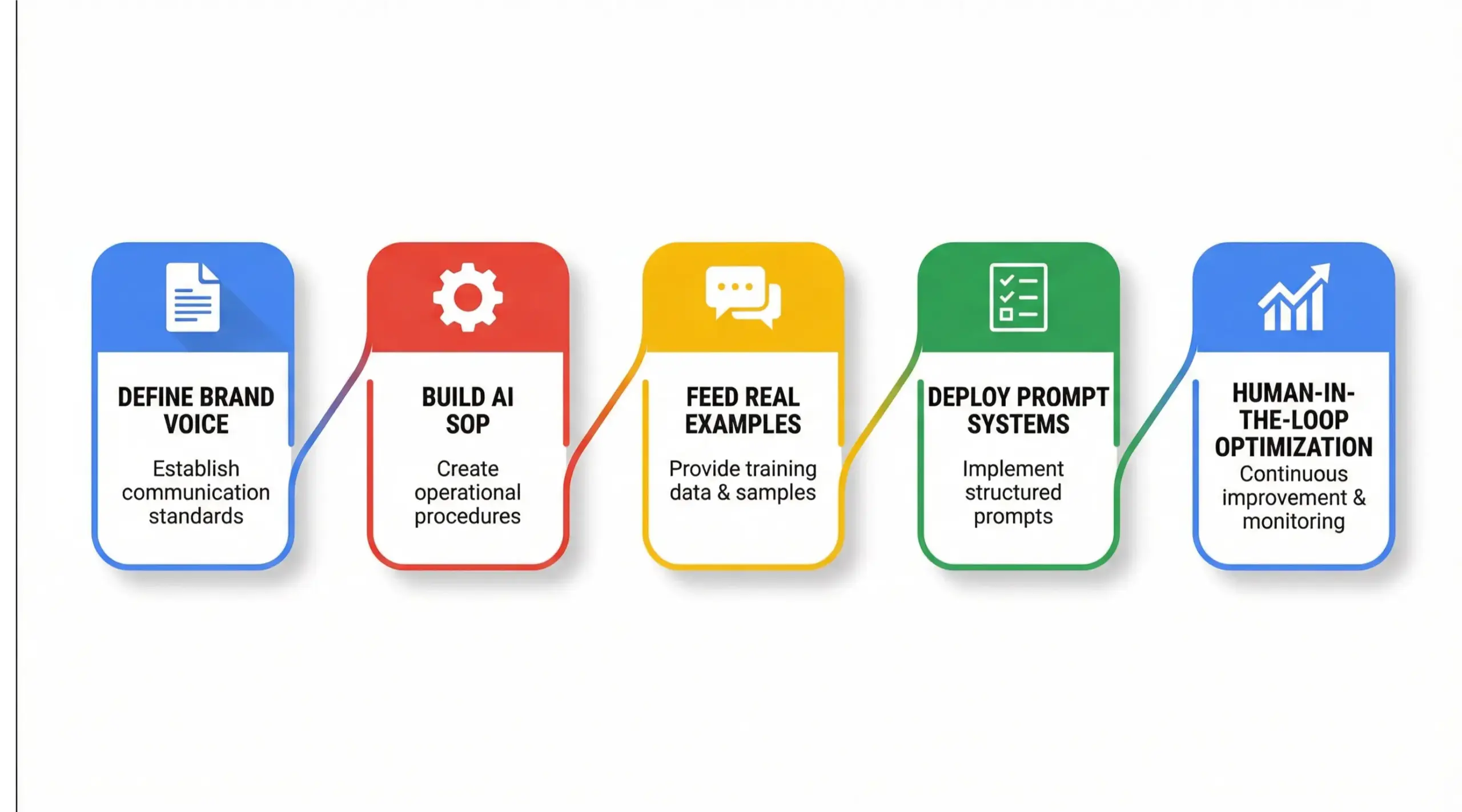
Step 6: Train AI on SOPs and Workflow Systems
AI employees become powerful when connected to operational clarity.
Upload or integrate:
- Standard Operating Procedures
- Customer journey maps
- Service descriptions
- Product documentation
- Objection handling scripts
When AI understands how your business operates, it supports execution – not just content.
Step 7: Align AI with Performance Metrics
AI should not just create content – it should support measurable outcomes.
Tie AI output to:
- Conversion rates
- Engagement metrics
- Click-through rates
- Lead generation
- Customer retention
Create quarterly AI performance audits.
“AI training without measurement leads to activity, not growth.”
AI Employee Training Framework (Complete System Overview)
| Phase | Objective | Key Action |
|---|---|---|
| Foundation | Define clarity | Brand voice + positioning |
| Structure | Build systems | AI SOP document |
| Calibration | Feed examples | Past best-performing assets |
| Deployment | Standardize output | Prompt frameworks |
| Oversight | Protect brand | Human review |
| Optimization | Improve performance | KPI tracking |
This is how businesses scale AI without losing identity.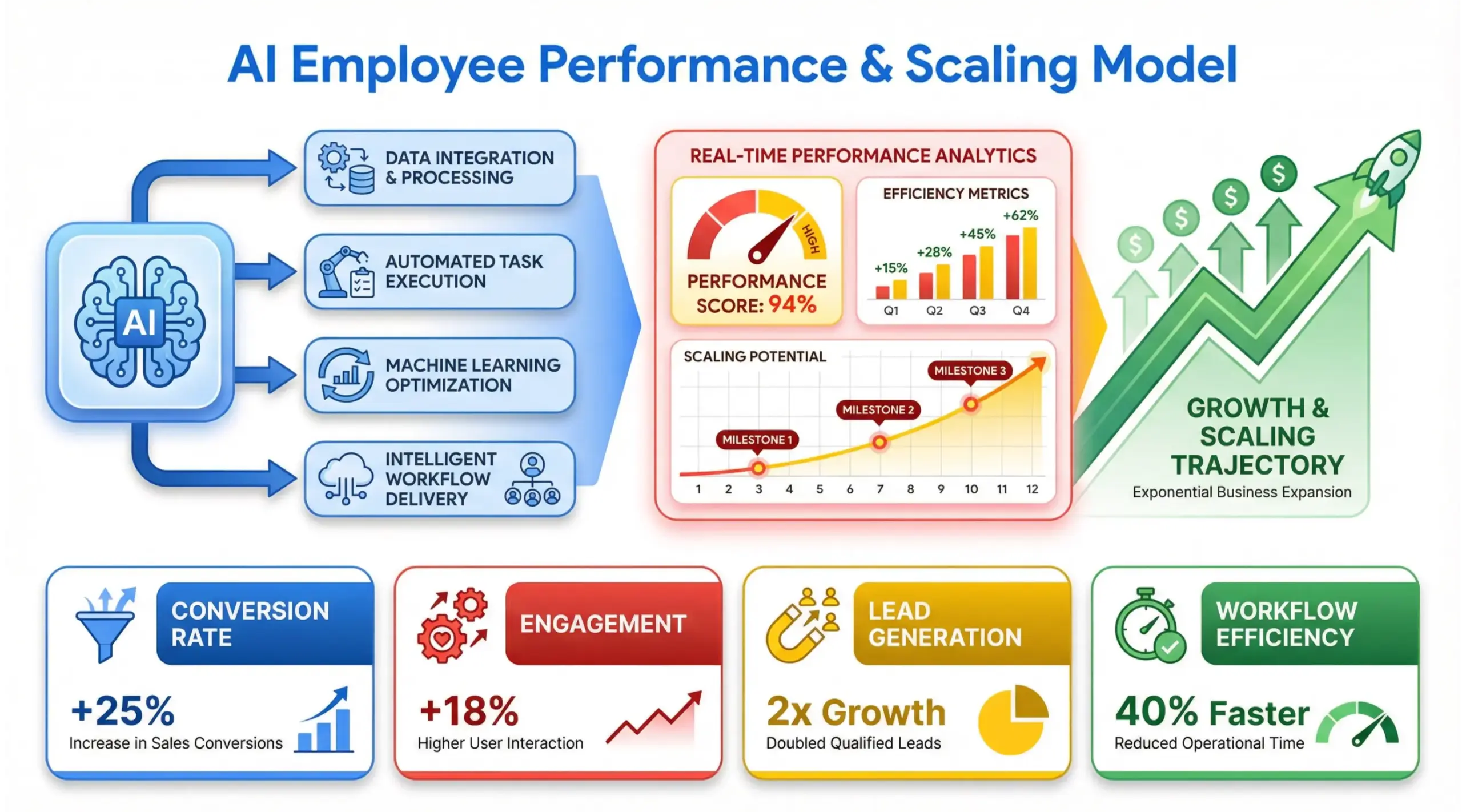
10 Frequently Asked Questions
1. How long does it take to train AI employees?
Training AI employees can take anywhere from two weeks to three months depending on documentation quality and system complexity. Businesses with existing SOPs, brand guides, and structured workflows train AI faster. Companies starting without documentation must first build clarity before automation.
2. Can small businesses effectively train AI employees?
Yes. Small businesses often train AI faster because decision-making is centralized. When the founder defines tone, messaging, and positioning clearly, AI alignment becomes easier. The key is documentation – not company size.
3. What tools are best for training AI employees?
The best tools depend on goals. For content: ChatGPT, Claude, Gemini. For workflow integration: Notion AI, Zapier AI, Make.com. For knowledge management: internal databases or cloud-based document systems. The tool matters less than the structure behind it.
4. Should AI employees replace human staff?
No. AI employees should enhance human performance, not replace strategic roles. AI handles drafting, structuring, summarizing, and pattern-based tasks. Humans handle creativity, strategic positioning, empathy, and final decisions.
5. Why does my AI output feel generic?
Generic output usually means:
- No brand voice input
- No sample data provided
- Overuse of vague prompts
- No constraints defined
AI mirrors the clarity of instructions.
6. Can AI employees learn company culture?
Yes, but only if culture is documented. Upload internal communication style examples, leadership tone, and company values. AI cannot intuit culture – it must be structured.
7. How do you prevent AI from going off-brand?
Create:
- Approved word lists
- Banned phrases
- Tone definitions
- Formatting requirements
- Human review checkpoints
Treat AI like onboarding a new hire.
8. Is AI training a one-time process?
No. AI training is iterative. As messaging evolves, SOPs change, and markets shift, your AI documentation must update. Quarterly calibration is recommended.
9. How do you scale AI employees across departments?
Create department-specific AI frameworks:
- Marketing AI SOP
- Sales AI SOP
- Operations AI SOP
- Customer Support AI SOP
Each department needs contextual training data.
10. What is the biggest mistake businesses make when training AI?
The biggest mistake is using AI before building clarity. Businesses rush into tools without defining brand, audience, positioning, or goals. AI amplifies strategy – it does not create it.
Conclusion: AI Employees Require Strategy, Not Shortcuts
Training AI employees is not about writing better prompts. It is about building systems that preserve clarity, consistency, and performance across your organization.
Companies that treat AI like a scalable team member – with onboarding, documentation, supervision, and performance reviews – gain leverage.
Those who skip structure get noise.
AI is not the competitive advantage.
Structured AI implementation is.


