


Running a Business Automation in Longwood, Florida means competing in a fast-moving local economy where efficiency, speed, and customer experience directly impact growth. Many businesses start strong with hands-on processes, spreadsheets, emails, and manual workflows. But as demand increases, those same systems become bottlenecks.
This is where Longwood business automation becomes a competitive advantage.
Business automation is no longer reserved for large enterprises or tech companies. Today, local service providers, professional firms, and growing businesses in Longwood are using automation to eliminate repetitive tasks, reduce errors, improve customer response times, and scale without adding unnecessary overhead.
In this guide, we’ll break down exactly what business automation means for Longwood businesses, which manual processes are holding companies back, how automation systems work together, and how local expertise makes all the difference when implementing automation correctly.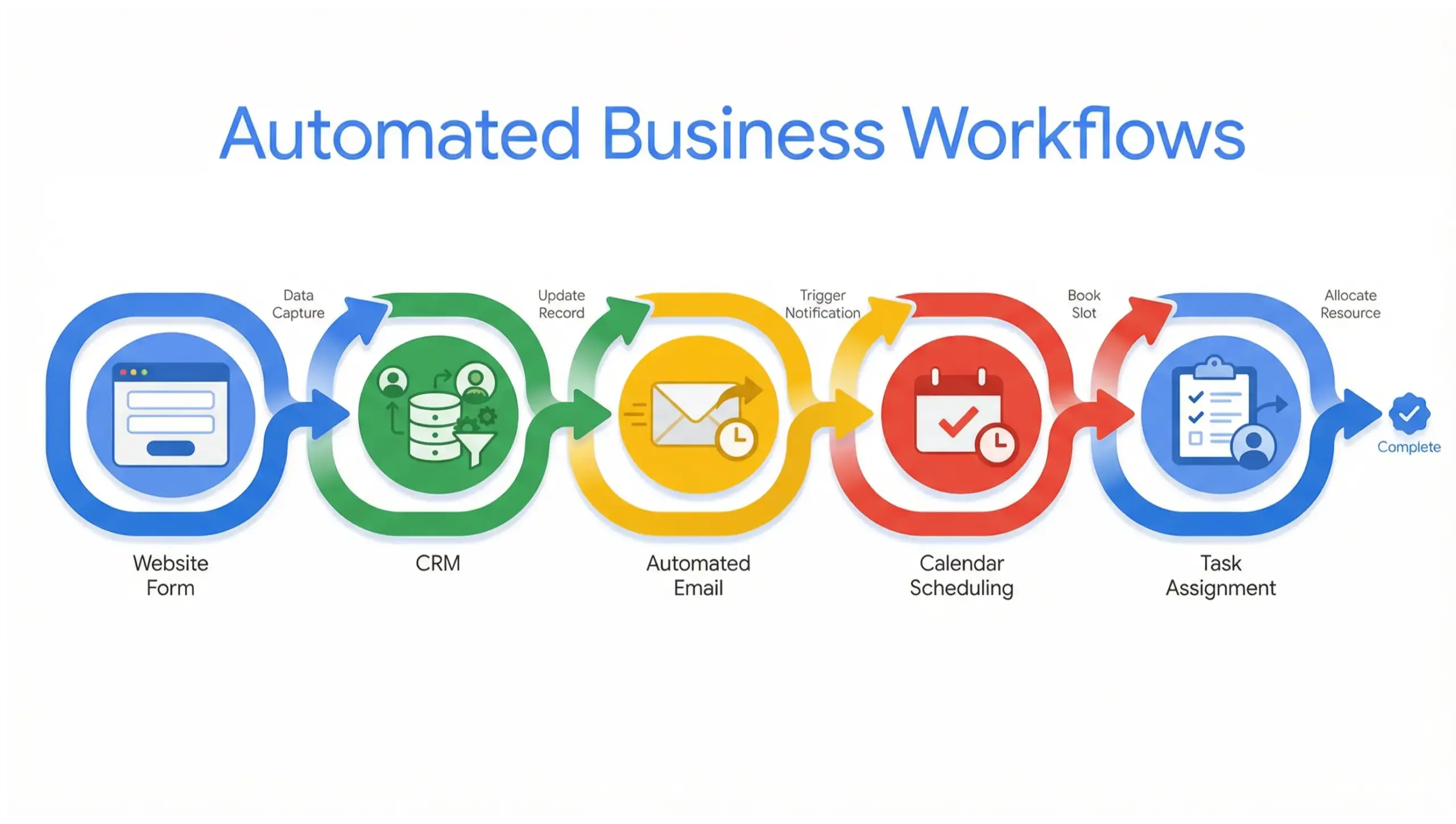
What Business Automation Means for Longwood Businesses
At its core, business automation is the use of technology to perform recurring tasks and workflows with minimal human intervention. Instead of relying on manual data entry, follow-up emails, scheduling calls, or disconnected tools, automation connects systems into a single, efficient operation.
For Longwood businesses, automation is not about replacing people. It’s about freeing teams from low-value tasks so they can focus on growth, service quality, and strategy.
Examples of business automation include:
- Automatically capturing leads from your website
- Sending follow-up emails or SMS messages without manual effort
- Syncing customer data between CRM, billing, and scheduling systems
- Automating invoicing, reminders, and internal workflows
- Tracking performance and operations in real time
When implemented correctly, Longwood business automation transforms how a company operates day to day.
Why Manual Work Is Holding Longwood Businesses Back
Many businesses don’t realize how much time and money is lost to manual processes until they step back and analyze their workflows.
Common signs your business is overdue for automation include:
- Re-entering the same information into multiple systems
- Missed follow-ups or delayed customer responses
- Inconsistent processes between team members
- Difficulty tracking performance or customer history
- Bottlenecks when business volume increases
Manual systems may work when a business is small, but growth exposes their weaknesses quickly. Every manual step increases the risk of errors, delays, and lost opportunities.
In a competitive local market like Longwood, slow response times and disorganized systems can cost businesses real revenue.
The True Cost of Manual Business Processes
Manual work doesn’t just cost time. It creates hidden expenses that add up over months and years.
Time Drain
Employees spend hours per week on tasks that could be automated in seconds. That time could be used for customer service, sales, or strategy.
Increased Errors
Manual data entry leads to mistakes, wrong invoices, missed appointments, incorrect records, which damage trust and credibility.
Inconsistent Customer Experience
Without automated systems, customers receive uneven communication, delayed responses, or conflicting information.
Limited Scalability
Manual workflows don’t scale. As demand increases, businesses either burn out staff or struggle to keep up.
Business automation directly addresses these challenges by creating consistent, reliable systems that grow with your business.
Core Business Automation Systems That Replace Manual Work
Effective Longwood business automation is not about installing random tools. It’s about designing connected systems that work together.
1. Customer Relationship Management (CRM) Automation
A CRM acts as the central hub for customer data. Automation ensures:
- Leads are captured automatically from forms, calls, or ads
- Follow-ups are triggered based on customer actions
- Sales pipelines update without manual input
- Customer history is always accessible
For Longwood businesses, CRM automation improves response times and ensures no lead slips through the cracks.
2. Workflow and Process Automation
Workflow automation handles internal tasks behind the scenes, such as:
- Assigning tasks to team members
- Sending internal notifications
- Moving projects through stages
- Triggering actions when conditions are met
Instead of relying on memory or manual checklists, workflows ensure processes happen the same way every time.
3. Scheduling and Appointment Automation
Scheduling automation eliminates back-and-forth communication by allowing customers to book appointments online.
Automation can:
- Sync calendars across teams
- Send confirmations and reminders
- Reduce no-shows
- Update CRM records automatically
This is especially valuable for service-based businesses in Longwood.
4. Billing and Payment Automation
Manual invoicing is one of the biggest time drains for growing businesses.
Automation allows:
- Invoices to be generated automatically
- Payment reminders to be sent on schedule
- Receipts to be logged instantly
- Financial data to sync with accounting systems
This improves cash flow and reduces administrative stress.
5. Reporting and Analytics Automation
Instead of pulling data manually from multiple platforms, automation centralizes reporting.
Businesses can track:
- Lead sources
- Conversion rates
- Revenue performance
- Operational efficiency
Automated reporting provides clarity and supports better decision-making.
Business Automation for Small vs Growing Businesses in Longwood
Automation looks different depending on a business’s stage of growth.
Small Businesses
For smaller companies, automation focuses on:
- Lead capture and follow-up
- Scheduling and reminders
- Simple CRM setup
- Basic workflow automation
These systems create stability and professionalism without complexity.
Growing Businesses
As companies scale, automation expands to:
- Advanced CRM pipelines
- Multi-step workflows
- System integrations
- Performance dashboards
- Cross-department automation
This allows businesses to grow without adding unnecessary staff or losing control.
Why Local Expertise Matters in Business Automation
One of the biggest mistakes businesses make is adopting automation tools without a strategy. Generic solutions often fail because they don’t account for local markets, business models, or team workflows.
Working with a local automation partner in Longwood offers key advantages:
- Understanding of local business operations
- Familiarity with service-based and regional industries
- In-person collaboration and support
- Systems tailored to real workflows, not templates
Longwood business automation works best when systems are designed around how your business actually operates, not how a software company assumes it should.
How Automation Improves Customer Experience
Customers don’t see your internal systems, but they feel the results.
Automation improves customer experience by:
- Responding instantly to inquiries
- Sending consistent communication
- Reducing errors and delays
- Creating smoother onboarding and service delivery
In a local market, reputation and trust are everything. Automation helps businesses deliver a reliable, professional experience every time.
Common Myths About Business Automation
Automation is only for large companies
Modern tools are affordable and scalable, making automation accessible for small and mid-sized businesses.
Automation replaces people
Automation replaces repetitive tasks, not human expertise, creativity, or relationships.
Automation is too complicated
With the right strategy and implementation, automation simplifies operations rather than complicating them.
The Role of Strategy in Longwood Business Automation
Automation without strategy leads to fragmented systems and wasted investments.
A proper automation strategy includes:
- Process mapping
- Identifying bottlenecks
- Selecting the right tools
- Designing integrations
- Training teams
- Ongoing optimization
This is where a consulting-led approach makes a difference.
How Omega Trove Helps Longwood Businesses Automate Smarter
Omega Trove Consulting approaches Longwood business automation as a system, not a software install.
Their process focuses on:
- Understanding your business model
- Identifying high-impact automation opportunities
- Designing scalable workflows
- Integrating CRM, scheduling, billing, and reporting
- Ensuring systems support long-term growth
Instead of selling tools, they build automation frameworks that align with real business goals.
The Long-Term Impact of Business Automation
Businesses that implement automation correctly experience:
- Lower operating costs
- Faster response times
- Higher customer satisfaction
- Better internal organization
- Scalable growth
Automation is not a one-time upgrade. It’s an operational foundation that supports long-term success.
Frequently Asked Questions About Longwood Business Automation
1. What is business automation?
Business automation uses technology to handle repetitive tasks and workflows automatically, reducing manual work and improving efficiency.
2. Is business automation expensive?
Costs vary based on complexity, but many automation systems are affordable and deliver strong ROI by saving time and reducing errors.
3. How long does it take to implement automation?
Simple systems can be implemented in weeks, while advanced automation may take several months depending on scope.
4. Can small businesses benefit from automation?
Absolutely. Small businesses often benefit the most by eliminating manual work early and building scalable systems.
5. What processes should be automated first?
Lead capture, follow-ups, scheduling, invoicing, and CRM workflows typically provide the fastest returns.
6. Does automation require technical expertise?
With the right partner, businesses don’t need technical skills. Systems are designed and managed for ease of use.
7. Can automation integrate with existing software?
Yes. Modern automation tools are designed to integrate with CRMs, accounting software, scheduling platforms, and more.
8. Will automation improve customer experience?
Yes. Faster responses, consistent communication, and smoother processes all enhance customer satisfaction.
9. Is automation secure?
When implemented correctly, automation systems follow security best practices and protect sensitive data.
10. Why choose a local automation partner in Longwood?
Local partners understand regional business needs and provide tailored, hands-on solutions that generic providers can’t match.
Final Thoughts: Automate Smarter, Not Harder
Manual work slows growth, increases stress, and limits potential. Longwood business automation gives companies the systems they need to operate efficiently, serve customers better, and scale with confidence.
When automation is designed strategically and implemented locally, it becomes one of the most powerful tools a business can invest in.
If your business is ready to eliminate manual work and build systems that support long-term growth, automation is not the future, it’s the next step.
For Central Florida businesses, our Google Maps optimization in Orlando can help. We also provide custom website development and e-commerce solutions.
Related Reading:
- What Is AI Search results for local businesses (and Why It Matters)
- What Is Voice Search & Why It Matters for Apopka Businesses
- Why Shopify Stores Are Turning to AI in Altamonte Springs
Ready to Get Started?
Learn More: Google Business Profile | Nap Consistency


