


Is the Click Really Disappearing?
Short answer: Yes and no.
Roughly 60% of Google searches now end without a click, meaning users get what they need directly on the search results page instead of visiting a website. This shift doesn’t signal the death of search or SEO. It marks a fundamental change in how visibility, authority, and influence are earned in an AI-driven search ecosystem.
For businesses, advertisers, and marketers, this isn’t just a traffic issue. It’s a strategic one. Google has evolved from a search engine into an answer engine, powered by AI summaries, featured snippets, maps, and knowledge panels. Understanding this reality and adapting to it is now essential for staying visible at all.
What Does “Zero Click Search” Actually Mean?
A zero click search occurs when a user completes a search without clicking on any external website. The query is “resolved” directly on Google’s results page through SERP features or AI-generated answers.
This behavior isn’t accidental. It’s intentional design.
Google now surfaces answers immediately for millions of informational, navigational, and even commercial queries especially on mobile where speed and convenience matter most.
What Counts as a Zero Click Search?
Zero click searches are typically driven by these features:
- Featured snippets (definition boxes at the top of results)
- Knowledge panels (brand, person, or topic summaries)
- Local map packs (business info, hours, calls, directions)
- Direct answers (weather, math, conversions, facts)
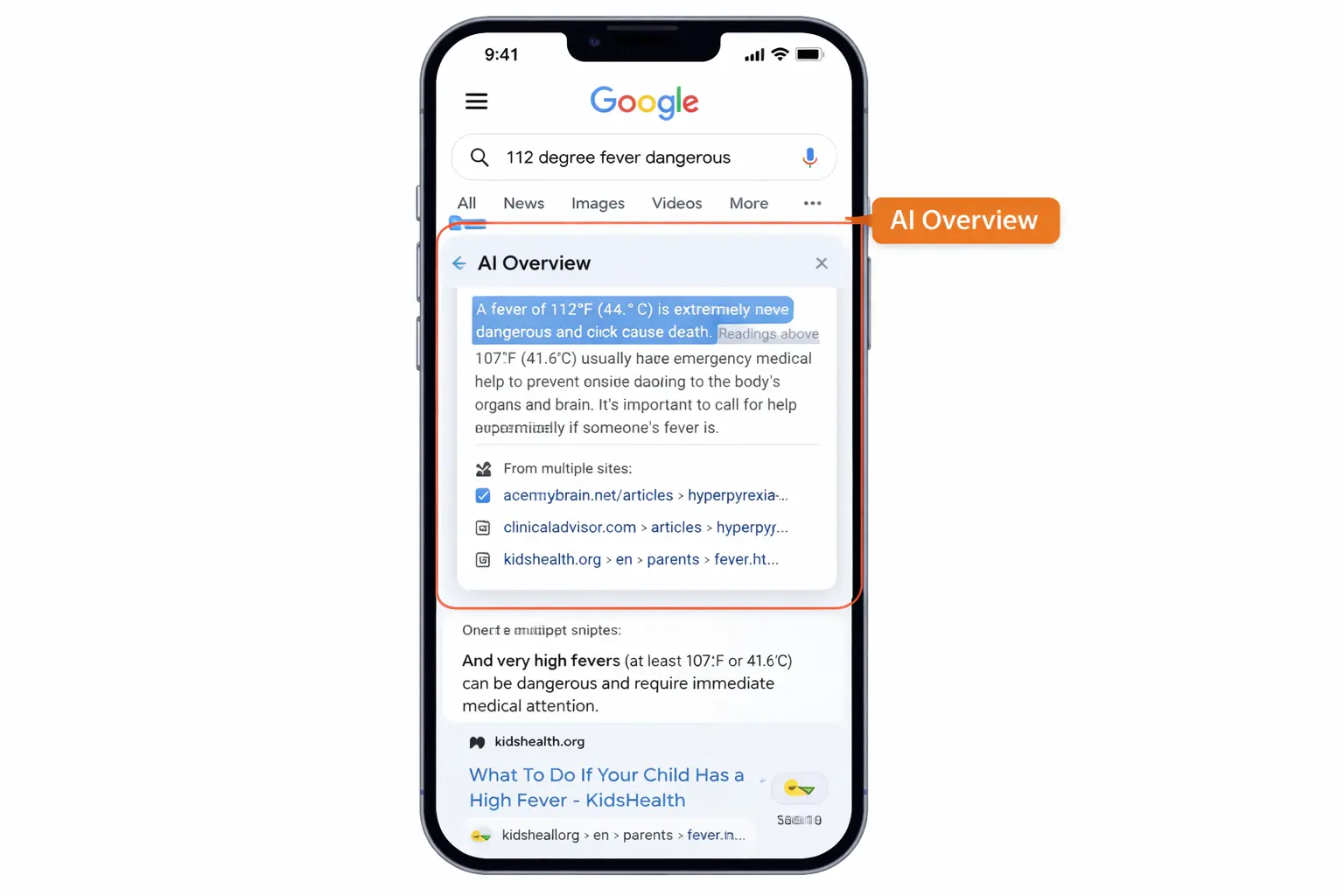
- AI Overviews (summarized, multi-source responses)
Why Users Don’t Click
The intent is satisfied instantly. From the user’s perspective, the problem is solved.
| SERP Feature | Why a Click Isn’t Needed |
|---|---|
| Featured Snippet | Immediate answer or steps |
| Knowledge Panel | Complete entity info |
| Maps / Local Pack | Phone, directions, reviews visible |
| AI Overview | Summarized multi-source answer |
Quote-ready insight:
“Zero click searches don’t mean zero visibility , they mean Google is fulfilling intent faster than ever.”
Is It True That 60% of Google Searches End Without a Click?
Yes , multiple independent studies consistently show that a majority of searches no longer result in a website visit. While the exact percentage varies by region, device, and methodology, the trend is undeniable.
Recent analyses estimate:
- ~58–60% of U.S. searches end without a click
- ~59–60% of EU searches behave the same way
Some datasets show even higher zero click rates on mobile and informational queries.
Why the Exact Number Matters Less Than the Trend
Debating whether the figure is 58% or 62% misses the bigger picture.
Quote-ready insight:
“The precise percentage matters less than the reality: most searches now end on Google itself.”
The real takeaway is structural: Google is retaining user attention inside its own interface, and AI is accelerating that shift.
Why Zero Click Searches Are Increasing So Fast
Zero click searches didn’t appear overnight. They’re the result of several converging forces.
Google’s Shift From “Search Engine” to “Answer Engine”
Google’s original mission was to organize information and send users elsewhere. Its current mission is to resolve intent immediately.
AI Overviews represent the clearest expression of this shift. Instead of ranking ten blue links, Google now:
- Extracts answers from multiple sources
- Synthesizes them into a single response
- Keeps users on the SERP longer
User Behavior Has Changed
Users now expect:
- Faster answers
- Fewer steps
- Mobile-friendly clarity
Scrolling through multiple sites feels inefficient when AI can summarize instantly.
AI Makes Extraction Cheaper Than Clicks
From Google’s perspective, clicks are optional. AI doesn’t need traffic , it needs trusted sources.
Quote-ready insight:
“AI doesn’t need traffic , it needs sources.”
Are AI Overviews Replacing Traditional SEO?
No , but they are redefining it.
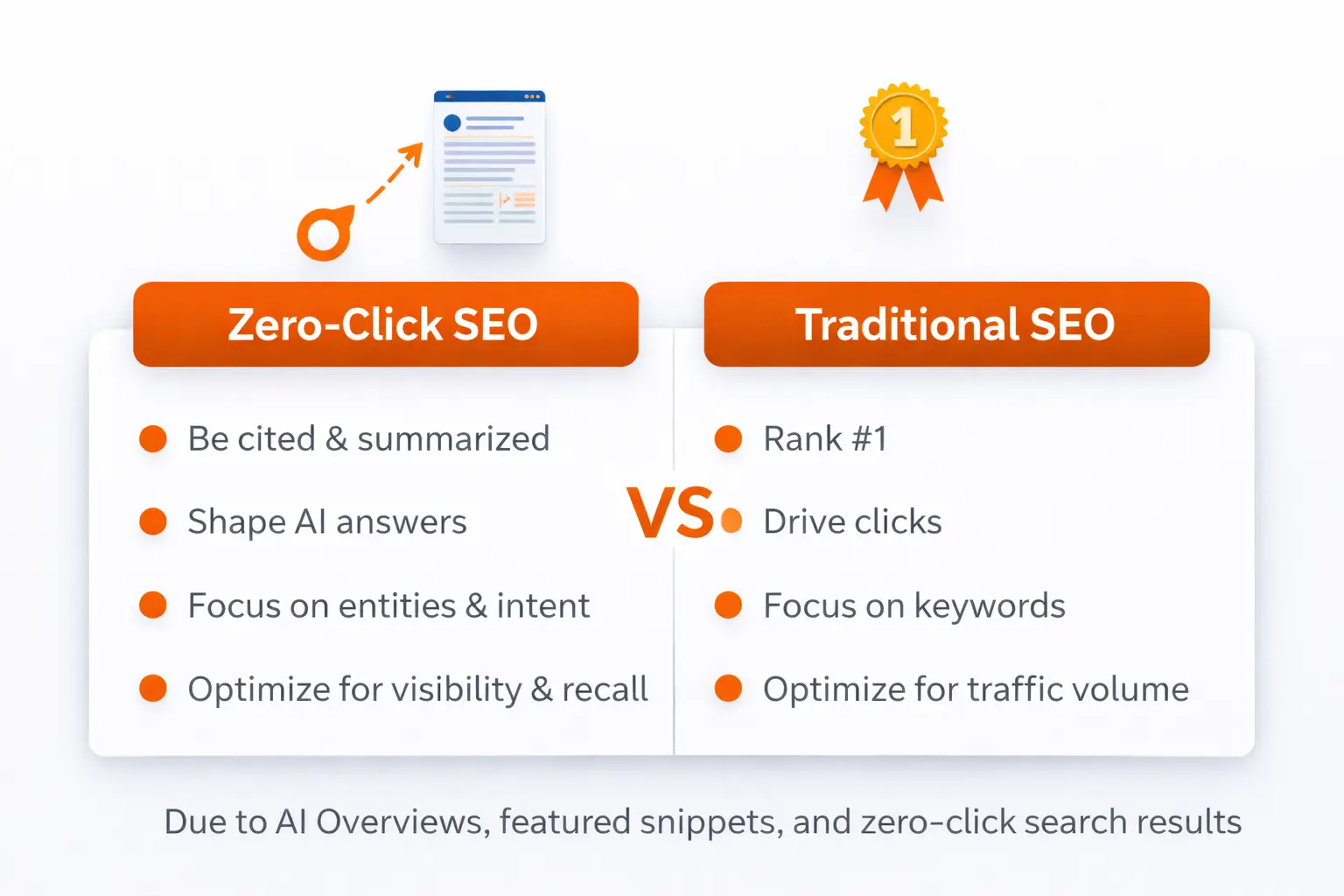
Traditional SEO focused on rankings and click-through rates. AI-driven search prioritizes clarity, authority, and extractability.
What SEO Used to Optimize For
- Ranking position
- Organic CTR
- Page visits
- Bounce rate
What SEO Optimizes For Now
- Inclusion in AI summaries
- Brand mentions and citations
- Answer clarity
- Entity trust
| Traditional SEO | AI-Driven SEO |
|---|---|
| Rank #1 | Be cited / included in summaries |
| Drive clicks | Shape answers |
| Keywords | Entities & intent |
| Traffic volume | Visibility & recall |
Quote-ready insight:
“SEO isn’t dead , click-only SEO is.”
What Zero Click Search Means for Website Traffic
Traffic loss feels real because it is real. Many sites are seeing fewer visits even while impressions remain stable or grow.
Why the Decline Feels Sudden
- SERPs are more crowded
- AI Overviews push organic links further down
- Fewer opportunities to earn the click
Why Traffic ≠ Visibility Anymore
Being visible doesn’t guarantee being visited.
Quote-ready insight:
“Being seen no longer guarantees being visited.”
Brands now win mindshare before they win traffic.
What Zero Click Search Means for Google Ads
Zero click search affects paid media too , just differently.
How AI Overviews Change Ad Dynamics
- Ads compete with AI summaries for attention
- Fewer clicks are available per query
- High-intent searches become more expensive
Why CPCs Tend to Rise
When supply (clicks) shrinks and demand stays constant, costs increase.
When Google Ads Still Perform Exceptionally Well
- High-intent transactional queries
- Local services
- Urgent needs (repairs, bookings, calls)
| Query Type | Organic Impact | Paid Opportunity |
|---|---|---|
| Informational | High zero-click | Low |
| Commercial research | Medium | Medium |
| Local service | Lower | High |
| Emergency / urgent | Low | Very high |
Is SEO Dead in the Age of AI?
No , SEO is more important than ever, but for different reasons.
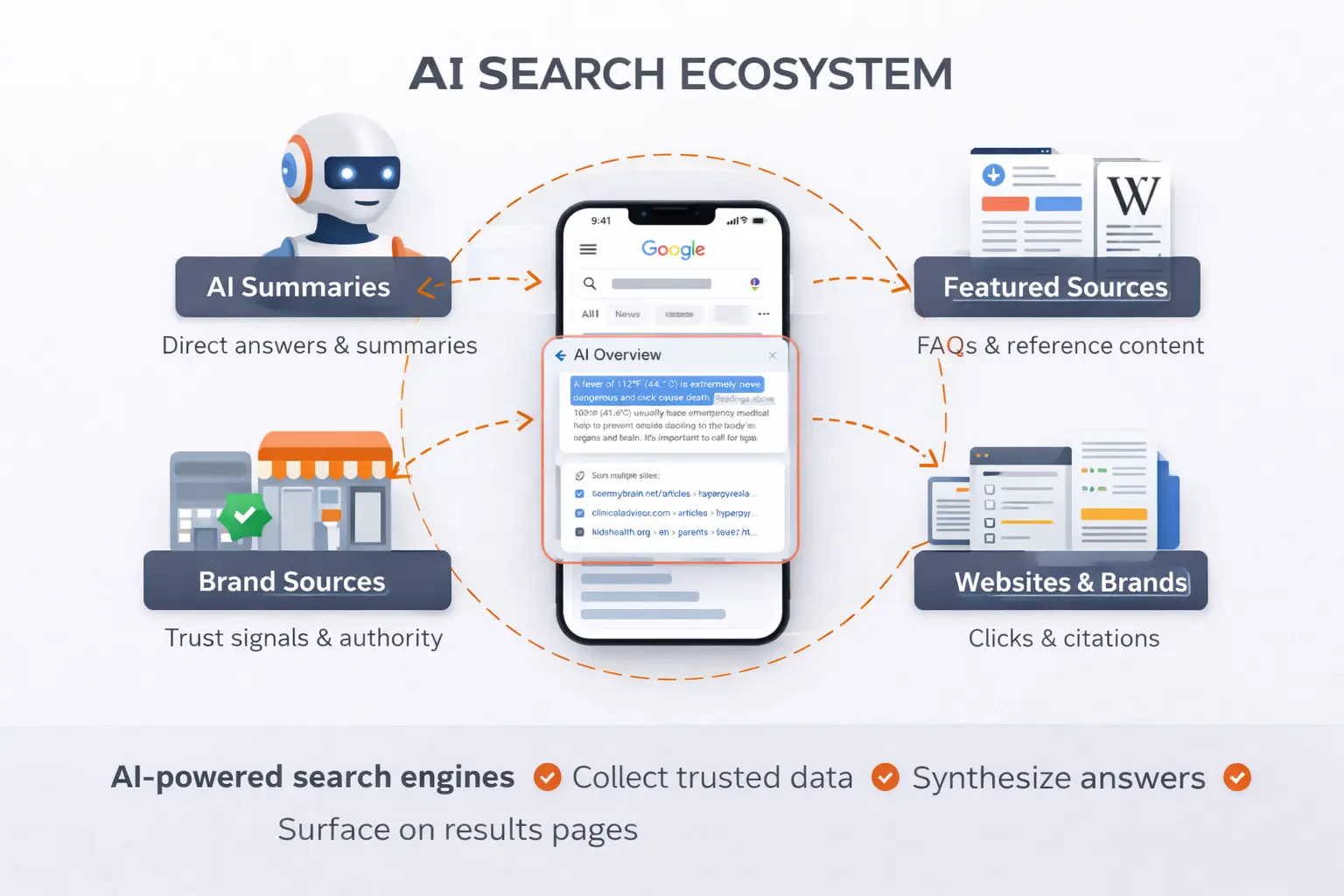
AI systems still rely on:
- Websites for training data
- Trusted sources for citations
- Consistent brands for confidence
Authority Matters More Than Rankings
AI doesn’t cite everyone. It cites sources that demonstrate:
- Experience
- Expertise
- Authoritativeness
- Trustworthiness
Quote-ready insight:
“AI cites what it trusts and it trusts what it understands.”
How AI Search Engines Decide Which Sources to Cite
This is where most brands fall short.
Content Clarity & Structure
AI favors content that:
- Answers questions directly
- Uses clear headings
- Avoids fluff
Authority & Consistency
Repeated brand mentions across platforms strengthen confidence.
Transparency Builds Trust
Cited sources usually:
- Reference data
- Explain nuance
- Avoid exaggerated claims
How Businesses Can Win Visibility Without Clicks
Winning in zero click search is about becoming the answer, not chasing the visit.
Optimize for Being the Answer
- Write definitions clearly
- Use quotable sentences
- Lead with conclusions
Build Brand Recall
If users don’t click, they should still remember who helped them.
Align SEO, Ads, and Content
Fragmented strategies fail in AI search. Systems win.
AI Visibility Optimization Checklist:
- Clear answer-first sections
- Consistent brand naming
- Structured content
- Schema markup
- Multi-channel presence
The Future of Search: What Happens Next?
Search won’t disappear , but it won’t revert.
Clicks Will Stabilize, Not Recover
The old baseline is gone.
Brands Become the Destination
People search about brands more than they search through links.
Trust Replaces Rankings
Trust is now the primary ranking signal.
What This Means for Businesses Right Now
What to stop doing:
- Obsessing over rankings alone
- Measuring success only by traffic
What to double down on:
- Authority-building content
- Brand consistency
- Answer-focused SEO
Where to invest next:
- GEO (Generative Engine Optimization)
- Brand-led search strategies
- Integrated SEO + Ads planning
Frequently Asked Questions (FAQ)
What is a zero click search?
A search where the user gets their answer directly on Google without clicking a website.
Why is Google doing this?
To improve user experience and resolve intent faster using AI.
Can websites still get traffic?
Yes , especially for high-intent and transactional queries.
Do zero click searches hurt small businesses?
They can , unless businesses adapt their visibility strategy.
How should SEO change in 2026?
From ranking-focused to authority- and citation-focused.
Conclusion: The End of the Click or the Start of Something Else?
The click isn’t gone. It’s no longer guaranteed.
Search has evolved from a gateway into a decision-making layer, powered by AI and trust. The brands that thrive won’t be the ones chasing traffic , they’ll be the ones shaping answers.
Final quote-ready insight:
“The future of search belongs to brands that are trusted enough to be quoted, not just clicked.”
If your visibility strategy still depends on clicks alone, it’s time to rethink how your brand shows up in AI-driven search.
For Central Florida businesses, our Google Maps optimization in Orlando can help. We also provide custom website development and e-commerce solutions.
Related Reading:
- What Is AI Search results for local businesses (and Why It Matters)
- What Is Voice Search & Why It Matters for Apopka Businesses
- Why Shopify Stores Are Turning to AI in Altamonte Springs
Ready to Get Started?
Learn More: Google Business Profile | Nap Consistency


