


DeBary business automation helps local companies eliminate repetitive manual tasks, streamline operations, and build scalable systems that support long-term growth.
In 2026, automation is no longer just for large enterprises. DeBary-based service providers, local businesses, and growing companies are using business automation to save time, reduce errors, and operate more efficiently without increasing headcount. This guide explains what business automation is, how it works, and how DeBary businesses can use it to build smarter, more resilient operations.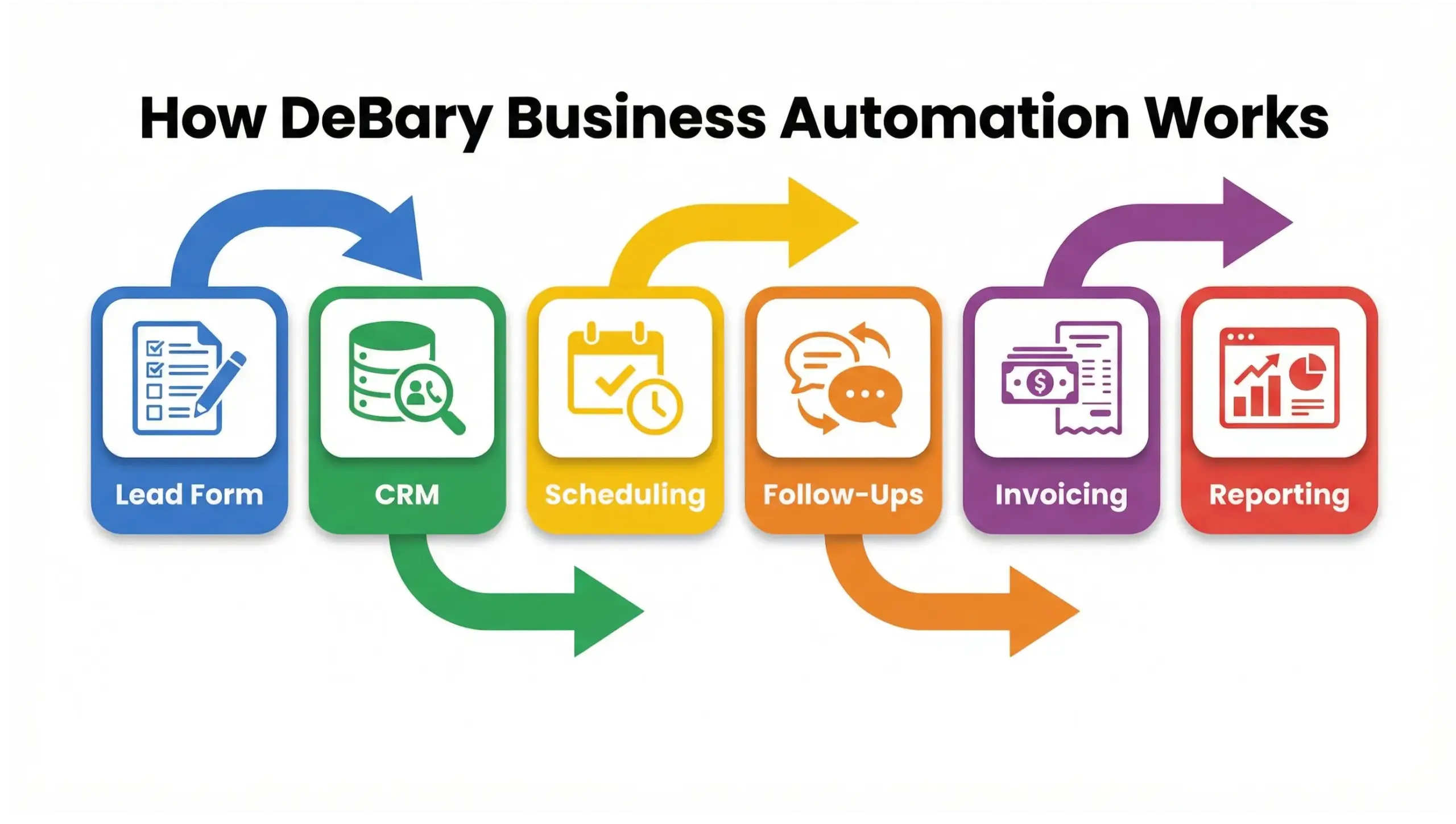
What Is Business Automation and Why Does It Matter for DeBary Businesses?
Business automation is the use of software, integrations, and workflows to handle repetitive tasks without manual effort.
For DeBary businesses, automation matters because it reduces operational bottlenecks, improves consistency, and frees owners and teams to focus on revenue-generating work instead of administrative tasks.
Automation connects tools like CRMs, scheduling platforms, email systems, accounting software, and internal databases into a single operational system. When designed correctly, these systems run in the background, ensuring nothing falls through the cracks.
Quote-ready insight:
“Business automation turns day-to-day operations into predictable systems, not daily fires.”
Why DeBary Businesses Are Adopting Automation Faster in 2026
DeBary businesses are adopting automation faster because local competition, rising labor costs, and customer expectations demand operational efficiency.
Customers expect faster responses, accurate follow-ups, and seamless experiences. Automation allows local companies to compete with larger organizations while staying lean.
Key local drivers include:
- Limited staff capacity
- Increasing demand for faster service
- The need for predictable workflows
- Growth without hiring pressure
Automation is no longer a “nice to have.” It is infrastructure.
What Types of Businesses in DeBary Benefit Most from Automation?
Any business with repeatable processes benefits from automation, but service-based and growth-focused companies see the fastest ROI.
Common DeBary businesses using automation:
- Home service providers (HVAC, cleaning, landscaping)
- Medical and wellness practices
- Professional services (consultants, agencies, legal support)
- Local retail and e-commerce hybrids
- Multi-location or expansion-ready businesses
If a task happens more than twice, it can usually be automated.
Which Business Processes Should Be Automated First?
The best automation opportunities are high-frequency, low-complexity tasks that consume time without adding strategic value.
High-impact processes to automate:
- Lead intake and form submissions
- Appointment scheduling and reminders
- CRM updates and follow-ups
- Invoicing and payment tracking
- Internal task assignments
- Customer onboarding sequences
- Review and feedback requests
Quote-ready insight:
“The fastest automation wins come from fixing what slows you down every single day.”
How DeBary Business Automation Improves Daily Operations
Automation improves daily operations by reducing human error, speeding up response times, and creating consistency across teams.
Instead of relying on memory, sticky notes, or manual data entry, automated workflows ensure every step happens automatically.
Examples include:
- New leads instantly added to a CRM
- Automatic follow-up emails after inquiries
- Scheduled reminders sent before appointments
- Tasks created for staff without manual assignment
This creates reliability, not chaos.
What Tools Are Commonly Used for Business Automation?
Business automation uses a combination of no-code tools, integrations, and custom workflows tailored to each business.
Common automation tools:
The tools matter less than the system design behind them.
What Is the Difference Between Business Automation and AI Automation?
Business automation focuses on rule-based workflows, while AI automation adds decision-making and intelligence.
Most DeBary businesses start with standard automation and layer AI later.
Comparison:
| Automation Type | What It Does |
|---|---|
| Business automation | Executes predefined rules |
| AI automation | Analyzes, predicts, and adapts |
| Workflow automation | Moves tasks between systems |
| CRM automation | Manages customer lifecycle |
Automation builds the foundation. AI enhances it.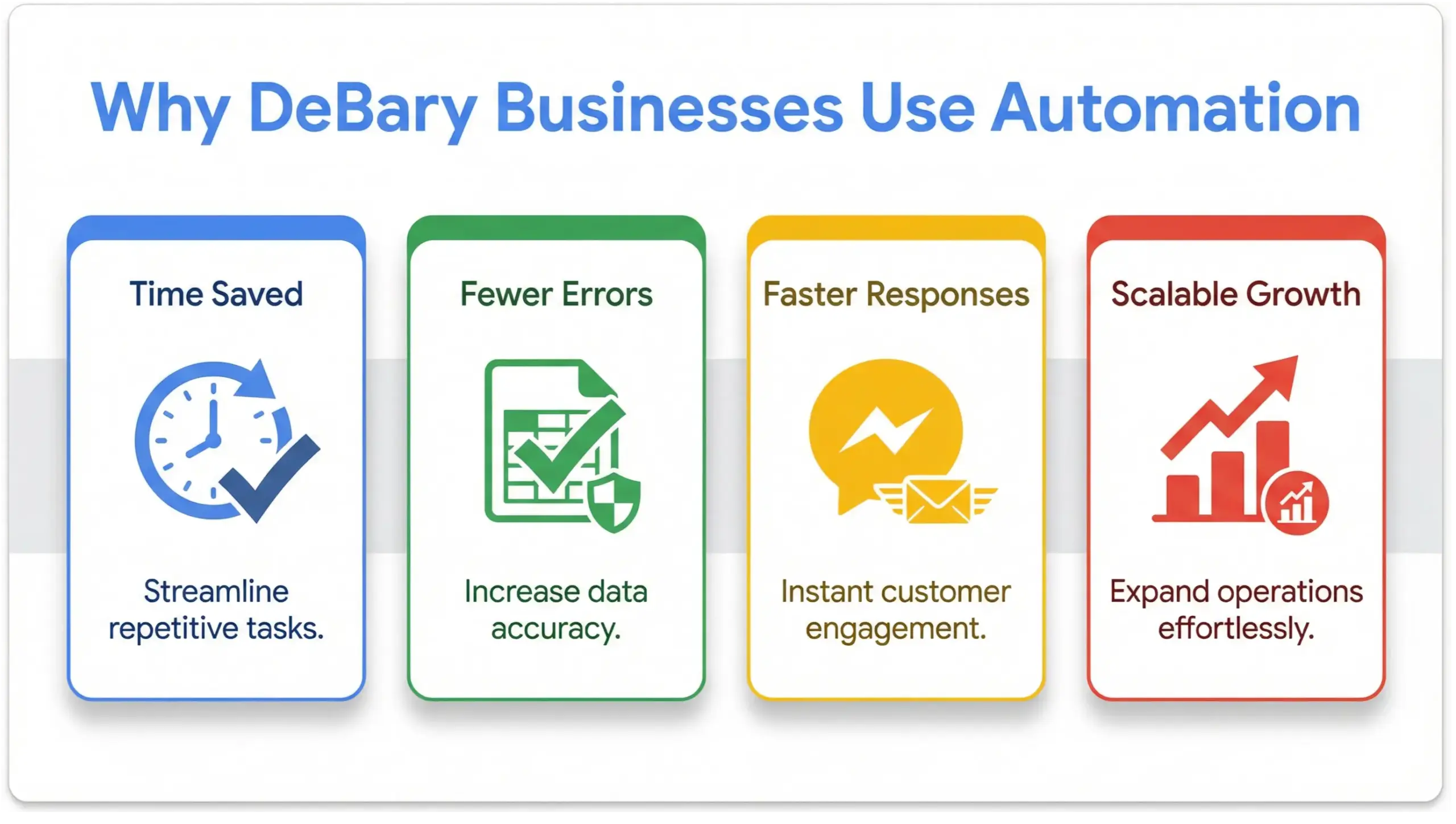
How Automation Supports Business Growth in DeBary
Automation enables growth by removing operational ceilings that limit scalability.
Without automation, growth creates stress. With automation, growth creates leverage.
Automation supports growth by:
- Handling higher lead volume
- Maintaining response speed
- Preserving customer experience
- Reducing dependency on individual staff members
- Supporting multi-location expansion
Quote-ready insight:
“Automation allows businesses to grow without breaking what already works.”
What Happens Without Business Automation?
Without automation, businesses rely on memory, manual effort, and inconsistent processes.
This leads to:
- Missed leads
- Delayed follow-ups
- Burnout
- Inconsistent customer experiences
- Poor reporting and visibility
Manual operations do not scale. Systems do.
How Business Automation Improves Customer Experience
Automation improves customer experience by ensuring fast, consistent, and professional interactions.
Customers notice when systems work smoothly, even if they never see the automation behind them.
Benefits include:
- Faster response times
- Clear communication
- Accurate scheduling
- Predictable follow-ups
- Fewer errors
Great customer experience is built on invisible systems.
How Long Does It Take to Implement Business Automation?
Most DeBary business automation systems can be implemented in phases over 30-90 days.
Implementation depends on complexity, number of tools, and existing systems.
Typical phases:
- Process mapping
- Tool audit and selection
- Workflow design
- Automation setup
- Testing and optimization
Automation is not a one-time task. It is an evolving system.
What Does Business Automation Cost in DeBary?
Business automation costs vary based on complexity, but most small businesses invest less than the cost of one part-time employee.
Automation replaces repetitive labor, not people.
Cost factors include:
- Number of workflows
- Tools required
- Integration complexity
- Custom logic needs
- Ongoing optimization
Quote-ready insight:
“Automation is an investment that pays for itself in time saved and mistakes avoided.”
Why Local Expertise Matters for DeBary Business Automation
Local expertise ensures automation systems align with how DeBary businesses actually operate.
Generic automation fails when it ignores real-world workflows.
Local-first automation considers:
- Local customer behavior
- Service area logistics
- Staffing realities
- Industry-specific needs
Systems should reflect reality, not templates.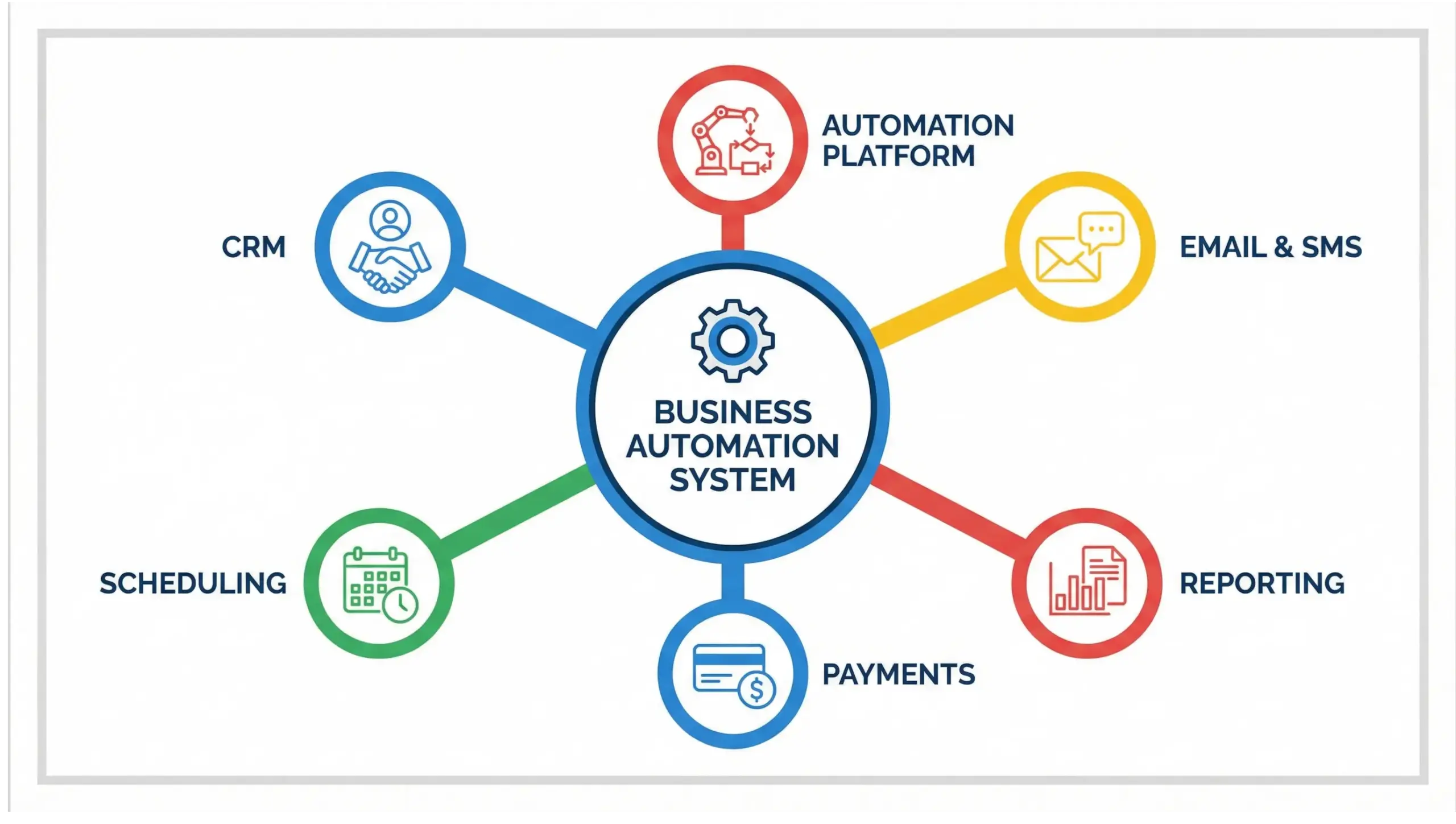
How Automation Integrates with Existing Systems
Automation works best when it enhances existing tools rather than replacing everything.
Most businesses already use CRMs, email platforms, or scheduling tools. Automation connects them into one system.
Integration creates:
- Unified data
- Fewer silos
- Better reporting
- Cleaner operations
When Is the Right Time to Invest in Business Automation?
The right time to automate is when growth starts to feel chaotic instead of exciting.
If operations are slowing revenue instead of supporting it, automation is overdue.
Common signals include:
- Too many manual steps
- Missed follow-ups
- Overworked staff
- Inconsistent processes
- Lack of visibility
What a Fully Automated DeBary Business Looks Like
A fully automated business runs predictably, even when the owner steps away.
Systems handle intake, communication, tracking, and reporting.
Key traits:
- Clear workflows
- Centralized data
- Automated follow-ups
- Scalable operations
- Reduced stress
Automation is not about replacing people. It is about protecting performance.
Frequently Asked Questions About DeBary Business Automation
1. What is DeBary business automation?
DeBary business automation is the use of software and workflows to eliminate manual tasks and streamline operations for local businesses.
2. Is business automation only for large companies?
No. Small and mid-sized DeBary businesses benefit the most because automation reduces overhead and increases efficiency.
3. What processes should I automate first?
Start with lead intake, scheduling, follow-ups, invoicing, and CRM updates.
4. How long does automation take to implement?
Most systems are implemented within 30-90 days, depending on complexity.
5. Do I need AI for business automation?
No. Traditional automation works first. AI can be layered later for optimization.
6. Will automation replace my staff?
No. Automation replaces repetitive tasks, not people, allowing staff to focus on higher-value work.
7. What tools are used for automation?
Common tools include CRMs, Zapier, Make, scheduling software, and communication platforms.
8. Is automation expensive?
Automation often costs less than hiring additional staff and delivers ongoing ROI.
9. Can automation work with my existing software?
Yes. Most automation systems integrate with tools you already use.
10. How do I know if my business is ready for automation?
If manual work is slowing growth, automation is the next logical step.
Final Thoughts: Building Smarter Businesses in DeBary
DeBary business automation is no longer optional in 2026-it is the foundation of scalable, resilient operations.
Businesses that invest in automation gain clarity, consistency, and control. Those that don’t risk falling behind competitors who operate smarter, not harder.
Final quote-ready takeaway:
“Automation is not about doing more work-it is about building systems that work for you.”
For Central Florida businesses, our Google Maps optimization in Orlando can help. We also provide custom website development and e-commerce solutions.
Related Reading:
- What Is AI Search results for local businesses (and Why It Matters)
- What Is Voice Search & Why It Matters for Apopka Businesses
- Why Shopify Stores Are Turning to AI in Altamonte Springs
Ready to Get Started?
Learn More: Google Business Profile | Nap Consistency


