


What Is the Real Manual Processes Cost for Growing Businesses?
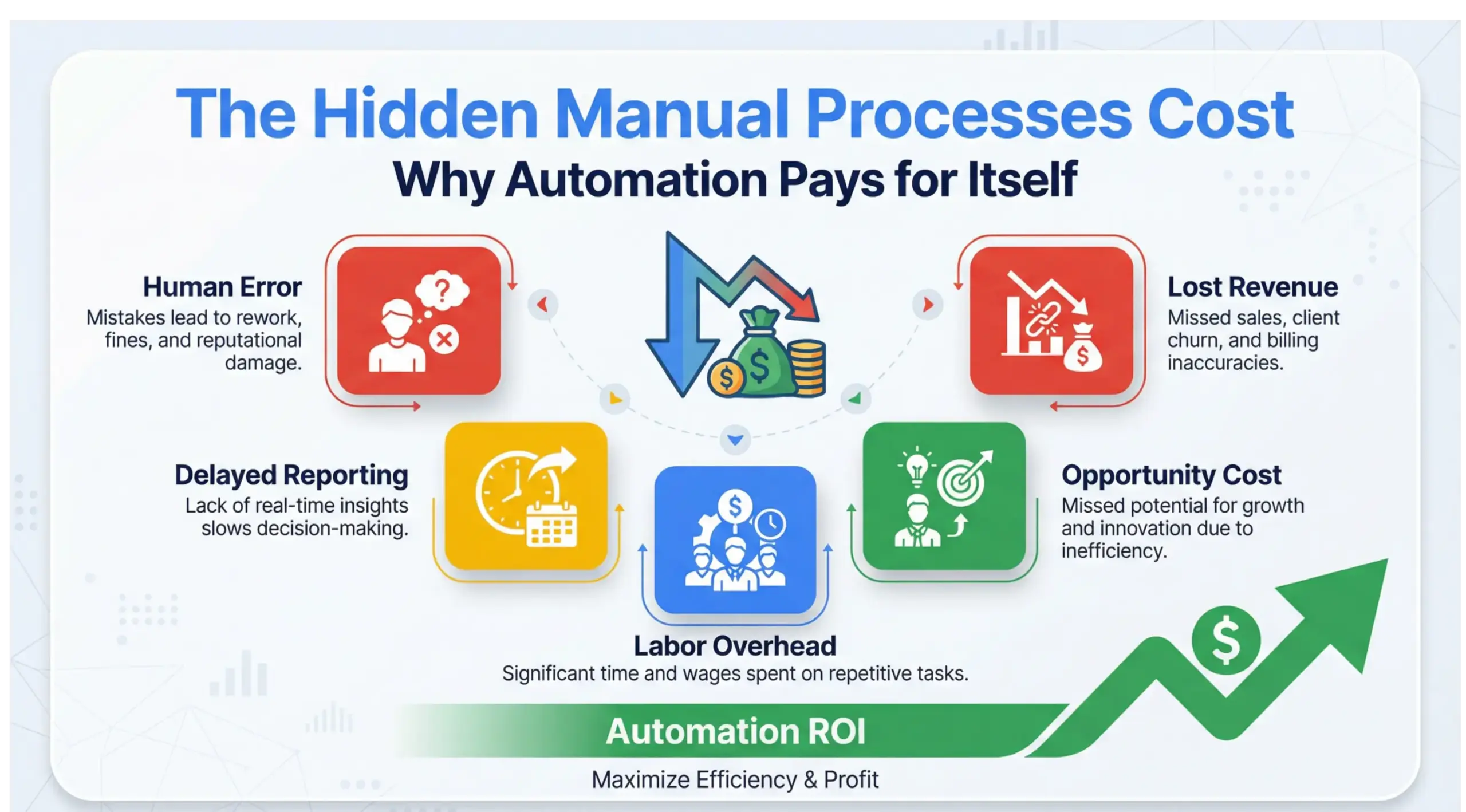
The real manual processes cost is far greater than payroll hours, it includes hidden inefficiencies, human error, delayed decisions, lost revenue opportunities, employee burnout, and scalability limitations. While manual workflows may seem inexpensive upfront, they silently drain profit margins and operational capacity over time.
Many businesses underestimate how much repetitive tasks, manual data entry, spreadsheet tracking, and disconnected systems truly cost them. The expense isn’t always visible on a financial statement, but it appears in reduced productivity, slower response times, inconsistent reporting, and stalled growth.
“Manual processes don’t just cost time – they compound inefficiency across every department.”
In this guide, we break down the financial impact of manual workflows, quantify hidden expenses, and demonstrate why automation consistently delivers measurable ROI.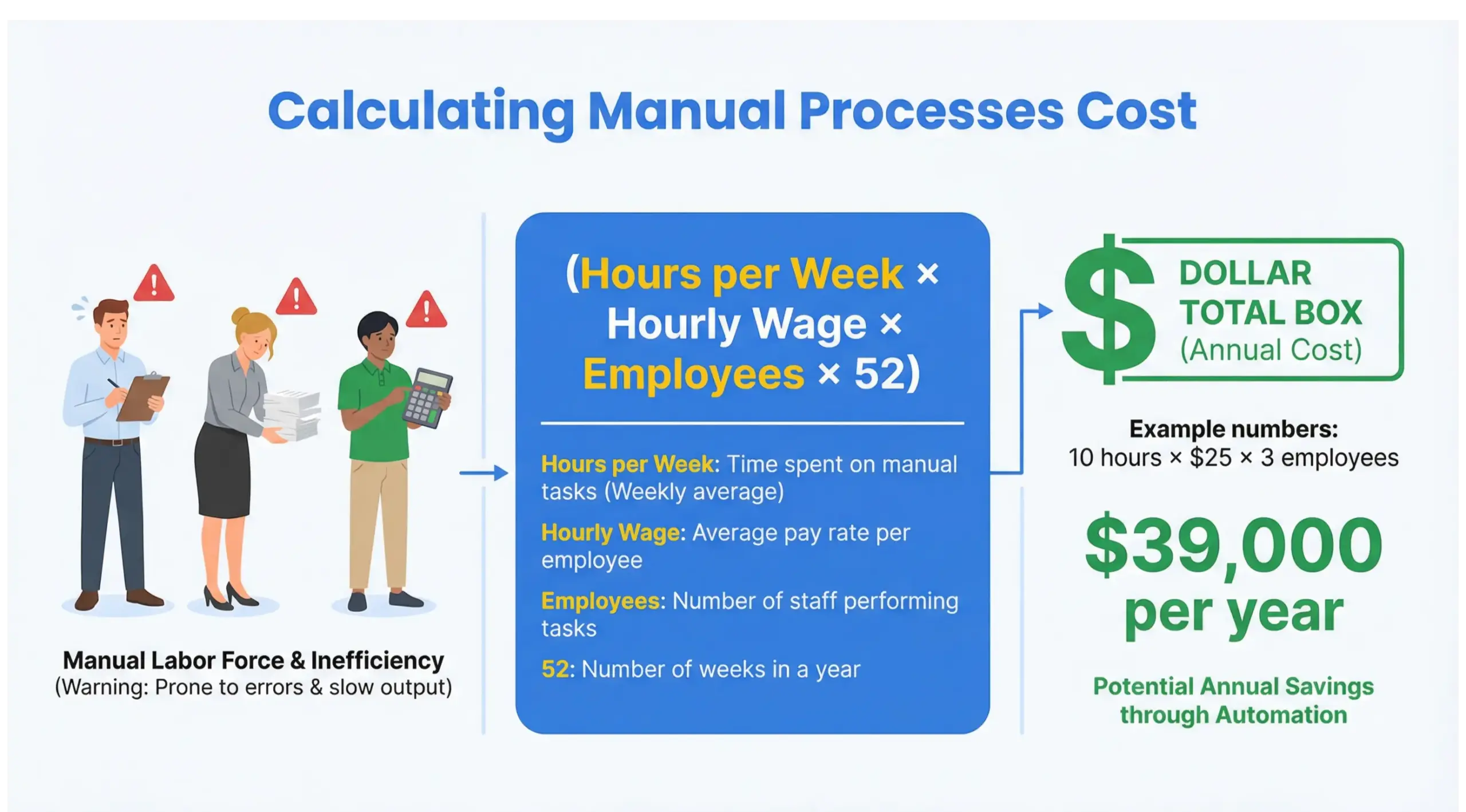
Why Do Manual Processes Cost More Than Businesses Realize?
Manual processes cost more than businesses realize because inefficiency compounds over time. A single repetitive task may seem insignificant, but multiplied across employees, departments, and months, it becomes a significant financial burden.
Consider these common manual workflows:
- Copying sales data from one system to another
- Manually reconciling invoices
- Updating inventory in spreadsheets
- Responding individually to repetitive email inquiries
- Generating reports manually
- Tracking customer information across disconnected systems
Each action consumes time. Time converts into payroll cost. Payroll cost impacts profit.
But the real expense extends beyond labor.
The Direct Financial Costs of Manual Processes
The most obvious manual processes cost is labor. Every hour spent on repetitive tasks is an hour not spent on strategic growth.
Example Calculation:
- 3 employees
- Each spends 10 hours per week on manual data entry
- Average hourly wage: $25
Weekly Cost:
3 × 10 × $25 = $750
Annual Cost:
$750 × 52 weeks = $39,000
That is $39,000 annually spent on repetitive work, before factoring errors or opportunity cost.
Multiply that across departments, and inefficiency quickly becomes a six-figure expense.
The Hidden Costs of Manual Processes
The visible payroll cost is only the beginning. The hidden manual processes cost includes:
1. Human Error
Manual data entry increases:
- Accounting mistakes
- Incorrect billing
- Inventory miscounts
- Duplicate customer records
- Compliance risks
Studies consistently show that human error rates in manual data entry range between 1–4%. Even a 1% error rate in high-volume transactions can result in substantial financial leakage.
2. Delayed Decision-Making
When reporting requires manual compilation:
- Leadership decisions are delayed
- Financial visibility becomes reactive
- Growth planning slows
Delayed decisions cost competitive advantage.
3. Employee Burnout
Repetitive tasks reduce morale. High burnout increases turnover. Recruitment and onboarding costs compound the manual processes cost.
4. Opportunity Cost
When staff focus on manual workflows, they are not focused on:
- Customer experience
- Sales growth
- Process improvement
- Innovation
Opportunity cost is often the most expensive component of manual inefficiency.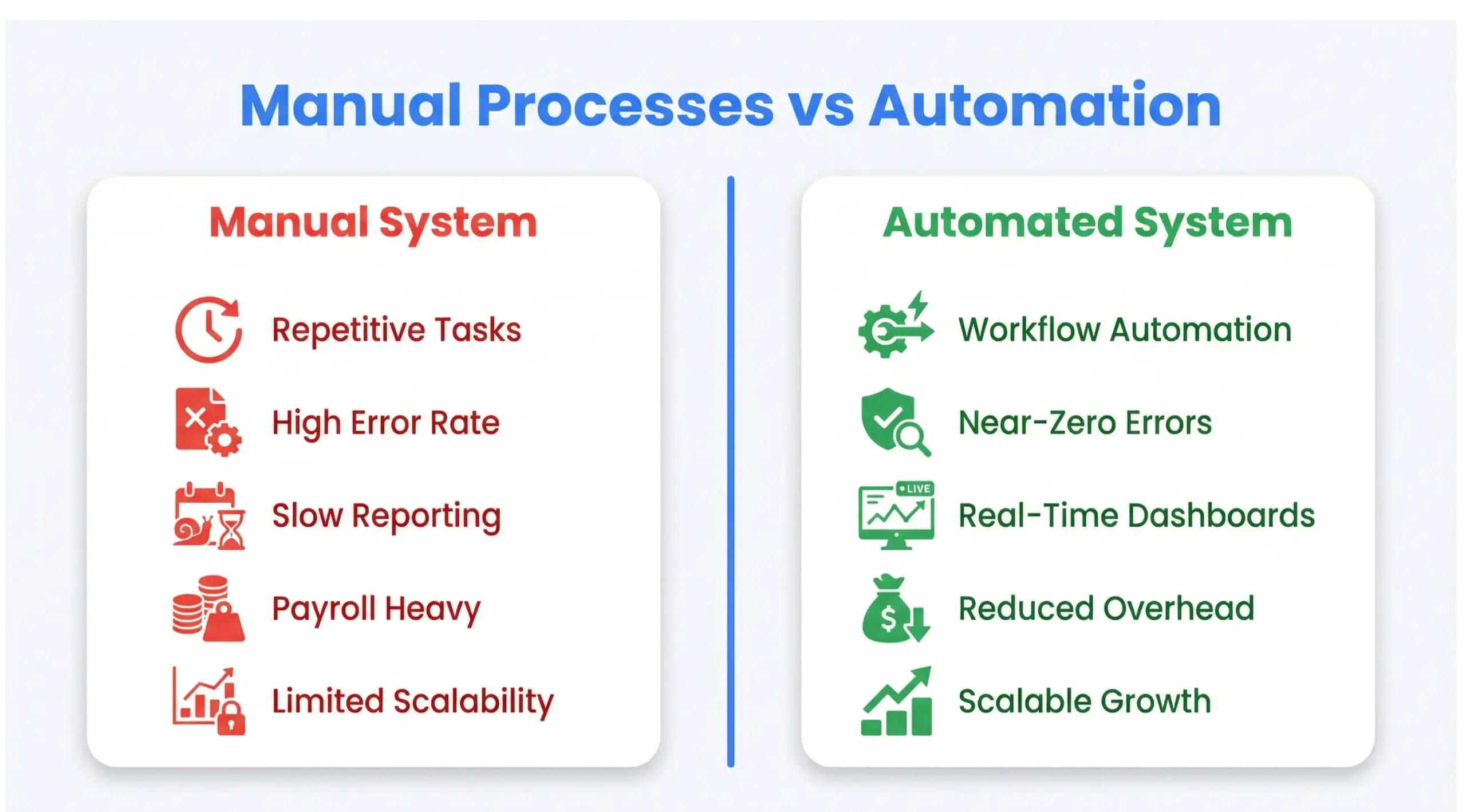
How Manual Workflows Reduce Profit Margins
Manual workflows directly compress margins by increasing operating expenses without increasing revenue.
Here’s how:
| Manual Process Issue | Financial Impact |
|---|---|
| Repetitive data entry | Increased payroll cost |
| Inventory errors | Overstock or lost sales |
| Invoice delays | Slower cash flow |
| Reporting gaps | Poor budgeting decisions |
| Customer response delays | Lost conversions |
| Disconnected systems | Redundant software expenses |
Margins shrink when inefficiency grows.
Automation reverses this trend.
Why Automation Pays for Itself
Automation pays for itself because it eliminates repetitive tasks, reduces error rates, accelerates reporting, and increases operational consistency.
When businesses implement automation systems:
- Payroll hours shift toward strategy
- Financial accuracy improves
- Customer experiences improve
- Reporting becomes real-time
- Scalability becomes predictable
“Automation transforms operational cost centers into strategic growth engines.”
Calculating the ROI of Automation
To understand whether automation pays for itself, businesses must calculate both direct and indirect savings.
Step 1: Calculate Current Manual Process Cost
Use this formula:
Manual Cost = (Hours per week × Hourly wage × Employees × 52)
Step 2: Estimate Error Reduction Savings
If automation reduces error rates from 3% to near zero, calculate annual financial leakage avoided.
Step 3: Factor Opportunity Cost
Estimate revenue gained by reallocating labor to growth activities.
Step 4: Compare Against Automation Investment
If automation costs $15,000 but saves $50,000 annually, ROI is clear.
ROI = (Annual Savings – Investment Cost) ÷ Investment Cost × 100
Example:
($50,000 – $15,000) ÷ $15,000 × 100 = 233% ROI
Automation often generates triple-digit returns.
Common Examples of Costly Manual Systems
Businesses frequently underestimate manual processes cost in these areas:
- Accounting reconciliations
- Payroll processing
- Customer onboarding
- Marketing campaign management
- CRM updates
- Inventory tracking
- Service scheduling
- Compliance documentation
- Sales reporting
- Multi-platform data syncing
Disconnected systems create duplicated effort.
Integrated automation eliminates duplication.
When Should a Company Automate Processes?
Businesses should automate when:
- Manual tasks exceed 5 hours per week per employee
- Errors occur regularly
- Reporting requires spreadsheets
- Growth creates operational stress
- Customer response times lag
- Payroll overhead increases without revenue growth
Waiting too long increases cumulative manual processes cost.
Early automation compounds efficiency gains.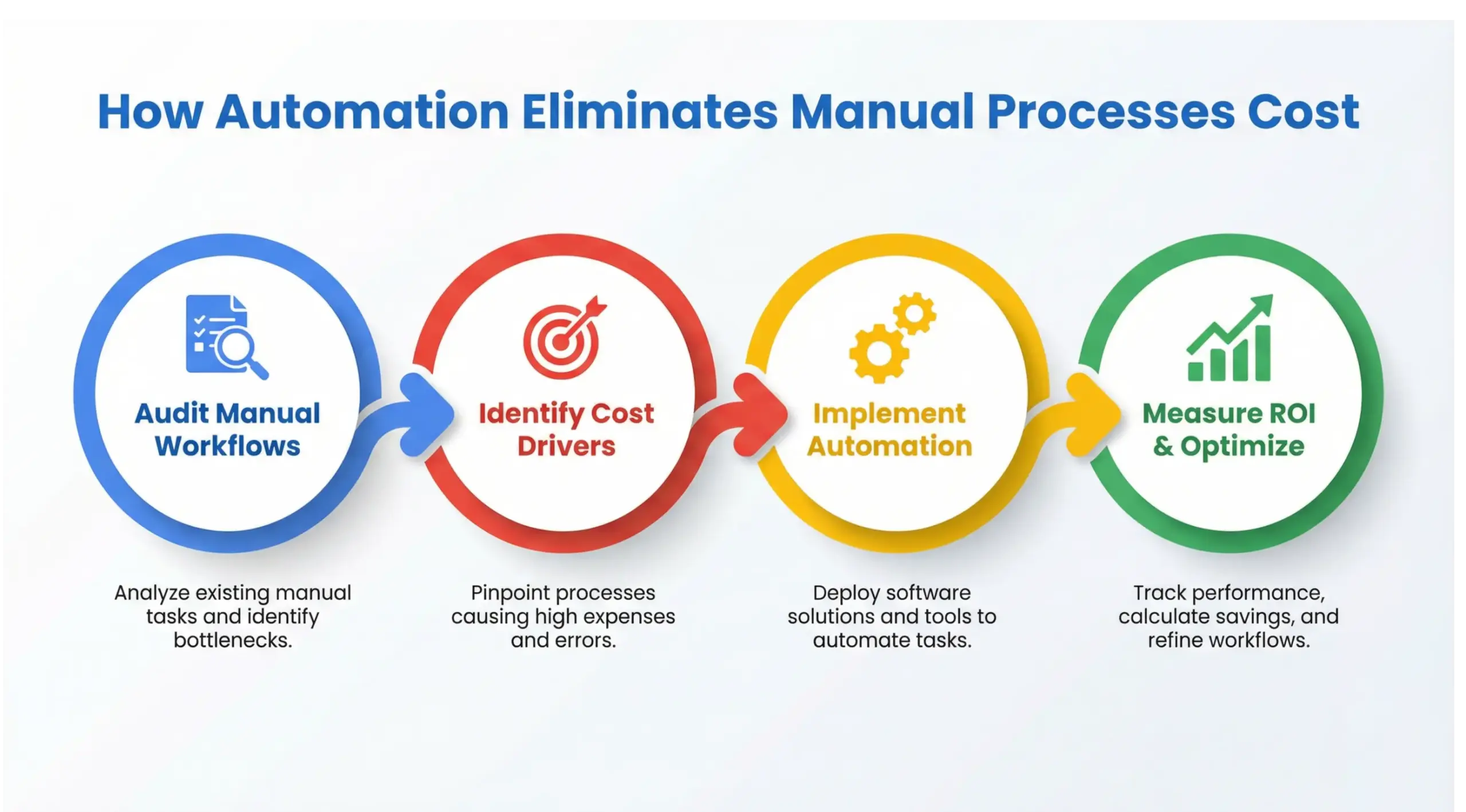
How Automation Improves Scalability
Manual systems collapse under growth pressure.
Automation systems expand capacity without expanding payroll proportionally.
Benefits include:
- Real-time dashboards
- Automated invoicing
- Inventory syncing
- CRM integration
- Email automation
- Workflow triggers
Automation enables companies to scale revenue without scaling inefficiency.
Strategic Advantages Beyond Cost Savings
The benefits of automation extend beyond direct savings:
- Improved compliance
- Data accuracy
- Stronger forecasting
- Faster onboarding
- Competitive agility
- Improved employee satisfaction
- Higher retention rates
- Brand professionalism
Manual inefficiency restricts growth.
Automation unlocks it.
The Long-Term Risk of Ignoring Manual Processes Cost
Ignoring manual processes cost leads to:
- Margin erosion
- Operational fragility
- Revenue leakage
- Poor customer experiences
- Employee stagnation
Small inefficiencies compound annually.
The longer businesses delay automation, the more expensive the transition becomes.
10 Frequently Asked Questions (FAQ)
1. What is the average manual processes cost for small businesses?
Manual processes cost small businesses tens of thousands annually due to payroll hours, human error, and operational inefficiency.
2. Why are manual workflows expensive?
They consume labor hours, increase error rates, slow reporting, and reduce scalability.
3. Does automation eliminate employees?
Automation reallocates employees to higher-value strategic tasks rather than repetitive work.
4. How do I calculate the cost of inefficiency?
Multiply time spent on manual tasks by hourly wage and annualize the result.
5. What is the ROI of business automation?
Automation often delivers 100–300% ROI within the first year through cost savings and efficiency gains.
6. What industries suffer most from manual processes?
Accounting, e-commerce, logistics, healthcare, and service businesses.
7. Are spreadsheets considered manual processes?
Yes. Heavy reliance on spreadsheets for recurring tasks increases error risk and inefficiency.
8. How long does automation implementation take?
Basic systems may take several weeks; complex integrations may take months depending on scope.
9. What is the biggest hidden cost of manual systems?
Opportunity cost , revenue lost from employees focusing on repetitive tasks instead of growth.
10. When is automation absolutely necessary?
When manual processes begin limiting growth, increasing errors, or creating operational stress.
Conclusion: Manual Processes Cost More Than You Think
The hidden manual processes cost is not just payroll, it is lost opportunity, compounded inefficiency, increased risk, and constrained growth.
Automation is not a luxury expense. It is a strategic investment.
Businesses that automate early gain competitive advantage, improve profitability, and build scalable systems designed for long-term growth.
Manual inefficiency compounds.
Automation compounds faster.
The choice determines which direction your business grows.


