


In 2026, the real cost difference between AI and human employees is not just salary versus software – it is payroll overhead versus scalable automation. A full-time U.S. employee earning $55,000 annually can cost a business $75,000- $95,000 after benefits and taxes, while many AI systems performing similar administrative or support functions cost between $3,000 and $25,000 per year. The decision, however, is strategic – not emotional.
This guide provides a full financial, operational, and ROI comparison for business owners deciding how to scale in a world where automation and human talent must coexist.
What Is the Real Cost Difference Between AI and Human Employees in 2026?
The true cost difference between AI and human employees becomes clear when you calculate total compensation versus total automation investment. Human employees come with layered overhead, while AI tools typically operate on subscription-based, scalable pricing models.
Average Annual Cost of a Human Employee
A $55,000 salary does not equal a $55,000 cost.
Here is what businesses actually pay:
| Cost Category | Estimated Annual Cost |
|---|---|
| Base Salary | $55,000 |
| Payroll Taxes (7.65–12%) | $4,500–$6,600 |
| Health Insurance | $6,000–$12,000 |
| Retirement Contributions | $2,000–$4,000 |
| Paid Time Off | $4,000–$6,000 |
| Equipment & Software | $2,000–$5,000 |
| Office Space | $3,000–$8,000 |
| Training & Onboarding | $1,500–$3,000 |
| Total Real Cost | $75,000–$95,000+ |
Additionally, turnover can cost 20-50% of annual salary.
A single mid-level employee can realistically cost close to six figures.
Average Annual Cost of an AI Employee (Automation Tools)
AI costs vary based on complexity and scale.
| AI Solution Type | Estimated Annual Cost |
|---|---|
| AI Customer Support Agent | $3,000–$12,000 |
| AI Content & Marketing Tools | $2,000–$8,000 |
| AI Bookkeeping Automation | $2,500–$10,000 |
| AI Scheduling & Admin | $1,500–$5,000 |
| Enterprise AI Systems | $15,000–$25,000+ |
AI does not require benefits, PTO, payroll taxes, or physical space.
The financial gap is often 60-85% lower for comparable task-based functions.
Is AI Cheaper Than Hiring Employees?
Yes – for repetitive, process-driven tasks, AI is significantly cheaper. However, cost alone should not determine your decision.
Short-Term Cost Comparison
In the first year, AI usually costs 70-90% less than a full-time hire for administrative and support functions.
Setup costs may include:
- Implementation
- Integration
- Staff training
- Workflow adjustments
Even with onboarding expenses, AI remains less expensive.
Long-Term ROI Comparison
Over five years, the difference becomes dramatic.
| Category | Human Employee (5 Years) | AI System (5 Years) |
|---|---|---|
| Total Direct Cost | $375,000–$475,000 | $15,000–$100,000 |
| Raises & Inflation | Yes | No |
| Scaling Cost | Linear | Minimal |
| Downtime | Yes | No |
| Sick Leave | Yes | No |
AI scales without payroll growth.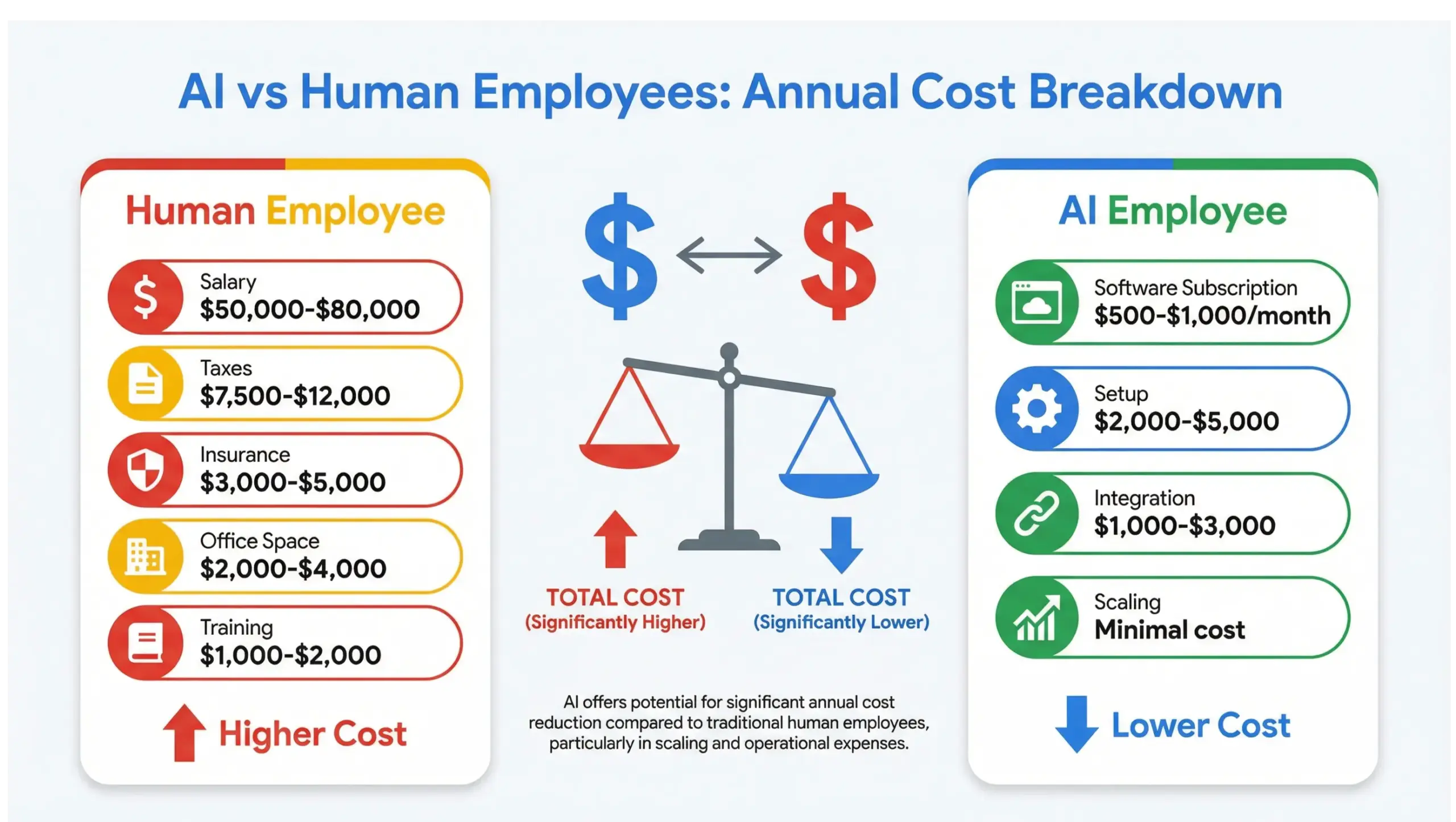
Hidden Costs Business Owners Miss
Human Costs:
- Burnout
- Performance variability
- HR management time
- Legal compliance risk
AI Costs:
- Subscription upgrades
- Tech dependency
- Occasional system errors
When analyzed fully, AI provides cost predictability, while human labor introduces variability.
What Jobs Can AI Replace in Small and Mid-Sized Businesses?
AI excels in structured, repetitive, and rule-based tasks.
Administrative Roles
- Appointment scheduling
- Email sorting
- CRM updates
- Document processing
Customer Support
- Chatbots
- FAQ automation
- Ticket triage
- Basic troubleshooting
Marketing Tasks
- Content drafts
- Social media scheduling
- Email sequences
- Data reporting
Data Entry & Operations
- Invoice processing
- Inventory tracking
- Reporting dashboards
Bookkeeping & Scheduling
- Expense categorization
- Payment reminders
- Calendar automation
AI thrives where process > personality.
What Jobs Still Require Human Employees?
AI cannot replace roles requiring emotional intelligence, strategic thinking, or relationship building.
Leadership & Strategy
Decision-making, risk analysis, vision-setting.
Sales & Relationship Roles
High-ticket closing and trust-based negotiation.
Creative Direction
Brand storytelling, emotional campaigns.
Skilled Trade & Physical Work
Construction, maintenance, logistics.
Emotional Intelligence Roles
Coaching, therapy, HR conflict resolution.
The strongest businesses use AI to enhance humans – not eliminate them.
How Does Productivity Compare Between AI and Human Workers?
AI is faster and more consistent in defined tasks. Humans are adaptive and creative.
| Metric | AI | Human |
|---|---|---|
| Speed | Instant | Limited by work hours |
| Accuracy | High (rule-based) | Variable |
| Consistency | 24/7 | Dependent on energy |
| Creativity | Low | High |
| Adaptability | Limited | Strong |
| Emotional Intelligence | None | High |
AI wins on efficiency. Humans win on connection.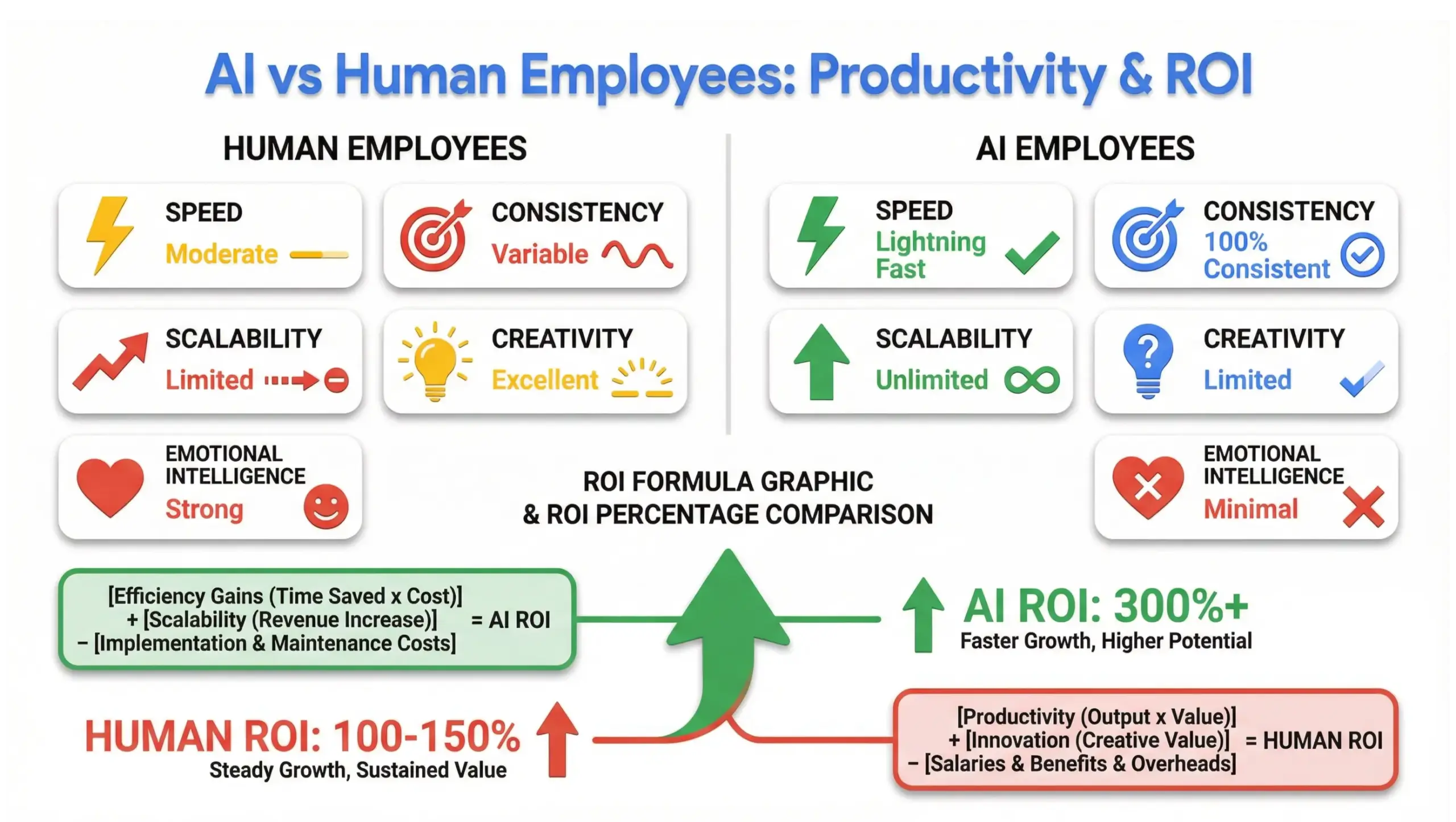
What Is the ROI of AI Employees?
Return on Investment (ROI) is calculated as:
ROI = (Cost Savings + Revenue Growth – Investment) ÷ Investment
Cost Savings
Replacing a $80,000 admin role with a $10,000 AI system saves $70,000 annually.
Revenue Increase
AI reduces response times, improving lead conversion.
Operational Efficiency
Tasks are completed instantly, reducing workflow bottlenecks.
Scaling Without Payroll Growth
AI allows growth without proportional labor costs.
Many businesses report ROI within 3-9 months of implementation.
Should Small Businesses Use AI Instead of Hiring Staff?
The answer depends on business maturity and task type.
When AI Is the Smarter Choice
- High repetitive workload
- Budget constraints
- Early-stage scaling
- Predictable process tasks
When Hiring Humans Is Better
- Complex sales
- Relationship management
- Strategy roles
- Brand development
Hybrid Model (Best Strategy for 2026)
Use AI for execution. Use humans for strategy.
This combination delivers maximum leverage.
What Are the Risks of Replacing Employees With AI?
AI is powerful but not perfect.
Brand Perception
Customers may prefer human interaction.
Over-Automation
Too much automation feels impersonal.
Technology Dependency
System outages disrupt operations.
Ethical & Legal Considerations
Data privacy compliance must be maintained.
Balance is essential.
How to Decide Between AI and Hiring (Strategic Framework)
Use this 5-step framework:
- Define the role clearly.
- Measure percentage of repetitive tasks.
- Calculate full human cost.
- Compare automation cost.
- Model hybrid option.
If over 60% of tasks are repetitive, AI likely provides strong ROI.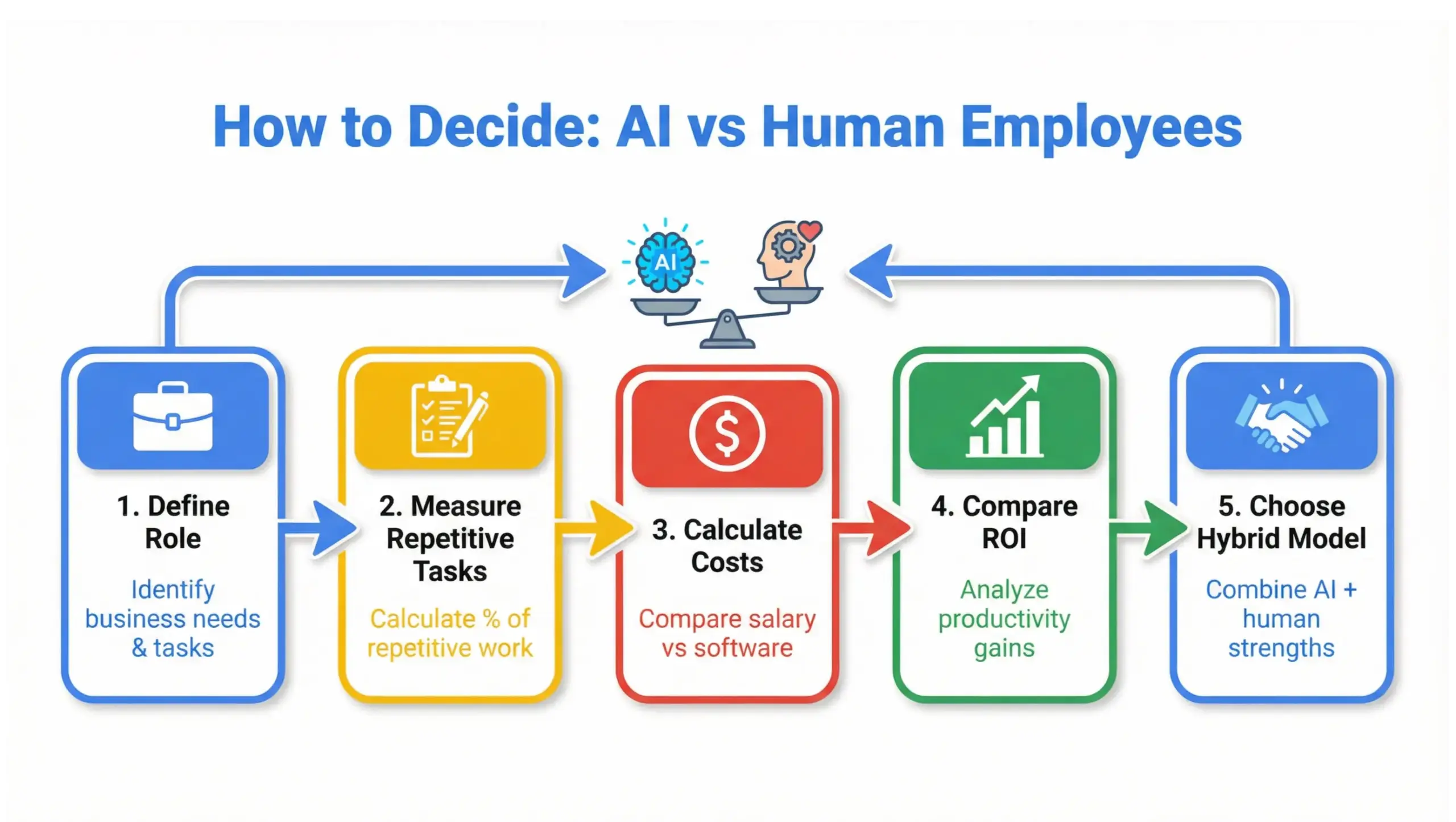
The Future of AI vs Human Employees (2026-2030 Outlook)
Workforce evolution will not eliminate humans – it will redefine roles.
Businesses that automate execution while empowering strategic talent will outperform competitors.
The future belongs to augmentation, not replacement.
Frequently Asked Questions (10)
1. How much does an AI employee cost per year?
Most AI systems cost between $3,000 and $25,000 annually depending on complexity and scale.
2. Is AI really cheaper than hiring employees?
Yes for repetitive tasks, often saving 60-85% compared to total employment cost.
3. Can AI fully replace human workers?
No. AI handles structured tasks but cannot replace strategic thinking or emotional intelligence.
4. What businesses benefit most from AI employees?
Service businesses, e-commerce, agencies, startups, and companies with high administrative workload.
5. Does AI reduce payroll taxes?
Yes. AI software does not require payroll taxes or benefits.
6. What are the risks of using AI in business?
Over-automation, tech dependency, and potential customer dissatisfaction if not implemented strategically.
7. How long does it take to see ROI from AI?
Many businesses see measurable savings within 3-9 months.
8. Is AI better than outsourcing?
AI offers more control and predictable costs, while outsourcing involves human management.
9. Can AI improve customer service?
Yes, by reducing response times and handling high-volume inquiries instantly.
10. Should startups hire AI before hiring employees?
Often yes. Automating first reduces burn rate and extends runway.
Conclusion
AI vs human employees is not a battle – it is a budgeting decision.
Human employees bring creativity, leadership, and connection. AI delivers efficiency, scalability, and cost control.
The smartest businesses in 2026 will not choose one over the other. They will design systems where automation handles execution and humans drive growth.
Scaling smarter means knowing when to automate and when to hire.


