


What Are AI Employees and Why Do They Matter in 2026?
AI employees are software-based digital workers powered by artificial intelligence that perform structured business tasks such as customer support, data processing, marketing automation, and operational workflows-without requiring salaries, benefits, or physical office space. In 2026, they are no longer experimental tools; they are becoming core components of modern business infrastructure.
The shift is not about robots replacing people overnight. It’s about businesses redesigning how work gets done.
Across industries, companies are using AI employees to reduce operational friction, improve response times, increase consistency, and scale without proportional payroll growth. According to multiple 2025-2026 enterprise technology reports, over 60% of mid-sized businesses now use at least one AI-powered workflow in daily operations.
This guide explains:
- What AI employees actually are
- What they can and cannot do
- Where they deliver real ROI
- The risks and limitations
- How to implement them strategically
- What the future of AI employees looks like
If you’re a business owner, startup founder, service provider, or growth-focused executive, this AI employees guide will give you clarity-not hype.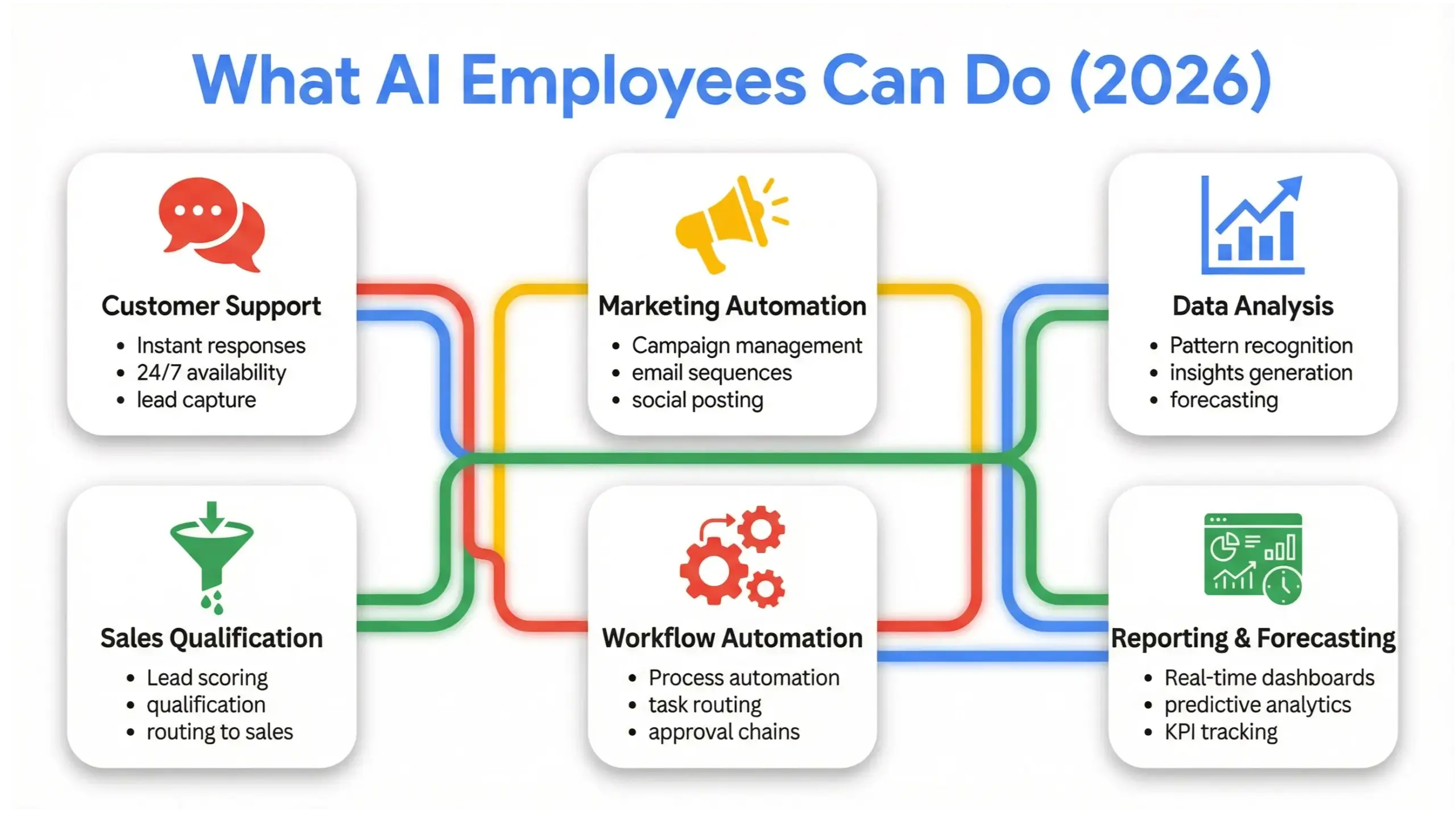
What Are AI Employees?
AI employees are digital systems designed to perform specific business functions using artificial intelligence, automation, machine learning, and natural language processing. Unlike simple automation scripts, AI employees can analyze information, respond dynamically, and improve performance over time.
Think of them as task-focused digital team members.
They are not conscious. They do not “think” independently. But they can:
- Process large volumes of information
- Respond to customer inquiries
- Generate content
- Analyze data patterns
- Automate repetitive workflows
- Execute predefined operational systems
In practical terms, an AI employee could be:
- A customer service chatbot
- A lead qualification assistant
- An automated email marketing system
- An AI content writer
- A data analytics engine
- A scheduling assistant
- A document processing system
The key difference between automation and AI employees is adaptive intelligence. Traditional automation follows strict rules. AI employees interpret input and generate context-based output.
What Tasks Can AI Employees Automate in 2026?
AI employees excel at structured, repeatable, data-driven tasks. In 2026, their capabilities have expanded significantly, but they remain strongest in process-driven environments.
Here’s a breakdown:
1. Customer Support & Communication
AI employees can:
- Answer FAQs instantly
- Route support tickets
- Handle live chat
- Process refund requests
- Book appointments
- Provide order status updates
They operate 24/7 without burnout.
2. Marketing & Content Operations
AI-powered marketing systems can:
- Generate blog drafts
- Write ad copy
- Optimize email campaigns
- Segment customer lists
- Analyze engagement data
- Personalize messaging
AI employees improve campaign efficiency and reduce turnaround time.
3. Sales & Lead Qualification
AI sales assistants can:
- Qualify inbound leads
- Score prospects
- Schedule discovery calls
- Follow up automatically
- Generate CRM updates
They reduce manual administrative workload for sales teams.
4. Data Analysis & Reporting
AI data systems can:
- Analyze large datasets
- Identify trends
- Forecast revenue
- Detect anomalies
- Generate performance reports
Instead of waiting for monthly analytics reviews, businesses get real-time insights.
5. Operations & Workflow Automation
AI employees can automate:
- Invoice generation
- Inventory management
- HR onboarding workflows
- Payroll calculations
- Document processing
- Contract review assistance
Operational efficiency increases dramatically when repetitive tasks are digitized.
AI Employees vs Human Employees: What’s the Difference?
AI employees are powerful-but they are not replacements for human intelligence. They are tools.
Here is a clear comparison:
| Category | AI Employees | Human Employees |
|---|---|---|
| Speed | Instant execution | Limited by time |
| Cost | Subscription-based | Salary + benefits |
| Emotional intelligence | Limited | High |
| Creativity | Pattern-based | Original thinking |
| Adaptability | Rule-trained | Contextual reasoning |
| Strategic thinking | Weak | Strong |
| 24/7 availability | Yes | No |
| Ethical judgment | Programmed | Human discretion |
Quote-ready insight:
“AI employees scale processes. Human employees scale possibilities.”
AI handles efficiency. Humans handle vision, leadership, empathy, and complex decision-making.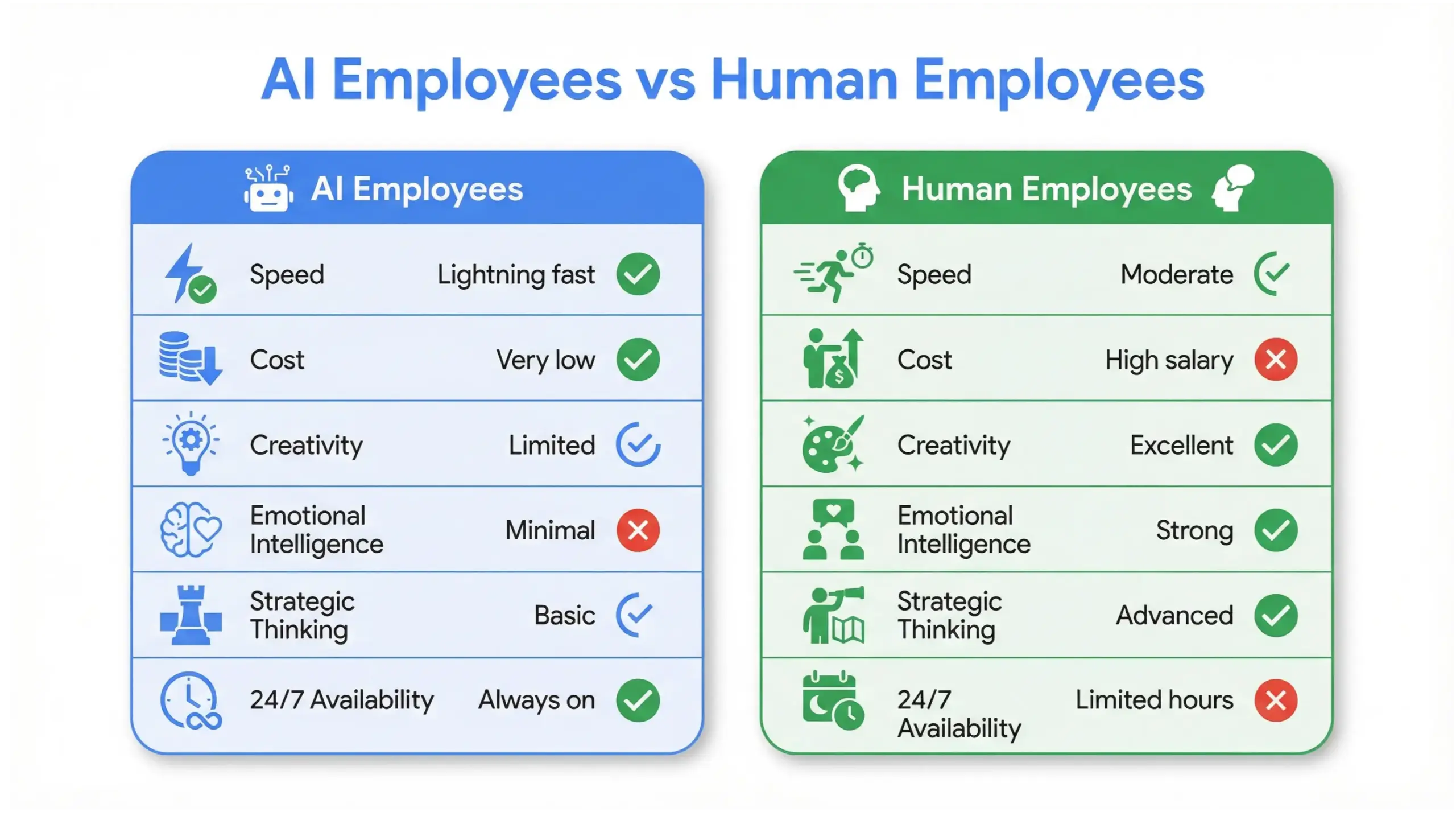
Can AI Employees Replace Human Workers?
AI employees can replace repetitive, rule-based tasks-but they cannot replace human judgment, creativity, leadership, and emotional intelligence.
The real transformation is augmentation, not elimination.
Industries most impacted include:
- Customer support
- Data entry
- Administrative processing
- Basic content drafting
- Appointment scheduling
However, AI struggles with:
- Conflict resolution
- Nuanced negotiations
- High-level strategy
- Brand storytelling rooted in lived experience
- Ethical decision-making
Businesses that win in 2026 are not replacing humans-they are redesigning workflows so humans focus on higher-value contributions.
How Can Small Businesses Use AI Employees?
Small businesses benefit the most from AI employees because they lack large operational teams.
Strategic implementation examples:
Local Service Business
- AI chatbot handles appointment scheduling
- AI system sends review requests
- AI email system follows up with customers
Result: Higher bookings with less manual labor.
Startup Founder
- AI content assistant drafts blogs
- AI CRM automates follow-ups
- AI data dashboard tracks metrics
Result: Lean growth without hiring prematurely.
E-Commerce Store
- AI handles abandoned cart emails
- AI chatbot answers product questions
- AI analytics system optimizes ad spend
Result: Improved conversion rates and reduced customer service burden.
AI employees allow small teams to operate like larger companies.
How Much Do AI Employees Cost?
AI employees are significantly cheaper than human employees, but pricing varies.
General comparison:
| Cost Type | AI Employee | Human Employee |
|---|---|---|
| Annual base cost | $1,200–$15,000 | $40,000–$120,000+ |
| Benefits | None | Required |
| Training | Setup cost | Ongoing |
| Scalability | Instant | Limited |
However, implementation costs include:
- Software subscriptions
- Integration setup
- Workflow design
- Training & monitoring
- Data infrastructure
The real cost is not software-it’s strategy.
Poorly implemented AI systems waste money. Properly integrated AI systems generate ROI.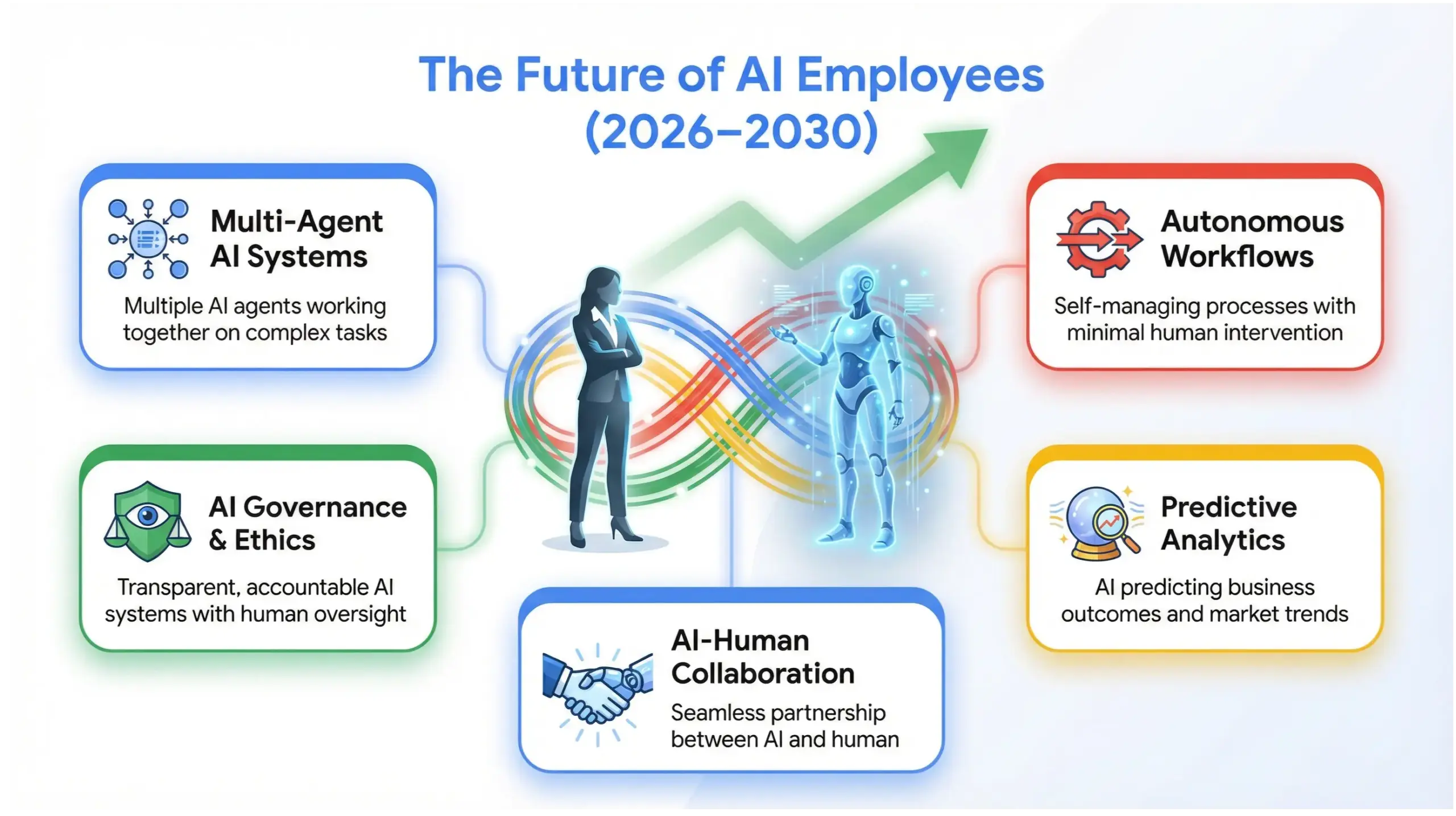
What Are the Risks of Using AI Employees?
AI employees are powerful but not flawless.
Major risks include:
- Data privacy concerns
- Over-automation leading to poor customer experience
- Bias in AI outputs
- Security vulnerabilities
- Loss of brand personality
- Over-reliance on automation
Businesses must maintain human oversight.
AI without supervision becomes fragile.
How Do You Implement AI Employees in a Company?
Successful AI adoption follows a structured process.
Step 1: Identify Repetitive Tasks
Audit workflows and identify tasks that are:
- Time-consuming
- Rule-based
- Data-driven
- Repetitive
Step 2: Map the Workflow
Document inputs, outputs, decision points, and exceptions.
Step 3: Choose the Right AI Tools
Select platforms that integrate with your CRM, marketing tools, and operational systems.
Step 4: Pilot Before Scaling
Test in one department before company-wide implementation.
Step 5: Maintain Human Oversight
Assign a human manager responsible for AI monitoring and optimization.
Step 6: Measure ROI
Track:
- Time saved
- Revenue impact
- Customer satisfaction
- Error reduction
AI success is measurable.
What Industries Benefit Most from AI Employees?
AI adoption is highest in:
- E-commerce
- SaaS
- Digital marketing
- Healthcare administration
- Financial services
- Logistics
- Real estate
- Customer support centers
Industries with structured data benefit the most.
What Is the Future of AI Employees?
The next 3-5 years will bring:
- Multi-agent AI systems
- Autonomous workflow orchestration
- AI-human collaboration dashboards
- Predictive business modeling
- Voice-driven AI assistants
- Personalized customer AI agents
However, regulation and ethical governance will expand alongside capabilities.
The future is hybrid.
Companies will build digital workforces that combine:
- AI efficiency
- Human creativity
- Strategic oversight
10 Frequently Asked Questions About AI Employees
1. What are AI employees?
AI employees are software-based systems that use artificial intelligence to automate and perform business tasks such as customer support, marketing, data analysis, and workflow management.
2. Can AI employees fully replace human workers?
No. AI employees can replace repetitive and rule-based tasks but cannot replace human creativity, empathy, leadership, or complex decision-making.
3. Are AI employees expensive?
Compared to human salaries, AI systems are significantly more affordable. However, proper implementation requires strategy and integration investment.
4. What businesses benefit most from AI employees?
Small businesses, startups, e-commerce stores, SaaS companies, and service providers benefit significantly due to operational efficiency gains.
5. Are AI employees secure?
Security depends on implementation. Businesses must choose reputable platforms and follow strong data governance policies.
6. Do AI employees require training?
Yes. AI systems require configuration, prompt structuring, and ongoing optimization for best performance.
7. Can AI employees handle customer service?
Yes. AI chatbots and support agents can handle FAQs, bookings, and common issues effectively-but complex issues require human escalation.
8. How long does AI implementation take?
Basic implementation can take days. Full integration into operational systems may take weeks or months.
9. Are AI employees ethical?
AI itself is neutral. Ethical outcomes depend on human oversight, data transparency, and governance policies.
10. What is the biggest mistake businesses make with AI employees?
Over-automation without strategy. AI should enhance human teams-not eliminate essential human touchpoints.
Conclusion: Should Your Business Adopt AI Employees?
AI employees are not a trend. They are infrastructure.
They reduce operational friction. They increase scalability. They enhance efficiency. They lower cost per task.
But they require clarity, structure, and strategic implementation.
The businesses that succeed in 2026 will not be those who automate everything blindly. They will be those who design intelligent hybrid systems where AI handles repetition and humans handle vision.
The future of work is not human versus machine.
It is human plus machine.
And the companies that master that balance will scale faster, operate smarter, and build stronger brands in the AI-driven economy.


