


A scalable business model is a structure that allows your company to grow revenue faster than it grows costs, without relying entirely on the founder’s time, energy, or constant involvement. True scalability means systems over personalities, not just sustained growth.
When you stop working, it must continue delivering value. That is scalability.
In this comprehensive guide, you will learn how to design a scalable business model from the ground up, implement systems that multiply output, and avoid the structural mistakes that prevent companies from scaling.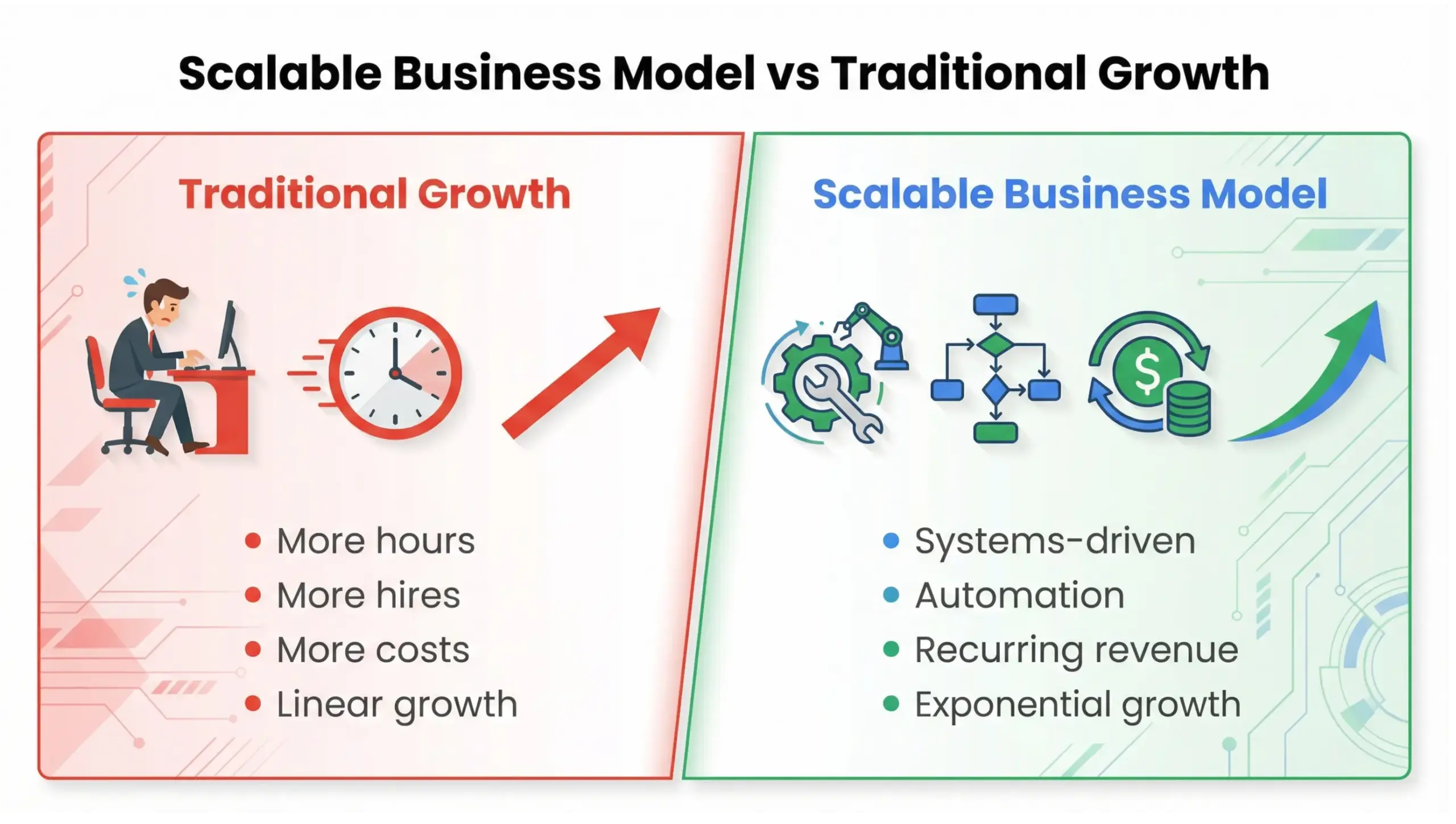
What Is a Scalable Business Model?
A scalable business model is a repeatable, systems-driven structure that allows a company to increase revenue without proportionally increasing operational costs.
In simple terms:
Scalable businesses grow output faster than they grow expenses.
For example:
| Business Type | Revenue Growth | Cost Growth | Scalable? |
|---|---|---|---|
| Freelancer Billing Hourly | +20% | +20% | No |
| SaaS with Subscription | +60% | +10% | Yes |
| Agency Dependent on Founder | +30% | +30% | No |
| Productized Service with Systems | +40% | +12% | Yes |
The difference is leverage. Scalable businesses leverage systems, technology, processes, brand authority, or assets that work independently of human time.
“If revenue requires equal effort every time, you don’t have a scalable business – you have a time-for-money exchange.”
Why Most Businesses Fail to Scale
Most businesses fail to scale because they confuse growth with scalability.
Growth means more revenue.
Scalability means sustainable, systemized expansion.
Here are the most common reasons companies hit a ceiling:
1. Founder Dependency
If the business depends on your decisions, your sales calls, your approvals, and your relationships, it cannot scale.
2. No Documented Systems
Without documented SOPs (Standard Operating Procedures), you cannot replicate performance.
3. Linear Revenue Model
Hourly billing and client work scale slowly because revenue increases only when labor increases.
4. Weak Infrastructure
No automation, no analytics dashboards, no CRM, no structured funnels.
5. Inconsistent Brand Positioning
Without clarity, marketing becomes reactive instead of strategic.
Scalability is not accidental. It is engineered.
What Makes a Business Model Truly Scalable?
A business model becomes scalable when it contains five structural pillars:
1. Repeatability
Your product or service can be delivered consistently without redesigning the process every time.
2. Systems & Automation
Technology handles repetitive tasks – CRM, billing, onboarding, email sequences, scheduling.
3. Delegation Framework
Roles are defined. Decisions are documented. Ownership is distributed.
4. Recurring Revenue
Subscriptions, retainers, licensing, or recurring contracts create predictable cash flow.
5. High Margins
Scalability requires margin cushion. Low-margin businesses struggle to expand sustainably.
“Scalability lives at the intersection of systems, margin, and leverage.”
How to Build a Scalable Business Model From Scratch
Here is a step-by-step framework to design scalability intentionally.
Step 1: Define Your Core Value Engine
Ask:
- What problem do we solve repeatedly?
- What transformation do we create?
- What part of this can be standardized?
Example:
Instead of “custom marketing services,” offer:
“Local Growth System for Service Businesses.”
Clarity increases replicability.
Step 2: Design a Productized Offer
Productization removes chaos.
Instead of endless customization, define:
- Deliverables
- Timelines
- Pricing tiers
- Scope boundaries
| Tier | Deliverables | Monthly Price |
|---|---|---|
| Growth Starter | SEO + GBP optimization | $1,500 |
| Growth Pro | SEO + Ads + Content | $3,000 |
| Growth Scale | Full digital system | $5,000 |
Clear structure allows faster scaling and team delegation.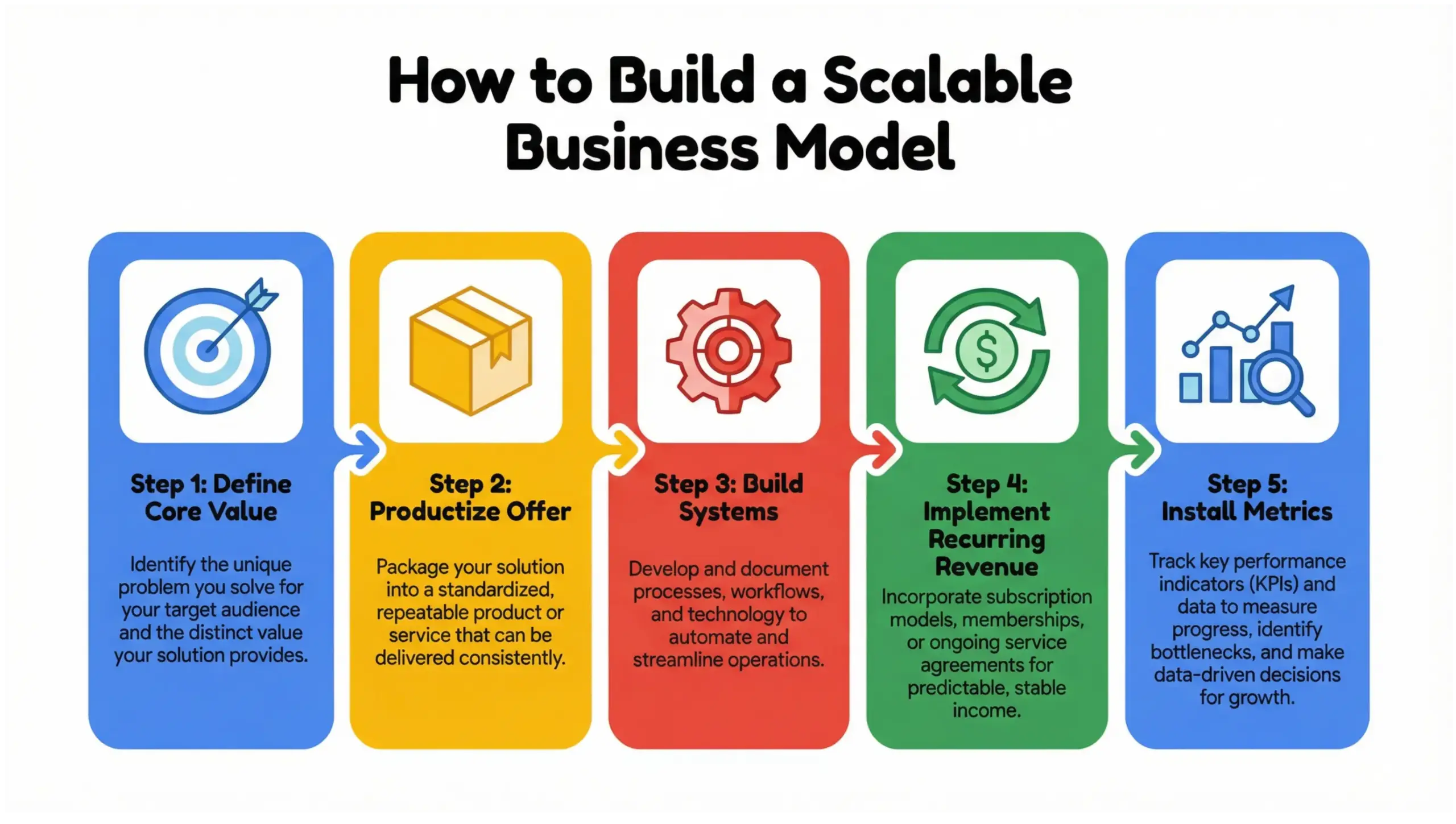
Step 3: Build Operational Systems
Document every key function:
- Sales pipeline
- Client onboarding
- Fulfillment workflow
- Reporting structure
- Client communication templates
Use tools:
- CRM
- Project management software
- Automation workflows
- Analytics dashboards
Systemization reduces founder involvement.
Step 4: Implement Recurring Revenue
Recurring revenue is the backbone of scalability.
Options:
- Retainers
- Membership models
- Subscription software
- Licensing
- Ongoing consulting
Recurring revenue creates predictability. Predictability funds expansion.
Step 5: Install Performance Metrics
What gets measured gets scaled.
Track:
- Customer acquisition cost (CAC)
- Lifetime value (LTV)
- Profit margin
- Conversion rate
- Churn rate
Without data, scaling becomes gambling.
Can a Service Business Be Scalable?
Yes – if execution transitions from custom services to structured systems.
Service businesses become scalable when they:
- Productize services
- Standardize delivery
- Automate onboarding
- Build recurring retainers
- Delegate execution
Many agencies fail because they remain founder-centric.
The shift happens when:
You stop selling hours and start selling systems.
What Is the Difference Between Growth and Scalability?
Growth increases revenue.
Scalability increases revenue efficiently.
| Growth | Scalability |
|---|---|
| Hire more people | Improve systems |
| Increase output | Increase efficiency |
| More effort | More leverage |
| Linear increase | Exponential potential |
You can grow and still be fragile.
Scalability builds resilience.
Examples of Scalable Business Models
- SaaS (Software as a Service) – Low marginal cost per user. Subscription revenue.
- Licensing Models – Sell intellectual property usage rights.
- E-Learning Platforms – Create once, sell infinitely.
- Marketplace Platforms – Connect supply and demand.
- Productized Agencies – Fixed packages, automation, recurring retainers.
How to Scale Without Increasing Costs Dramatically
- Automate before hiring
- High-ticket positioning
- Upselling existing customers
- Cross-selling services
- Improving retention
Retention is cheaper than acquisition.
“Scaling is not about doing more. It’s about multiplying what already works.”
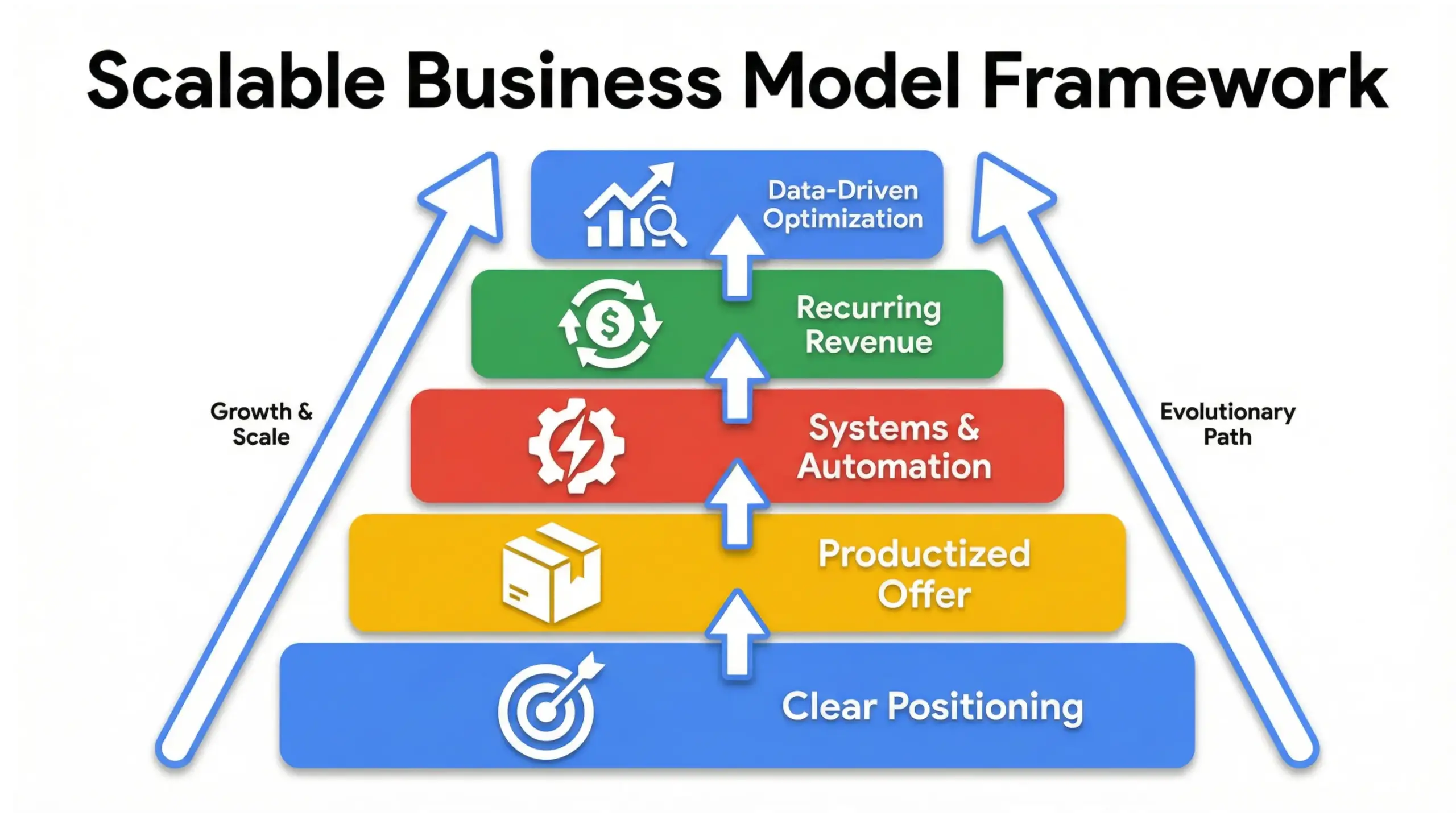
The Scalable Business Framework (Visual Model)
Scalable Model Structure:
- Clear Positioning
- Productized Offer
- Systemized Delivery
- Recurring Revenue
- Data-Driven Optimization
If one layer is weak, growth slows.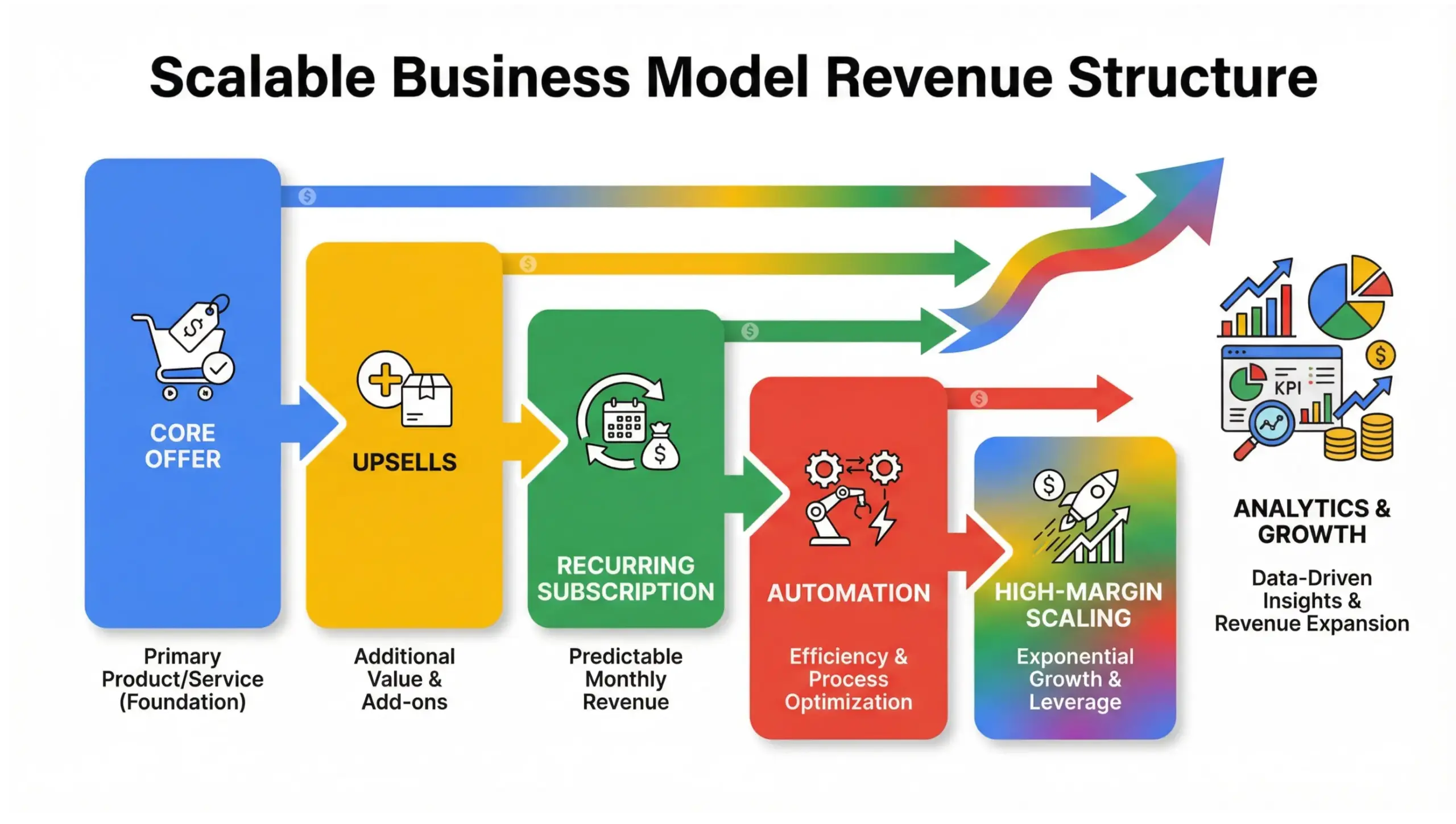
The Role of Leadership in Scalability
Scalable businesses require a mindset shift.
From Operator – Architect
From Doer – Designer
From Manager – Systems Builder
You must design the machine, not run inside it forever.
10 Frequently Asked Questions
1. What is a scalable business model in simple terms?
A scalable business model allows a company to grow revenue without increasing costs at the same rate. It relies on systems, automation, and repeatable processes rather than founder effort.
2. How do I know if my business is scalable?
If revenue increases without proportional increases in hours worked or staff costs, your business is scalable. If growth requires equal effort, it is not scalable yet.
3. Can a small business become scalable?
Yes. Scalability is not about size – it is about structure. Even small service businesses can scale by productizing and systemizing operations.
4. What industries are most scalable?
Technology, SaaS, digital education, licensing, marketplaces, and productized services are highly scalable due to low marginal costs.
5. Why do most startups fail to scale?
Lack of product-market fit, weak systems, founder dependency, insufficient margins, and poor data tracking are common reasons.
6. How important is automation in scalability?
Automation is critical. It removes repetitive tasks and allows your team to focus on growth-driving activities.
7. What is recurring revenue, and why does it matter?
Recurring revenue provides predictable cash flow. Predictability enables hiring, investment, and confident expansion.
8. Is hiring more employees the best way to scale?
Not always. Hiring without systems increases complexity and costs. Systems should come before expansion.
9. What are scalable revenue streams?
Subscriptions, retainers, licensing, digital products, recurring services, and intellectual property monetization.
10. How long does it take to build a scalable model?
It depends on complexity, but most businesses need 6-12 months to restructure, implement systems, and stabilize recurring revenue.
Final Thoughts: Build Systems, Not Stress
A scalable business model is not about chasing more revenue – it is about building an infrastructure that sustains expansion without chaos.
If your business depends entirely on you, it is vulnerable.
If your business runs on documented systems, automation, and recurring revenue – it becomes resilient.
“Scalability is engineered clarity.”
The entrepreneurs that dominate markets are not the busiest.
They are the most structured.
Build once. Refine consistently. Scale intentionally.


