


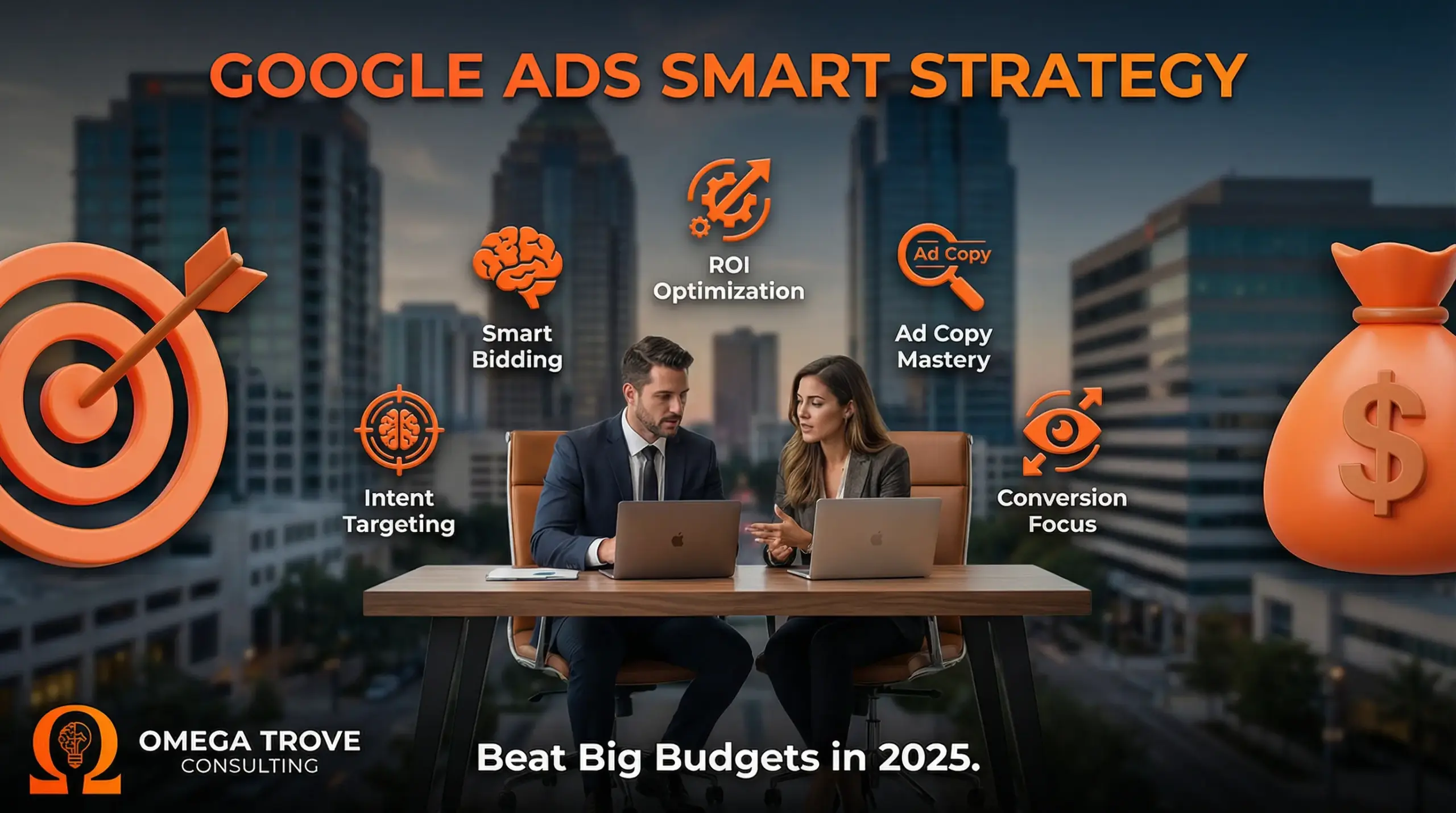
Google Ads is no longer a game won by the highest bidder. In 2025 and beyond, small brands are consistently outperforming big-budget advertisers by using smarter, more focused Google Ads strategies , not more spend.
For startups and Florida SMBs competing against national brands, this shift represents both a challenge and an opportunity. Businesses that understand how intent, relevance, and structure drive performance are generating leads at lower costs and higher quality than competitors spending 5–10x more.
This guide explains why Google Ads has changed, how small brands are winning despite limited budgets, and what strategic adjustments matter most in today’s intent-driven, AI-influenced ad landscape.
Why Google Ads No Longer Rewards Big Budgets Alone
For years, advertisers believed Google Ads success depended on one thing: spend more, win more. That assumption is now outdated.
In 2025, Google Ads prioritizes:
- Relevance over reach
- Intent over impressions
- Quality signals over raw budget
Google’s ad system is designed to protect user experience. Ads that align closely with search intent, landing page relevance, and engagement signals are rewarded , even if they come from smaller advertisers.
This is why small brands with focused strategy now outrank and out-convert enterprise advertisers who rely on scale without precision.
Big budgets buy visibility. Smart strategy buys conversions.

How Small Brands Are Winning on Google Ads in 2025
Small brands don’t win by competing head-to-head on broad, expensive keywords. They win by out-positioning larger competitors where it matters most.
Winning small brands share a few common traits:
- They target high-intent searches, not vanity traffic
- They structure campaigns tightly around services or offers
- They eliminate waste aggressively through negatives and exclusions
- They optimize for conversion paths, not clicks
Instead of asking, “How do we get more traffic?” They ask, “Who is ready to buy right now?”
That shift changes everything.
What Changed in Google Ads (And Why It Matters)
Google Ads has evolved dramatically in the last few years.
Key changes shaping performance in 2025 include:
- Increased automation and smart bidding
- Higher competition on broad-match keywords
- Rising cost-per-click across most industries
- Greater emphasis on landing page experience
- AI-driven interpretation of intent and relevance
Automation didn’t eliminate strategy , it punished weak strategy.
Advertisers who rely on defaults, broad targeting, and generic messaging are seeing rising costs and declining returns. Those who control structure, intent, and relevance are scaling efficiently.

Smart Strategy vs Big Budget: The Real Difference
The difference between high-performing small accounts and underperforming big ones isn’t spend , it’s discipline.
| Big-Budget Approach | Smart Small-Brand Strategy |
|---|---|
| Broad keywords | Intent-specific keywords |
| Large catch-all campaigns | Tightly themed campaigns |
| Generic ad copy | Message-match ad copy |
| Traffic-focused | Conversion-focused |
| Automated without oversight | Automation with guardrails |
| Vanity metrics | Revenue and lead quality |
Small brands win by reducing noise, not increasing spend.
The Power of High-Intent Keywords
High-intent keywords are the foundation of profitable Google Ads campaigns in 2025.
These searches signal readiness:
- “emergency AC repair Orlando”
- “bookkeeping services for small businesses”
- “Google Ads agency for startups”
- “near me” and service-based queries
Small brands that prioritize intent:
- Pay for fewer clicks
- Convert at higher rates
- Waste less budget on research-stage users
Big brands often chase volume. Small brands win by capturing decision-stage demand.
Why Relevance Beats Reach Every Time
Google Ads doesn’t just measure what users search , it measures how they respond.
Relevance signals include:
- Click-through rate
- Time on landing page
- Conversion rate
- Message match between ad and page
When ads feel specific and helpful, Google rewards them with:
- Lower CPCs
- Higher impression share
- Better placement
This is how a local business with a $2,000/month budget can outperform a national brand spending $50,000.
Local Strategy Is a Built-In Advantage for Florida SMBs
Florida-based businesses have a strategic edge many national brands can’t replicate easily: local intent.
Searches like:
- “near me”
- “in Orlando”
- “Winter Park”
- “local [service]”
Carry stronger buying intent and lower competition.
When Florida SMBs:
- Use location-based keywords
- Reference service areas clearly
- Align landing pages to local needs
They convert faster and cheaper than broad national campaigns.
Local relevance is no longer optional , it’s a performance multiplier.
Why Campaign Structure Matters More Than Ever
In 2025, Google Ads rewards clarity.
High-performing small brands:
- Separate campaigns by service, not category
- Avoid bloated ad groups
- Control match types intentionally
- Align ads 1:1 with landing pages
Poor structure forces Google’s automation to guess. Clean structure guides the algorithm.
This is where most wasted spend occurs , and where smart strategy creates immediate gains.
Automation Isn’t the Enemy – Blind Automation Is
Google encourages automation, but automation without strategy increases waste.
Winning small brands:
- Use smart bidding after conversion data is clean
- Set clear conversion goals
- Exclude irrelevant searches aggressively
- Monitor search terms weekly
Automation amplifies what you give it. If the foundation is weak, automation accelerates failure.
Landing Pages: The Silent Performance Lever
Many advertisers focus obsessively on ads and ignore the landing page.
In 2025, landing pages influence:
- Quality Score
- CPC
- Conversion rate
- AI-driven relevance signals
Small brands win by:
- Matching page content exactly to the ad
- Removing distractions
- Clarifying next steps
- Designing for mobile-first users
You don’t need more traffic , you need fewer leaks.

Measuring Success the Right Way
Smart advertisers don’t measure success by clicks.
They track:
- Cost per qualified lead
- Conversion quality
- Call duration and form intent
- Revenue attribution
- Assisted conversions
Big brands often optimize for dashboards. Small brands optimize for profitability.
Common Google Ads Mistakes Small Brands Still Make
Even strong businesses struggle when they:
- Target keywords that are too broad
- Skip negative keywords
- Send traffic to generic pages
- Chase impressions instead of intent
- Expect instant results
Google Ads rewards patience, iteration, and structure , not shortcuts.
How Long Does It Take to See Results?
With the right setup:
- Early performance signals: 2–4 weeks
- Optimization phase: 30–60 days
- Consistent ROI: 90 days
Google Ads isn’t instant but when built correctly, it becomes predictable.
Is Google Ads Still Worth It for Small Brands in 2025?
Yes, if strategy leads spend.
Benefits include:
- Immediate demand capture
- High-intent visibility
- Measurable ROI
- Scalable lead generation
- Reduced reliance on long-term SEO alone
For startups and Florida SMBs, Google Ads remains one of the fastest ways to generate qualified demand – when done right.
Final Thoughts
The future of Google Ads isn’t bigger budgets , it’s better decisions.
Small brands that prioritize:
- Intent
- Relevance
- Structure
- Local clarity
Are consistently beating competitors with deeper pockets and weaker strategy.
In a crowded auction, precision wins.
Want Help Building a Smarter Google Ads Strategy?
Omega Trove helps startups and Florida SMBs design conversion-first Google Ads systems that turn limited budgets into measurable growth.
If you’re ready to stop guessing and start competing strategically, we’re ready to help you build it right.
Local roots. Digital growth.
For Central Florida businesses, our branding services in Central Florida can help. We also provide creative design solutions and brand identity development.
Related Reading:
- Ranking in Google’s AI Overviews: The New Game for Orlando Brands
- The Rise of Generative Engine Optimization (GEO) in Winter Park: Is Your Brand Ready?
- Why Altamonte Springs Brands Are Investing in AI-Driven Content Strategy
Ready to Get Started?
Learn More: Google Business Profile | Nap Consistency


